
Service History
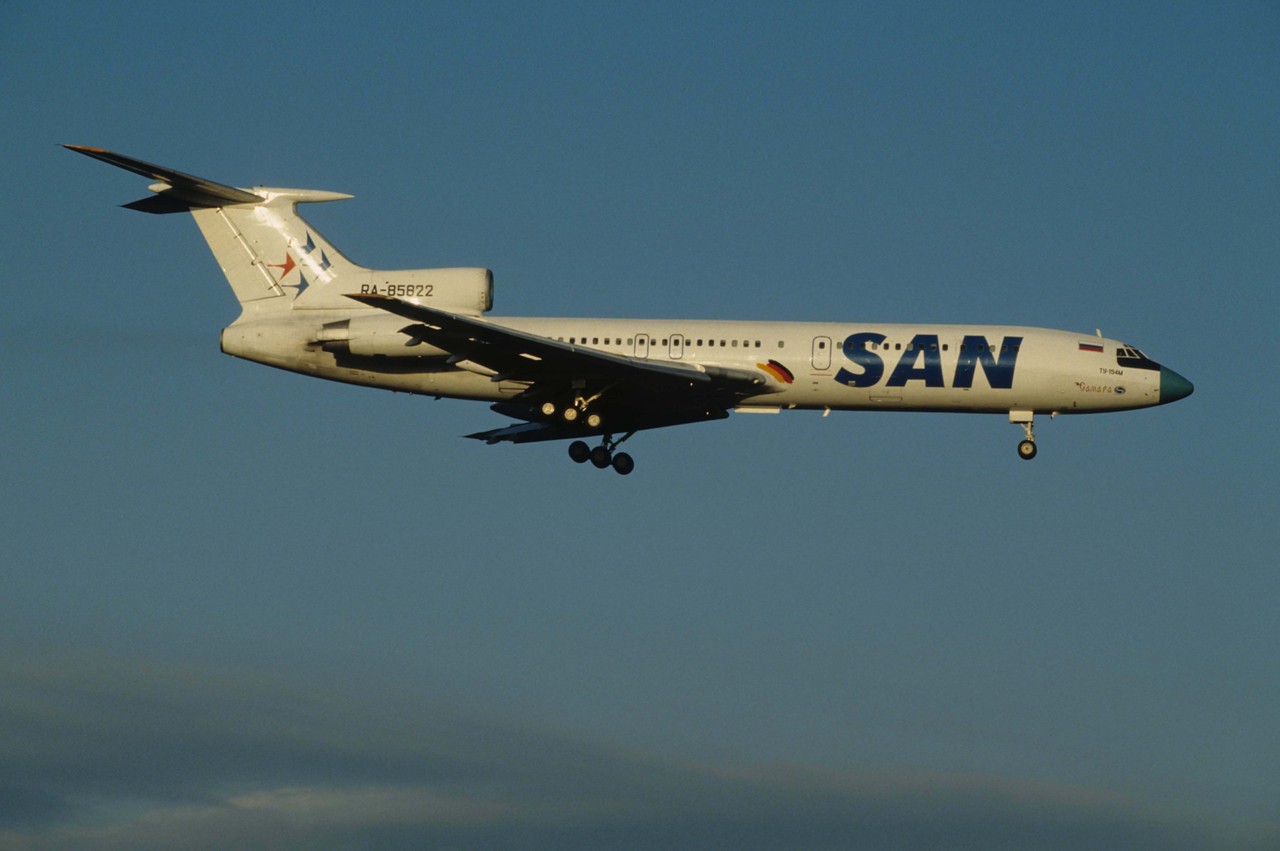
The Tu-154 became the backbone of Soviet commercial aviation, with Aeroflot operating the type from 1972 onward. At its peak in 1990, the aircraft carried approximately 137 million passengers annually for the state airline, accounting for 243 billion passenger-kilometers and roughly 50 percent of Aeroflot's total passenger traffic. The trijet dominated Eastern Bloc aviation, serving airlines including LOT Polish Airlines, CSA Czechoslovak Airlines, China's CAAC, and Syria's Assouriya. Unlike Western contemporaries such as the Boeing 727, the Tu-154 was specifically engineered for operation from unpaved and semi-prepared airfields, enabling air service to remote locations across the vast Soviet territory.
The Manufacturer
Tupolev, founded in 1922 by legendary designer Andrei Tupolev, had established itself as a premier aircraft manufacturer through designs like the Tu-2 bomber during World War II and the Tu-104, the Soviet Union's first jet airliner in 1955. Following the dissolution of the USSR in 1991, the company restructured as Tupolev PSC and became part of the United Aircraft Corporation in 2006. Today, Tupolev PSC continues operations under UAC, focusing primarily on military and special-purpose aircraft development.
Design and Development
The Tu-154 project began with ambitious requirements: replace three different aircraft types (Tu-104, An-10, and Il-18) with a single design capable of carrying 16-18 tons of payload over 2,850-4,000 kilometers, or 5.8 tons over extended ranges of 5,800-7,000 kilometers. Chief designers Sergey Yeger, Dmitriy Marov, and Aleksandr Shener led the development team at Tupolev OKB. The hand-built prototype was constructed at Tupolev's Moscow facility, then transported by road to Zhukovsky Airfield for flight testing.
Engine and Technical Innovation
Three Soloviev D-30KU turbofan engines, mounted on the aft fuselage in the popular trijet configuration of the era, powered the Tu-154. Each engine produced up to 23,500 pounds of thrust, manufactured by the Soloviev Design Bureau (later incorporated into NPO Saturn). The D-30 series entered production in the late 1960s and proved exceptionally reliable in harsh operating conditions. Later variants, particularly the Tu-154M introduced in 1984, featured improved D-30KU-154 engines that enhanced both range and fuel efficiency.
Production and Variants
Production commenced in 1968 at the Kuybyshev plant (now Samara), continuing until 2013 with only a brief interruption from 1982 to 1984 to prioritize Tu-142 maritime patrol aircraft manufacturing. Exactly 1,025 aircraft rolled off the production line across all variants, including approximately 150 export deliveries. The original Tu-154 saw limited production with just 42 examples built. The improved Tu-154A, Tu-154B series, and Tu-154M comprised the bulk of production, with the final variant accounting for 320 aircraft featuring the most advanced engines and systems.
Operational Characteristics
Pilots found the Tu-154 capable of sustained cruise speeds approaching 900-950 kilometers per hour at service ceilings up to 12,000 meters. The aircraft's robust landing gear and reinforced structure allowed operations from rough airfields that would challenge Western contemporaries. Standard crew complement consisted of five to nine members depending on variant and route requirements. Range varied significantly by model, from 2,850 kilometers for maximum payload operations to over 7,000 kilometers in reduced passenger configurations.
Legacy and Current Operations
As of 2024, an estimated 100 to 214 Tu-154s remain in active service, primarily with Russian and Commonwealth of Independent States carriers on regional routes. The type earned the NATO reporting name "Careless" and became a symbol of Soviet aviation engineering resilience. Several examples are preserved in museums, including facilities at Monino near Moscow. The Tu-154's 45-year production run ranks among the longest for any commercial airliner, testament to its effectiveness in serving the unique requirements of Soviet and post-Soviet aviation markets. Despite its age, the aircraft continues connecting remote communities across Russia and Central Asia, fulfilling its original mission of providing reliable air transport to locations beyond the reach of conventional airliners.