
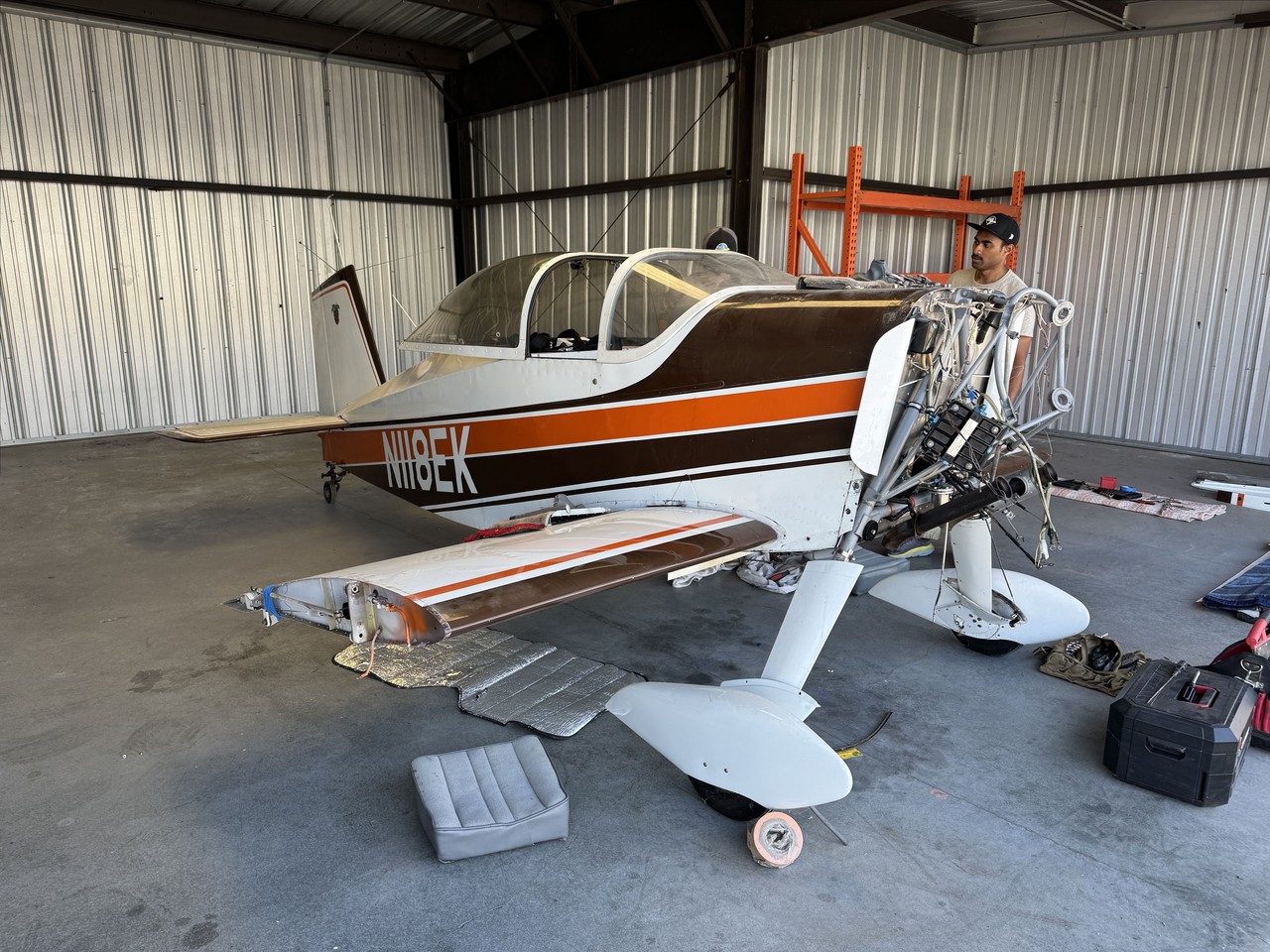
Revolutionary Homebuilt Design
John Thorp created the T-18 in 1963 with a revolutionary goal: to prove that metal homebuilt aircraft could be simpler, faster to build, and cheaper than traditional wood designs while delivering exceptional performance. As his 18th design, Thorp engineered the aircraft specifically for amateur construction using basic aluminum sheets and pop rivets, making advanced aircraft construction accessible to weekend builders.
The original design featured an open cockpit configuration that quickly evolved to incorporate a distinctive bubble canopy, cowled engine, and slotted flaps. Thorp's engineering philosophy emphasized using surplus military engines to keep costs low while achieving remarkable performance figures that rivaled factory-built aircraft.
Engine and Performance Excellence
The T-18's original powerplant consisted of modified Lycoming O-290G engines producing 125 horsepower, converted from surplus military ground power units. These air-cooled, horizontally-opposed engines were readily available and affordable in the post-World War II era, enabling builders to achieve cruise speeds of 160-200 mph. Later variants incorporated larger Lycoming engines up to 200 horsepower, including the popular O-360-A2A producing 180 horsepower.
With dimensions of 18 feet 2 inches in length, 20 feet 10 inches wingspan, and 4 feet 10 inches in height, the T-18 demonstrated impressive performance specifications. The aircraft typically cruised at 175 mph with a maximum speed capability exceeding 200 mph. Standard range reached 500 miles, though modified versions with additional fuel tanks achieved extraordinary ranges of 1,800-2,400 miles. The service ceiling extended to 20,000 feet, while maintaining an empty weight of just 900 pounds and gross weight of 1,500 pounds.
Production and Variants
By 2011, over 1,600 sets of plans had been sold worldwide, with approximately 400 completed aircraft flying. Production occurred through individual homebuilders using plans and parts supplied by companies including Eklund Engineering, which offered laser-cut kits as of 2009, and Classic Sport Aircraft, which provided complete kits until closing in 2014. Thorp Central later acquired Classic Sport Aircraft's assets to continue supporting builders.
Several notable variants emerged over the decades. The T-18W featured a fuselage widened by two inches, designed by Lou Sunderland for improved comfort. The T-18C introduced convertible folding wings for trailering capabilities. The most significant variant, the S-18, appeared in 1984 through collaboration between Thorp and Lou Sunderland, incorporating an improved airfoil for lower stall speeds and structural modifications rated for +6/-3G loads. The S-18T added tricycle landing gear for easier ground handling.
Record-Breaking Achievements
The T-18's most famous example, Don Taylor's 1968 aircraft N455DT named "Victoria," became the first homebuilt aircraft to circumnavigate the globe. Powered by a Lycoming O-360 engine, Taylor departed Oshkosh, Wisconsin on August 1, 1976, and returned September 30, 1976, covering 26,200 miles in 60 days. This remarkable journey demonstrated the T-18's reliability and long-range capabilities on a global scale.
Taylor's aircraft later achieved another milestone with a North Pole flight in the 1980s, utilizing Sperry inertial navigation equipment. In 1983, he donated N455DT to the EAA Museum in Oshkosh, Wisconsin, where it remains on permanent display. Another notable achievement occurred in 1976 when Clive Canning successfully flew his T-18 from Australia to England, further proving the design's intercontinental capabilities.
Cultural Impact and Legacy
The T-18 fundamentally transformed the homebuilt aircraft movement during the 1960s and 1970s. Prior to its introduction, most amateur-built aircraft utilized wood construction and achieved modest performance. Thorp's all-metal design proved that homebuilders could construct aircraft rivaling factory-built machines in speed and capability while using simplified construction techniques.
The aircraft gained prominence through extensive coverage in EAA Sport Aviation magazine beginning in 1962, inspiring countless builders to attempt metal construction. The T-18's influence extended throughout the experimental aircraft community, establishing construction techniques and performance benchmarks that influenced subsequent designs.
Today, approximately 400 T-18s remain active worldwide, with new construction continuing through available plans and parts suppliers. The design's enduring appeal stems from its combination of high performance, relatively simple construction, and proven reliability demonstrated through decades of service and record-setting flights. While later challenged by Van's RV series aircraft in popularity, the T-18 remains historically significant as the aircraft that proved homebuilt performance could match professional manufacturers.