
Training Legacy
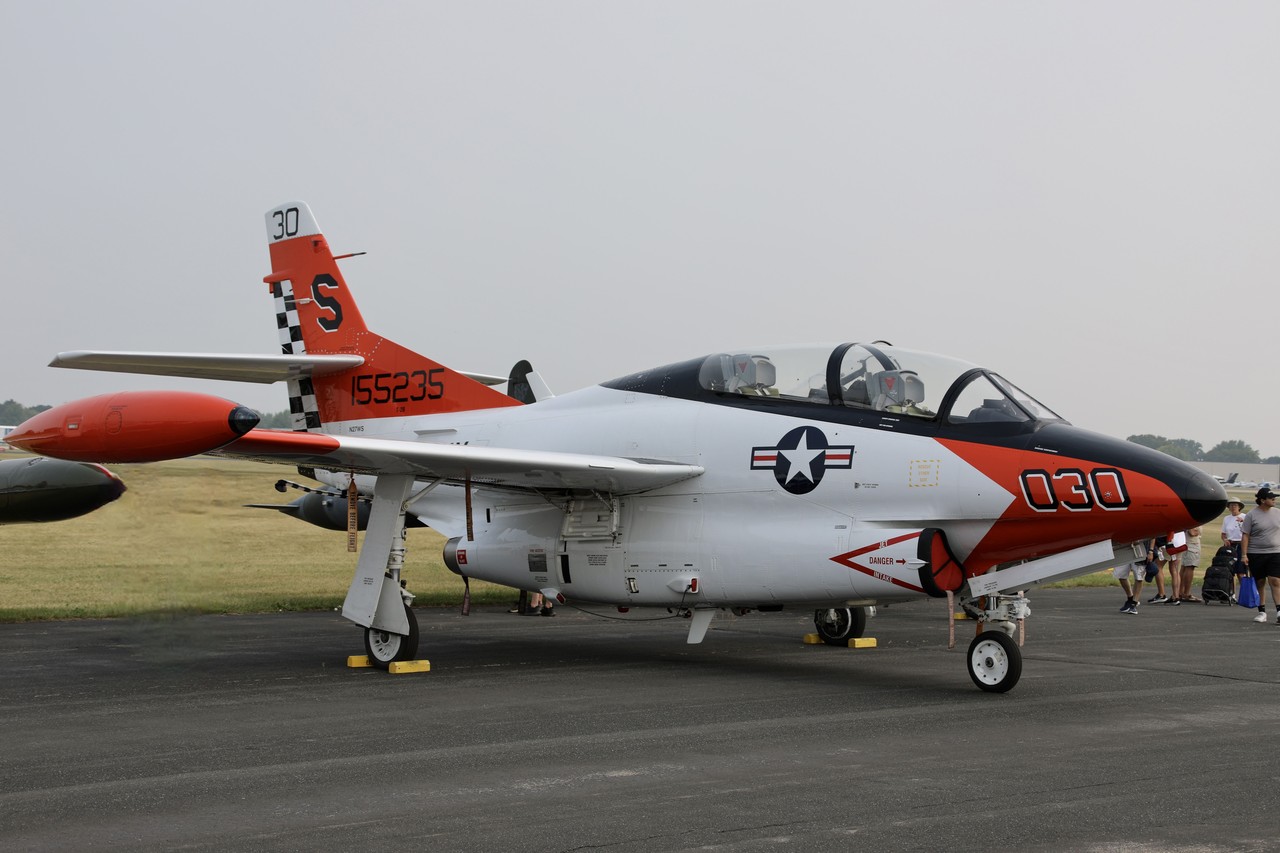
The T-2 Buckeye earned its place in aviation history by training more than 11,000 students across 18 different models of Navy jet aircraft during nearly five decades of service. Every jet-qualified Naval Aviator and virtually every Naval Flight Officer from the late 1950s until 2004 learned their craft in the Buckeye's tandem cockpit. This remarkable training record established the aircraft as the backbone of naval aviation education during the Cold War era and beyond.
The first operational Buckeyes arrived at Training Squadron VT-4 at Naval Air Station Pensacola in July 1959, followed by the establishment of VT-7 at NAS Meridian later that year. A milestone occurred on June 2, 1960, when the first student pilots achieved carrier qualification aboard the USS Antietam, demonstrating the aircraft's effectiveness in preparing aviators for demanding carrier operations.
Design Evolution
North American Aviation won the Navy's trainer competition in mid-1956 with their NA-241 design, taking the unusual step of skipping traditional prototyping and proceeding directly to pre-production with six YT2J-1 evaluation aircraft. This bold approach relied on proven design elements from the company's previous successful aircraft, reducing development risk while accelerating the program timeline.
The aircraft underwent significant powerplant evolution throughout its production life. The initial T2J-1 variant, later redesignated T-2A in 1962, featured a single Pratt & Whitney J60 turbojet engine. However, operational experience revealed limitations with single-engine configuration for training purposes. In August 1962, the first twin-engine variant emerged when two YT2J-2 test aircraft were converted with dual Pratt & Whitney J60-P-6 engines producing 3,000 pounds of thrust each, creating the T-2B model.
The definitive T-2C variant appeared in 1968 when engineers replaced the Pratt & Whitney powerplants with two General Electric J85-GE-4 turbojets, each generating 2,950 pounds of thrust. This configuration provided improved performance and reliability while maintaining the excellent handling characteristics that made the Buckeye an ideal training platform.
Manufacturing and Variants
North American Aviation built all 609 Buckeyes at Air Force Plant 85, located south of Port Columbus Airport in Columbus, Ohio. The aircraft's nickname honored Ohio's state tree and the mascot of Ohio State University. Production encompassed several distinct variants: 217 T2J-1/T-2A aircraft, 97 T-2B models, and 231 T-2C trainers formed the bulk of manufacture. Small numbers were later converted to DT-2B and DT-2C drone director configurations for specialized missions.
International sales expanded the Buckeye's reach beyond American naval aviation. Venezuela acquired 12 T-2D aircraft, while Greece purchased 40 T-2E models for their air force training programs. These export versions demonstrated the design's versatility and effectiveness in meeting diverse operational requirements.
Operational Challenges and Solutions
By the early 1980s, intensive training operations had depleted the active T-2 fleet, creating a shortage that threatened naval aviation training capacity. The Navy responded with an innovative regeneration program, retrieving retired T-2B aircraft from storage at the Military Aircraft Storage and Disposition Center. The Naval Air Rework Facility at Pensacola, Florida, restored these aircraft to operational condition, providing an additional nine years of service until their final retirement in 1991.
Company Legacy
North American Aviation, the Buckeye's creator, underwent significant corporate changes during the aircraft's service life. In 1962, the company became part of North American Rockwell, which later evolved into Rockwell International. This corporate evolution reflected the consolidation occurring throughout the aerospace industry during the Cold War period, as companies merged to handle increasingly complex defense contracts.
Technical Innovation
The T-2's design incorporated several features that enhanced its training effectiveness. The tandem seating arrangement placed the instructor's position higher than the student's, providing excellent forward visibility over the trainee's head. Both crew members sat on North American-built ejection seats, introducing students to the safety systems they would encounter in operational aircraft. The mid-wing configuration provided stable flight characteristics ideal for beginning jet pilots while maintaining sufficient performance for advanced training maneuvers.
End of an Era
The Buckeye's long service career concluded when the McDonnell Douglas T-45 Goshawk assumed training duties in 2008. The T-45's digital cockpit and performance characteristics more closely matched modern fighter aircraft compared to the T-2's analog instrumentation. However, the Buckeye's four-decade training legacy remained unmatched, having established outstanding records for safety and reliability while preparing generations of naval aviators for service.
Today, T-2 Buckeyes continue flying with the Hellenic Air Force in Greece, extending the type's operational life well beyond its American retirement. This ongoing service testament to the aircraft's enduring design qualities and North American's engineering excellence in creating one of history's most successful military training aircraft.