
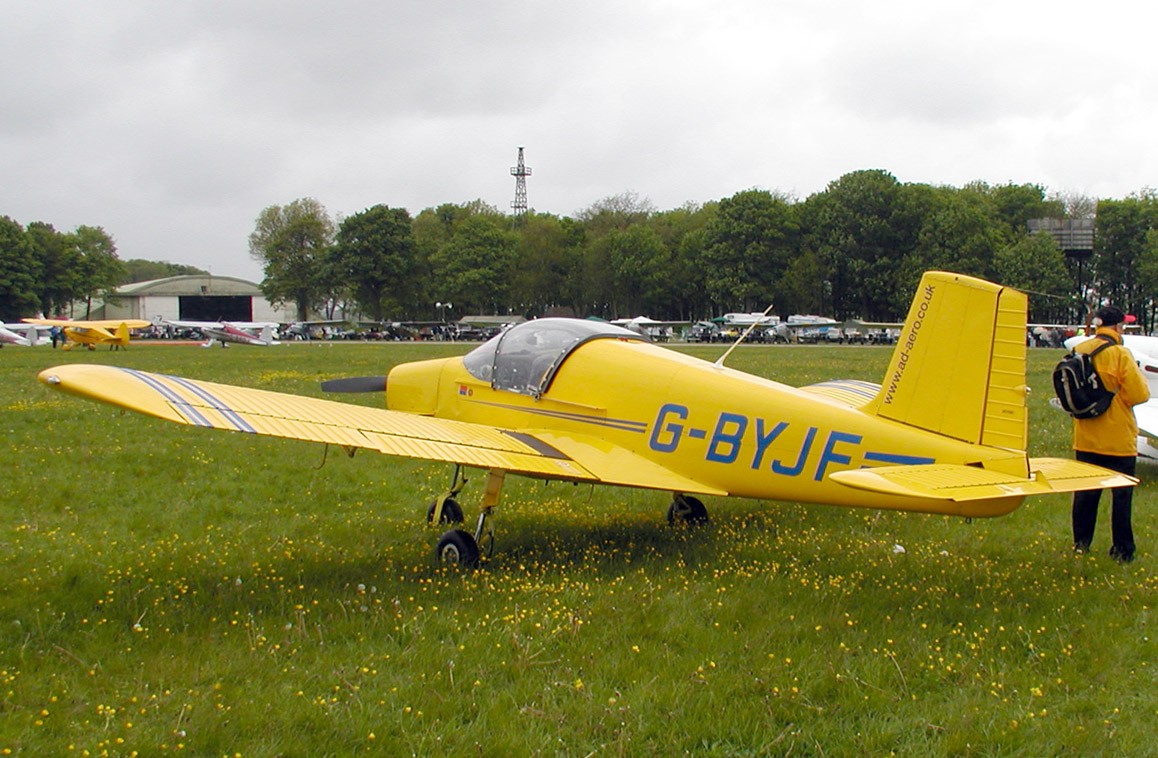
Design Innovation and Engineering
John Thorp's T-211 emerged from a design philosophy focused on weight reduction and structural efficiency. Working as a Lockheed engineer, Thorp began developing the aircraft in 1942 as a private venture, evolving the design through several iterations including the single-seat Little Dipper and two-seat Big Dipper before settling on the Sky Skooter configuration by 1945.
The aircraft incorporated revolutionary construction techniques for its era. Most notably, Thorp employed externally ribbed, corrugated wings and tailplane surfaces that provided structural stiffness while dramatically reducing weight. Each wing contained only three internal ribs, eliminating hundreds of rivets compared to conventional designs while maintaining spanwise airflow control. The T-211 also featured an all-movable horizontal stabilizer, providing superior control authority compared to traditional elevator systems.
Fragmented Production History
The T-211's production history spans seven decades across multiple manufacturers, reflecting both the design's appeal and the challenges of general aviation manufacturing. Thorp built eight prototypes between 1945 and 1947, achieving FAA Certification A-791 on December 22, 1948, though none of these original aircraft sold.
Tubular Aircraft Products Company of Los Angeles revived the design in 1964, producing 111 kits and 11 complete aircraft by 1966. This version, powered by the 100-horsepower Continental O-200 engine, received supplemental certification on April 20, 1964. Eight aircraft were completed by spring 1965, demonstrating renewed market interest in Thorp's efficient design.
Subsequent ownership changes reflected the volatile nature of general aviation manufacturing. Adams Industries acquired the rights in 1981, building only one demonstrator (c/n 010, N29754) before transferring ownership to Thorp Aero Inc. in 1989. Operating from Sturgis, Kentucky, Thorp Aero produced five examples between 1989 and 1991, receiving supplemental certification on February 20, 1991. Due to liability concerns, these aircraft were marketed exclusively for overseas sales and Part 141 flight training operations.
Modern Renaissance
The T-211 experienced unexpected revival in the 2000s when IndUS Aviation of Dallas, Texas, adapted the design for the emerging Light Sport Aircraft category. This modern iteration, marketed as the "Thorpedo" when equipped with the 120-horsepower Australian Jabiru 3300 engine, became the first US-designed aircraft to receive LSA certification from the FAA.
IndUS Aviation offered multiple configurations to meet varying regulatory requirements: type-certified T-211s, LSA-compliant Sport E models, and kit-built experimental versions. This flexibility allowed the design to serve different market segments while maintaining Thorp's original emphasis on performance and efficiency.
Engine Evolution
Throughout its production life, the T-211 utilized various powerplants reflecting changes in engine availability and performance requirements. The original 1946 prototype flew with a 65-horsepower Lycoming O-145-B2, while a 90-horsepower Continental C-90 powered the T-111 variant in the early 1950s.
The 100-horsepower Continental O-200 became the standard engine for type-certified versions from 1953 onward, providing the aircraft with both VFR and IFR capability. Modern LSA variants adopted the Jabiru 3300, a six-cylinder Australian engine producing 120 horsepower while meeting LSA weight restrictions.
Influence on Aviation Design
The T-211's most significant contribution to aviation extends beyond its own production numbers. John Thorp's work on the aircraft directly influenced the development of the Piper PA-28 Cherokee, one of general aviation's most successful designs. By the early 1950s, Thorp had developed a 180-horsepower preliminary design based on T-211 principles. Piper adopted this concept in 1956, ultimately producing the Cherokee with 150 horsepower and manufacturing thousands of examples.
Thorp's subsequent homebuilt design, the T-18, also gained recognition when builder Don Taylor flew his T-18 around the world in 1960, becoming the first homebuilt aircraft to achieve this milestone.
Current Status and Legacy
While exact numbers of airworthy T-211s remain undocumented, examples continue flying worldwide. Aircraft N2501A, built by Thorp Aero in 1991, underwent airworthiness testing on February 15, 1991, and remained registered with Egmond Aircraft LLC as of 2016, operating between the United States and Belgium.
The aircraft's legacy extends through continued kit production by AD Aerospace in Manchester, United Kingdom, and Venture Light Aircraft in the United States. These manufacturers maintain the T-211's availability for homebuilders seeking Thorp's combination of performance, efficiency, and innovative construction techniques.
The T-211 represents a unique chapter in aviation history, bridging post-war general aviation development with modern light sport aircraft regulations while demonstrating how innovative design principles can influence aircraft development for decades beyond their original application.