
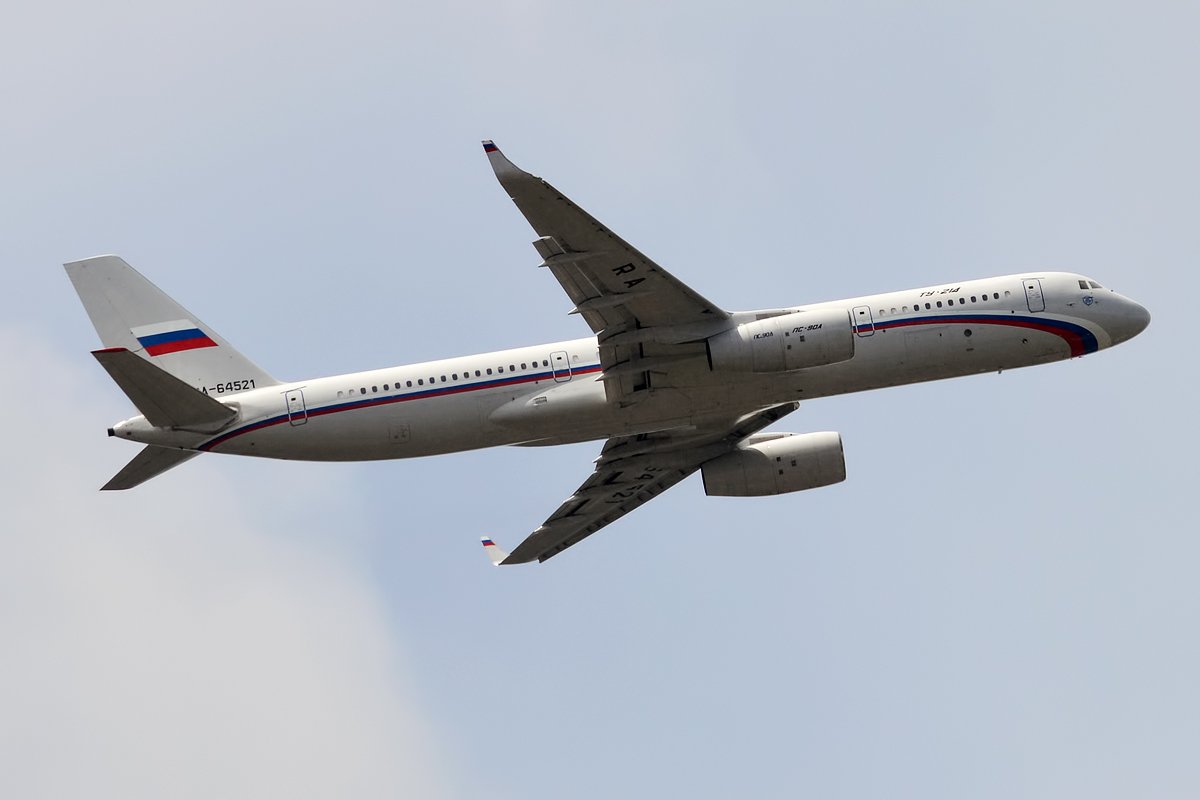
Strategic Intelligence Platform
The Tu-214R emerged from Russia's need for a modern electronic intelligence platform to replace aging Soviet-era reconnaissance aircraft. In 2002, the Russian Defense Ministry awarded a contract worth 3.4 billion rubles for the development of this specialized variant, transforming the civilian Tu-214 airliner into a sophisticated spy plane. The aircraft incorporates advanced ELINT (Electronic Intelligence) systems capable of intercepting and analyzing electronic communications across vast distances.
Military Service and Operations
The Russian Air Force operates the Tu-214R primarily for strategic reconnaissance missions along international borders and areas of military interest. During the Russo-Ukrainian conflict beginning in 2022, these aircraft have conducted observation flights over Crimea and adjacent regions. The type represents a significant advancement over previous reconnaissance platforms, offering extended range and modern avionics systems that enhance intelligence-gathering capabilities.
A related variant, the Tu-214ON, initially served under the Open Skies Treaty with the first aircraft delivered on August 22, 2013, and a second unit (RA-64525) delivered on July 4, 2014. Following the United States' withdrawal from the Open Skies Treaty in 2020 and Russia's subsequent exit in 2021, these aircraft transitioned to purely military observation roles.
Manufacturing Heritage
The Kazan Aircraft Production Association, known as the Kazan Aviation Plant named after S.P. Gorbunov, has exclusively manufactured all Tu-214 variants since the program's inception. Established in 1927, this facility possesses deep Soviet-era roots and underwent significant modernization during the 1960s through 1980s. Today operating under the United Aircraft Corporation umbrella, KAPO distinguishes itself from the related Tu-204 production line in Ulyanovsk.
Production of the Tu-214 family began in the mid-1990s, with the first aircraft (RA-64501) rolling out in 1994. Manufacturing rates remained modest throughout the program's history, typically producing five or fewer aircraft annually through the 1990s and 2000s, peaking at ten units in 2008 before declining to zero to three aircraft per year from 2012 to 2024.
Technical Foundation
The Tu-214R employs twin Aviadvigatel PS-90 high-bypass turbofan engines, representing Russia's commitment to domestic powerplant technology. These engines provide the necessary thrust and fuel efficiency for extended reconnaissance missions, while ongoing "russification" efforts have replaced Western components with domestic alternatives amid international sanctions. The aircraft received certification under Russian AP-25 standards in December 2000, establishing its airworthiness for both military and civilian operations.
The reconnaissance variant incorporates specialized electronic equipment that significantly differentiates it from standard passenger configurations. This equipment suite enables the aircraft to conduct sophisticated intelligence-gathering operations while maintaining the operational flexibility of the baseline airliner design.
Production Revival and Future
In March 2022, Rostec CEO Sergey Chemezov announced plans to relaunch Tu-214 series production amid Western sanctions, with United Aircraft Corporation CEO Yuri Slusar confirming the start of production for twenty aircraft on April 6, 2022. This revival aims to achieve production rates of ten to twelve aircraft annually by the mid-2020s, with targets of seventy total aircraft by 2030.
KAZAN has undertaken significant facility modernization to support this production increase, with full commissioning of modernized serial production facilities planned for 2025. These improvements include automated assembly processes, digital avionics integration, and comprehensive workforce retraining programs designed to achieve up to twenty aircraft annually by the late 2020s.
Operational Legacy
More than 85 Tu-214s of all variants have been constructed to date, though approximately 40 have been withdrawn, written off, stored, or broken up according to recent data. The specialized reconnaissance variants like the Tu-214R represent a small but strategically significant portion of this total production, serving exclusively in military roles where their intelligence-gathering capabilities provide crucial strategic advantages.
The aircraft symbolizes Russia's post-Soviet aviation self-reliance, particularly under the 2022 sanctions regime that has accelerated domestic aircraft development priorities. A fully Russian-made prototype is scheduled to fly in November 2025, with certification by Rosaviatsiya expected in December 2025, marking a significant milestone in the program's evolution toward complete technological independence.