
Service History
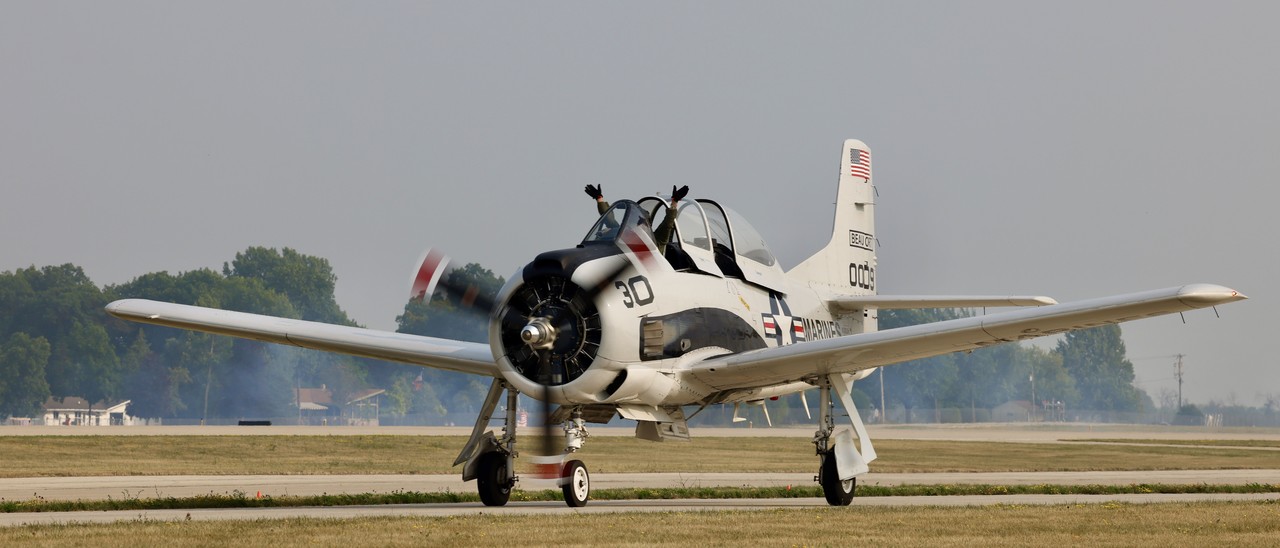
The T-28 Trojan revolutionized military pilot training by introducing jet-age handling characteristics while retaining the reliability of piston power. Beginning service in 1950 at Eglin Air Force Base, Florida, the aircraft replaced the venerable T-6 Texan that had trained pilots since the mid-1930s. The United States Navy adopted the type in 1952 as their primary basic trainer, operating it until 1984 and training thousands of naval aviators who would transition to carrier-based jets.
The Trojan's tricycle landing gear proved revolutionary for training purposes, teaching pilots the same takeoff and landing techniques required for high-performance jets. Its bubble canopy provided superior visibility compared to earlier trainers, while the low-wing configuration offered handling characteristics that closely approximated those of contemporary fighters.
Combat Service and Variants
Beginning in 1962, the peaceful trainer transformed into a combat aircraft when the United States Air Force modified more than 200 T-28As for counterinsurgency warfare in Southeast Asia. Redesignated T-28D "Nomad," these aircraft received the more powerful 1,425-horsepower Wright R-1820-86 engine and external hardpoints for weapons carriage.
The combat variants proved highly effective in Vietnam, providing close air support against enemy forces in jungle environments where their slower speed and excellent maneuverability offered advantages over jets. The aircraft could loiter over target areas longer than faster jets while delivering precise strikes with conventional ordnance.
North American developed an experimental turboprop version, the YAT-28E, powered by a 2,445-horsepower Lycoming YT-55L-9 engine and capable of carrying 6,000 pounds of weapons on twelve underwing hardpoints. Three prototypes flew beginning February 15, 1963, but the program ended in 1965 without production orders.
The Manufacturer
North American Aviation designed and built the T-28 at their Dallas, Texas facility as part of their dominance in military training aircraft. The company had previously created the legendary P-51 Mustang fighter and T-6 Texan trainer, establishing their reputation for robust, pilot-friendly designs.
Founded in 1928, North American Aviation became one of America's premier aerospace manufacturers, later producing the X-15 rocket plane and Apollo command module. The company merged with Rockwell in 1967 to form North American Rockwell, later becoming Rockwell International. Boeing acquired Rockwell's aerospace division in 1996, continuing the T-28's manufacturer lineage within modern aerospace giants.
Engine and Technical Innovation
The T-28A employed an 800-horsepower Wright R-1300-1 radial engine driving a two-bladed propeller, providing adequate power for basic training missions. Navy variants T-28B and T-28C utilized the substantially more powerful 1,425-horsepower Wright R-1820-86 radial with three-bladed propellers, nearly doubling available power for advanced training scenarios.
The Wright R-1820-86B consumed approximately 50 gallons per hour from the aircraft's 178-gallon fuel system, providing over three hours of flight time. This endurance allowed extended training flights without frequent fuel stops, maximizing training efficiency.
The aircraft's design incorporated several innovations for 1950s trainers, including hydraulically-operated flaps, electrical systems similar to contemporary jets, and instrumentation that prepared students for transition to high-performance aircraft. The T-28C variant featured carrier-specific modifications including arresting gear and a shortened propeller arc with flat blade ends to improve deck clearance.
Performance and Pilot Experience
Pilots praised the T-28's forgiving handling characteristics combined with performance approaching that of World War II fighters. Maximum speeds varied by variant from 283 to 346 miles per hour, with cruise speeds between 190 and 230 miles per hour. Service ceilings ranged from 25,200 feet for early variants to 37,000 feet for later models, allowing training at altitudes similar to operational aircraft.
The aircraft's 8,500-pound maximum weight and tricycle landing gear provided stable ground handling, while the tandem seating arrangement with dual controls allowed effective instruction. Students appreciated the excellent visibility and responsive controls, while instructors valued the aircraft's ability to demonstrate advanced maneuvers safely.
Production and Legacy
North American produced 1,194 T-28As for the Air Force, 489 T-28Bs for Navy land-based training, and 299 T-28Cs for carrier training, totaling 1,948 military aircraft. An additional 50 aircraft were manufactured for Taiwan between 1976 and 1981, extending the production timeline.
Today, numerous T-28s continue flying in civilian hands as warbirds and aerobatic performers. The civilian T-28-R2 variant received FAA certification in 1962 as the fastest single-engine aircraft in the standard category, demonstrating the design's performance potential beyond military training.
Museums across America display preserved examples, including the Air Heritage Aviation Museum in Pennsylvania, Warhawk Air Museum in Idaho, and Palm Springs Air Museum in California. These survivors represent an important transitional period in military aviation when propeller-driven trainers prepared pilots for the emerging jet age.