
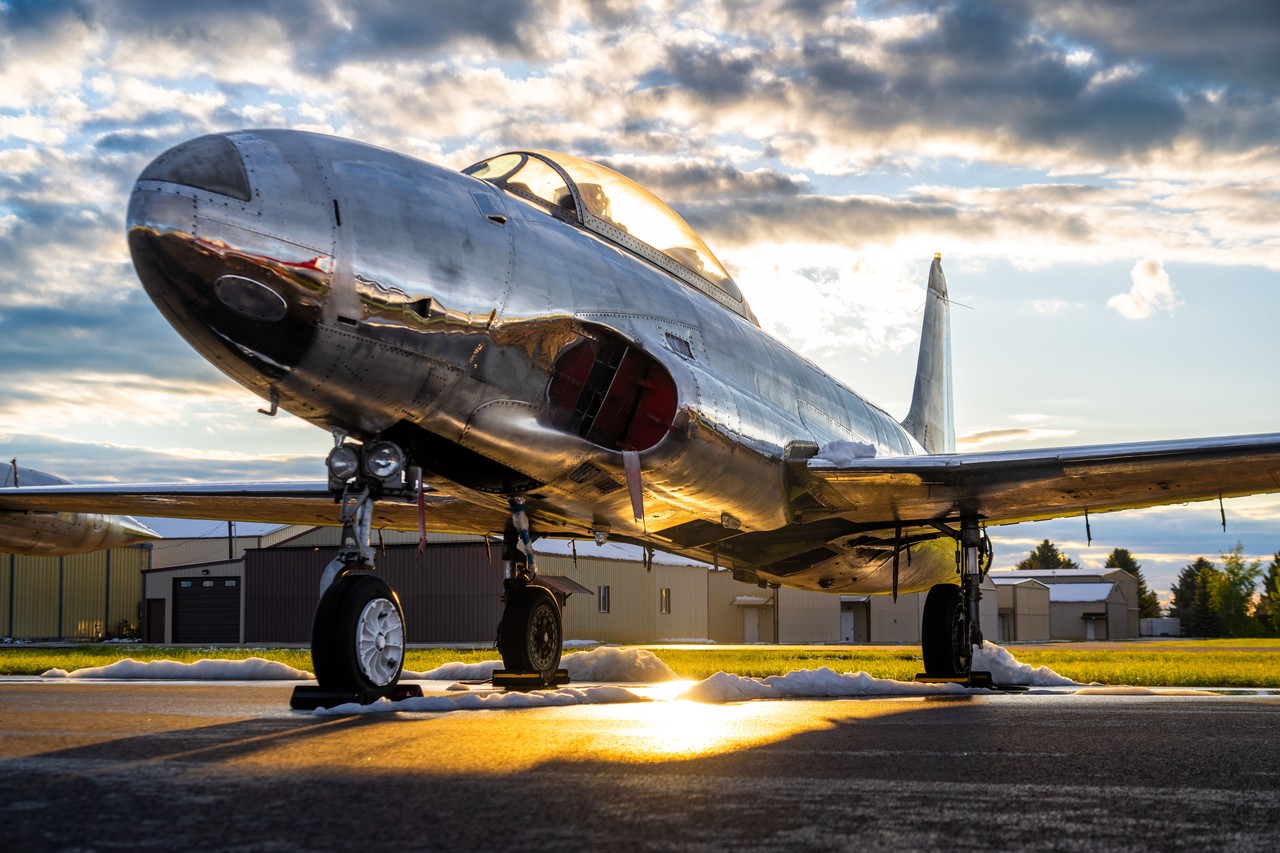
Global Training Dominance
The T-33's impact on military aviation training was unprecedented. During its peak operational years, the Shooting Star served with 30 air forces worldwide, becoming the standard jet trainer for the United States Air Force and NATO allies. Of the 6,557 T-33s produced between 1948 and 1959, Lockheed manufactured 5,691 at its Burbank, California facility, while Canadair built 656 under license in Canada and Kawasaki produced 210 in Japan.
Development and Design Heritage
The T-33's success stemmed from its lineage as a direct descendant of America's first operational jet fighter, the P-80 Shooting Star. Kelly Johnson's legendary Skunk Works team had developed the original P-80 in just 143 days during 1943-1944, with test pilot Milo Burcham making the first flight on January 8, 1944. Originally designated TF-80C when the prototype flew in March 1948, the trainer was redesignated T-33A in May 1949 after 128 aircraft had been completed.
The two-seat configuration proved remarkably superior to its single-seat fighter ancestor. Test pilots discovered that the trainer actually flew better than the original P-80, with improved climb performance and cruise characteristics thanks to refinements in the airframe and the reliable Allison J33-A-35 turbojet engine.
Lockheed Aircraft Corporation
Lockheed Aircraft Corporation established itself as a pioneer in both military and civilian aviation through the mid-20th century. The company's Burbank facility became synonymous with advanced aircraft development, housing the famous Skunk Works division that produced breakthrough designs from the P-80 through the U-2 spy plane. Lockheed continued T-33 production until August 1959, maintaining consistent quality control throughout the program's eleven-year manufacturing run.
Technical Excellence and Performance
The T-33's single Allison J33-A-35 turbojet engine provided the reliability essential for training operations. Unlike temperamental early jets, the J33 powerplant offered predictable performance characteristics that allowed student pilots to focus on mastering jet flight principles rather than managing engine quirks. The straight-wing design provided forgiving handling characteristics while still introducing pilots to jet-speed operations.
Instructors appreciated the T-33's dual-control configuration, which allowed safe supervision of student pilots during their transition from propeller aircraft. The tandem seating arrangement with the instructor in the rear seat provided excellent visibility for monitoring student performance and intervening when necessary.
Military Service Across Branches
While primarily designed as a trainer, the T-33 served multiple military roles. The U.S. Air Force used it as its primary jet trainer from 1948 until the mid-1980s. The U.S. Navy adopted the aircraft in 1949, initially designating it TV-2 before changing to T-33B in 1962. Air National Guard units continued flying T-33s until 1994, representing nearly five decades of American military service.
The Royal Canadian Air Force began operating the Canadair-built CE-133 variant in 1955, using it to prepare pilots for frontline fighters and bombers. The CE-133 became particularly associated with Canada's Snowbirds aerobatic demonstration team, serving as a support aircraft.
Variant Development
Beyond basic training, specialized T-33 variants expanded the aircraft's utility. The DT-33 served as a drone director for target operations, while the RT-33 performed reconnaissance missions. The AT-33A variant was configured for light attack duties, demonstrating the design's versatility beyond its primary training role.
Congressional Mandate and Retirement
Despite its continued effectiveness, the U.S. Congress ordered the T-33's removal from military service by September 1987, ending nearly four decades of American military operations. This decision reflected the military's transition to more modern training aircraft rather than any deficiency in the T-33's performance.
International Legacy and Museum Preservation
The T-33's global impact continues through extensive museum preservation efforts. Notable examples include the National Warplane Museum's CE-133 (serial 133083), built by Canadair in 1953, and the Prairie Aviation Museum's T-33 delivered to the Air Force on October 15, 1955. The EAA Museum displays a 1952 T-33A, while the Canadian Warplane Heritage Museum maintains a former Snowbirds support aircraft acquired in 1995.
Several T-33s remain operational with foreign air forces, testament to the design's durability and continued relevance. The Shooting Star's 46-year service span with U.S. forces and ongoing international operations establish it as one of aviation history's most successful training aircraft, having prepared thousands of pilots for the jet age.