
Service Dominance
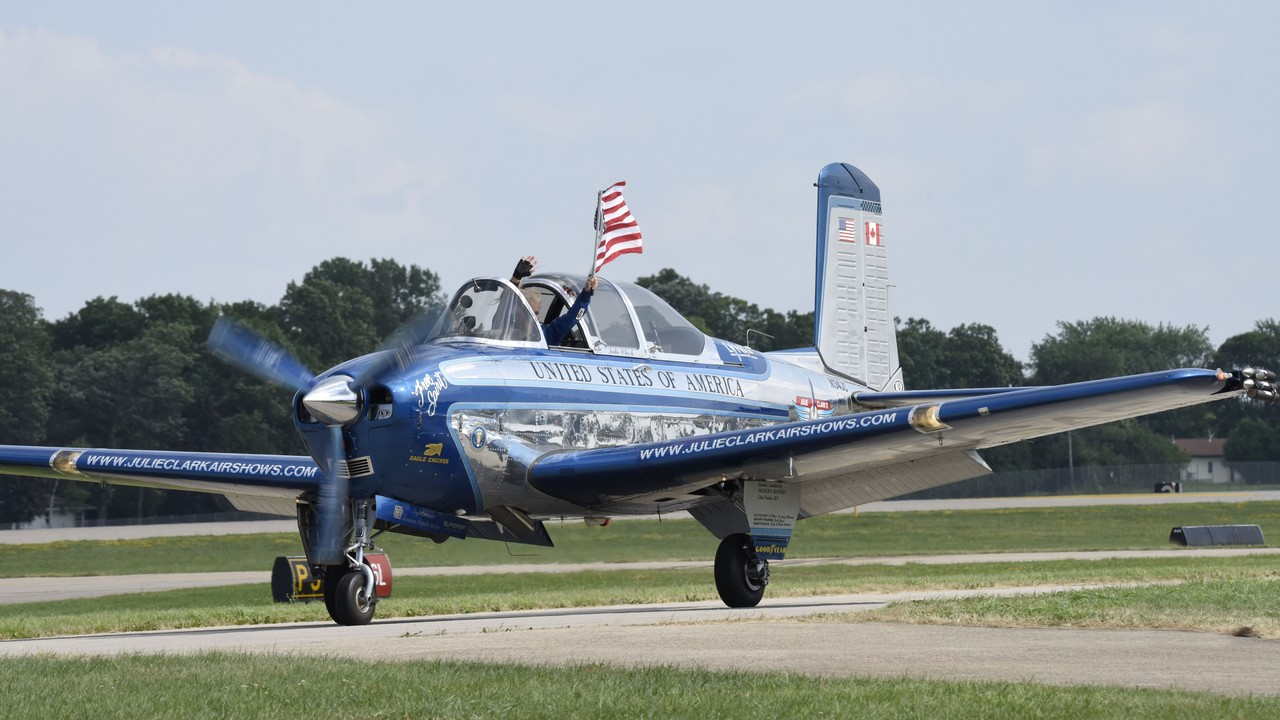
The T-34A Mentor transformed military flight training when it entered United States Air Force service in October 1953. Air Training Command operated 450 T-34As at nine contract flying schools, where the aircraft's efficiency allowed the USAF to slash primary training from 74 hours to just 36 hours per student. This dramatic reduction in training time, combined with improved safety records, made the Mentor an immediate success in the cost-conscious post-Korean War military environment.
The Navy adopted its own version, the T-34B, acquiring 423 aircraft for operations at Naval Air Station Pensacola beginning in 1955. One particularly well-documented T-34B accumulated 5,115 flight hours and 16,459 landings by 1960, demonstrating the type's exceptional durability under intensive training operations.
International Success
Beyond American service, the T-34 achieved remarkable international success through licensed production agreements. Canadian Car and Foundry manufactured 125 aircraft in Montreal, while Fuji Heavy Industries built 173 units in Japan and Fábrica Militar de Aviones produced 75 in Argentina. The aircraft served with air forces in more than ten countries, including Chile, Colombia, El Salvador, Turkey, and Ecuador, establishing the Mentor as one of the most widely exported American trainers of the 1950s.
The Beechcraft Legacy
Beechcraft Corporation, founded in 1932 by Walter H. Beech and Olive Ann Beech, had already established itself as an innovator with aircraft like the Model 17 Staggerwing and the revolutionary Model 35 Bonanza. The T-34's design team cleverly adapted the Bonanza's proven airframe, narrowing the fuselage and strengthening the structure for the demanding training environment. This approach allowed Beechcraft to offer a modern, economical trainer that far surpassed the capabilities of existing aircraft.
The company underwent several ownership changes, becoming part of Raytheon in 1980, then Hawker Beechcraft in 2006, before Textron acquired it in 2007. Today, Textron Aviation continues the Beechcraft tradition, producing aircraft that trace their lineage back to the T-34's successful design philosophy.
Engine and Technical Innovation
The T-34A's heart was the Continental O-470-13 engine, a six-cylinder air-cooled powerplant producing 225 horsepower. Continental Motors, which became Teledyne Continental Motors and later Continental Aerospace Technologies, built this reliable engine that proved ideally suited to the demanding training environment. The O-470 series powered thousands of general aviation aircraft from the late 1940s through the 1980s, with the T-34 installation demonstrating exceptional reliability during aerobatic maneuvers including spins, loops, and stalls.
Pilot Experience
Pilots praised the T-34A for its forgiving handling characteristics and excellent aerobatic capabilities. The aircraft's clean, all-metal construction provided predictable flight behavior that built student confidence while challenging them with realistic flight training scenarios. With a service ceiling of 20,000 feet and a range of 821 miles, the Mentor offered operational flexibility that training commands found invaluable for diverse mission requirements.
The tandem seating arrangement placed the instructor behind the student, providing excellent visibility for both occupants while maintaining clear communication during critical training phases. This configuration became the standard for military trainers and influenced aircraft design for decades.
Production Achievement
Beechcraft completed T-34A production in 1956 after delivering 353 aircraft to the USAF, while T-34B production for the Navy concluded on October 31, 1957. Including all licensed production variants, total manufacturing of Continental-engine T-34s reached 1,904 aircraft by 1958, making it one of the most successful trainer programs of the era.
The USAF replaced the T-34A with the Cessna T-37 jet trainer in the late 1950s as pilot training evolved toward all-jet instruction. However, many surplus T-34As found new life in base aero clubs, where they continued training military pilots in their off-duty hours.
Continuing Legacy
Hundreds of T-34 Mentors remain airworthy today in private ownership, serving as aerobatic aircraft and warbird display planes. The T-34 Association maintains an active community of owners and enthusiasts who preserve these historic trainers. Notable museum examples include aircraft at the National Museum of the United States Air Force at Wright-Patterson Air Force Base in Ohio, March Field Air Museum in Riverside, California, and various Commemorative Air Force wings.
The T-34's success led directly to the turboprop-powered T-34C, which Beechcraft produced from 1975 to 1990, delivering 353 additional aircraft and extending the Mentor's training legacy well into the modern era. The original T-34A's efficient design and proven training effectiveness established principles that continue to influence primary trainer development today.