
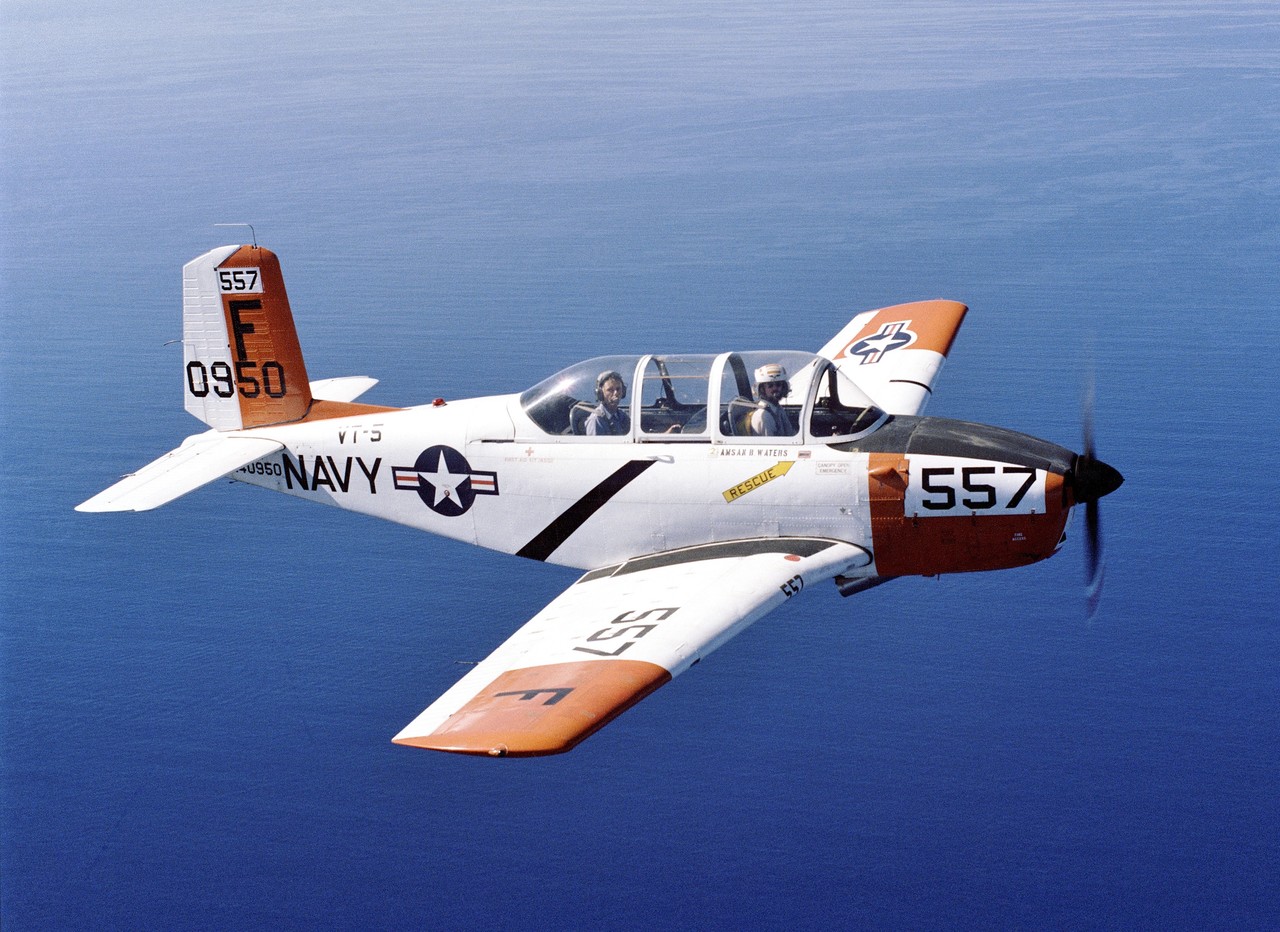
Service History
The T-34C dominated U.S. Navy primary flight training from 1978 until approximately 2002, when the service transitioned to the T-6 Texan II. Student training officially began in January 1978, and the aircraft's turboprop powerplant reduced training syllabus time by more than 50 percent compared to earlier piston-engine trainers. The Navy received the majority of the 353 aircraft produced, with the U.S. Army acquiring six additional units through transfers.
Export Variants and Armed Service
Beechcraft developed the T-34C-1 export variant beginning in 1977, featuring four underwing hardpoints capable of mounting rockets and bombs for light attack missions. Algeria became the first international customer, acquiring six aircraft designated as "Turbine Mentor 34C" for their national pilot training school in 1979. Unlike the standard Navy trainer, these armed variants provided basic counter-insurgency capabilities alongside pilot instruction duties.
The Manufacturer
Beech Aircraft Corporation, founded in 1932 by Walter Beech and Olive Ann Beech, established its reputation with innovative designs like the Model 17 Staggerwing in 1934. During World War II, the company expanded rapidly producing military trainers including the AT-10 Wichita. Raytheon acquired Beechcraft in 1980, beginning a series of ownership changes that included Hawker Beechcraft in 2006, bankruptcy restructuring in 2012, and finally merger with Cessna under Textron Aviation in 2014, where the brand continues today.
Engine and Technical Innovation
The T-34C's transformation from its piston-engine predecessors centered on the Pratt & Whitney Canada PT6A-25 turboprop, rated at 550 shaft horsepower and driving a three-bladed Hartzell variable-pitch propeller. This free-turbine engine, first introduced in 1963, provided exceptional reliability with mean time between overhauls exceeding 5,000 hours. The powerplant offered superior hot-and-high performance compared to piston engines, along with reverse-thrust capability for enhanced ground handling.
Design Evolution
Beechcraft's engineering team, led by figures including Vernon "Bush" Carstens, adapted the successful Model 35 Bonanza design for military training requirements. The T-34C incorporated the wing structure from the Beech Baron, landing gear from the Beech Duke, and increased fuel capacity to 130 U.S. gallons. These modifications created an aircraft specifically optimized for the demanding requirements of military pilot instruction while maintaining the docile handling characteristics essential for student training.
Performance Characteristics
Pilots praised the T-34C for its forgiving flight characteristics combined with turboprop performance that better prepared students for advanced military aircraft. The trainer achieved a maximum speed of 322 mph, service ceiling of 28,300 feet, and range of 1,151 miles. Its climb rate of 3,500 feet per minute provided dynamic training scenarios impossible with earlier piston trainers, while retaining the predictable handling essential for primary instruction.
Production Legacy
Beechcraft manufactured all 353 T-34C aircraft at their United States facilities between 1975 and 1990. The aircraft achieved a notable milestone on November 16, 1977, when a T-34C completed the first Atlantic crossing by this variant. Production statistics demonstrate the type's focused military mission, with the vast majority serving the U.S. Navy's training command rather than pursuing broader commercial markets.
Current Status and Museum Preservation
Dozens of T-34C airframes remain airworthy today, though exact numbers fluctuate as aircraft transition between active and static display roles. The Pima Air & Space Museum in Tucson, Arizona, preserves a representative U.S. Navy T-34C for public display. The T-34 family, spanning over 70 years from the original 1953 piston variants through the turboprop C-model, represents one of the longest-serving trainer designs in U.S. military history, having instructed thousands of naval aviators in fundamental flight skills.