
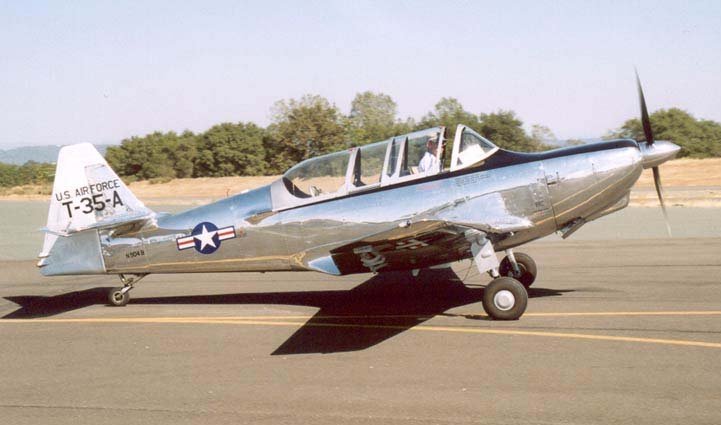
Development and Design Philosophy
The T-35 Buckaroo emerged from TEMCO's ambitious attempt to dominate the post-World War II training aircraft market through radical cost reduction. Cotton Conder, a former Globe Aircraft employee, led the development team in transforming the side-by-side Globe Swift GC-1B into a purpose-built military trainer. The design philosophy centered on creating the most affordable primary trainer possible, sacrificing performance and comfort for simplicity and low manufacturing costs.
Engineers lengthened the fuselage by three inches, raised the horizontal tail by nine inches, and completely redesigned the cockpit with tandem seating under an elongated two-piece canopy. The wing structure received significant strengthening to handle 9G loads, while the electrical system was upgraded to 24 volts to meet military specifications. These modifications, while improving the aircraft's training suitability, came at the cost of the Swift's relatively graceful appearance.
Military Evaluation and Failure
The United States Air Force conducted extensive evaluations of three YT-35 aircraft between 1949 and 1951 at Randolph Air Force Base, James Connally AFB, and Goodfellow AFB. The Buckaroo faced formidable competition from the Beech T-34 Mentor, Fairchild T-31, Boulton Paul Balliol, and de Havilland Chipmunk in what would become a decisive competition for America's primary trainer contract.
Despite TEMCO's emphasis on low cost, the T-35 ranked poorly in Air Force evaluations. Test pilots found the aircraft's performance mediocre, with handling characteristics that failed to impress military evaluators. The outbreak of the Korean War in 1950 further complicated the evaluation process, as military priorities shifted toward more capable training aircraft that could better prepare pilots for jet-age combat requirements. By 1951, all three YT-35 evaluation aircraft had been overhauled and sold as surplus, marking the end of the type's U.S. military aspirations.
International Service with Saudi Arabia
The T-35's only military success came through the Mutual Defense Aid Program, when the Royal Saudi Air Force acquired ten T-35A aircraft in May 1953. These aircraft, delivered to Jiddah, represented some of the earliest modern training aircraft in the Saudi inventory. Serial number 34470 was among the first RSAF trainers, serving in the kingdom's emerging pilot training program during the early 1950s.
The Saudi aircraft were powered by 145-horsepower Continental C-145-2H engines, providing adequate performance for basic pilot training in the desert kingdom. However, the limited documentation of their service history suggests the T-35A had minimal impact on Saudi aviation development compared to later, more capable training aircraft.
TEMCO Aircraft Corporation
TEMCO Aircraft Corporation operated from 1946 until 1960, when it merged with Ryan Aeronautical to form Temco-Ryan, later becoming part of Ling-Temco-Vought in the 1960s. Based in Dallas and Grand Prairie, Texas, TEMCO focused heavily on subcontracting work, including P-51D Mustang conversions, B-47 Stratojet fuselage sections, and licensed F3H-1 Demon production before that program's cancellation.
The company's post-T-35 ventures included the 1956 Model 58 counter-insurgency prototype, demonstrating TEMCO's continued interest in military aircraft markets. However, none of these projects achieved the commercial success needed to establish TEMCO as a major aircraft manufacturer. The company's lineage eventually evolved into LTV, which ceased aerospace operations in the 1990s and 2000s.
Technical Specifications and Performance
The production T-35 featured a bewildering array of powerplant options reflecting ongoing attempts to optimize performance and cost. Early TE-1A prototypes used 125-horsepower engines, later upgraded to 145-horsepower Continental units. The YT-35 evaluation aircraft received 165-horsepower Franklin 6A4-165-B3 inline engines, while production T-35A aircraft for Saudi Arabia returned to the 145-horsepower Continental C-145-2H.
With a maximum speed of 165 mph, service ceiling of 20,000 feet, and range of 650 miles, the T-35 offered respectable but unexceptional performance for a primary trainer. The tandem seating arrangement provided good visibility for both instructor and student, while the strengthened airframe could handle the rigors of military training operations.
Legacy and Surviving Aircraft
With only 26 aircraft built across all variants, the T-35 Buckaroo represents one of aviation's notable failures in the competitive post-war trainer market. A handful of aircraft reached civilian hands through surplus sales, receiving registrations such as N901B, N902B, N903B, and N68773, but none are confirmed flying today.
The T-35's failure highlighted the rapid evolution of military training requirements in the jet age, where the Beech T-34 Mentor's superior performance and handling characteristics proved more valuable than TEMCO's emphasis on low cost. The Buckaroo remains a footnote in aviation history, representing missed opportunities in an era when innovative design and superior engineering trumped budget considerations in military procurement decisions.