
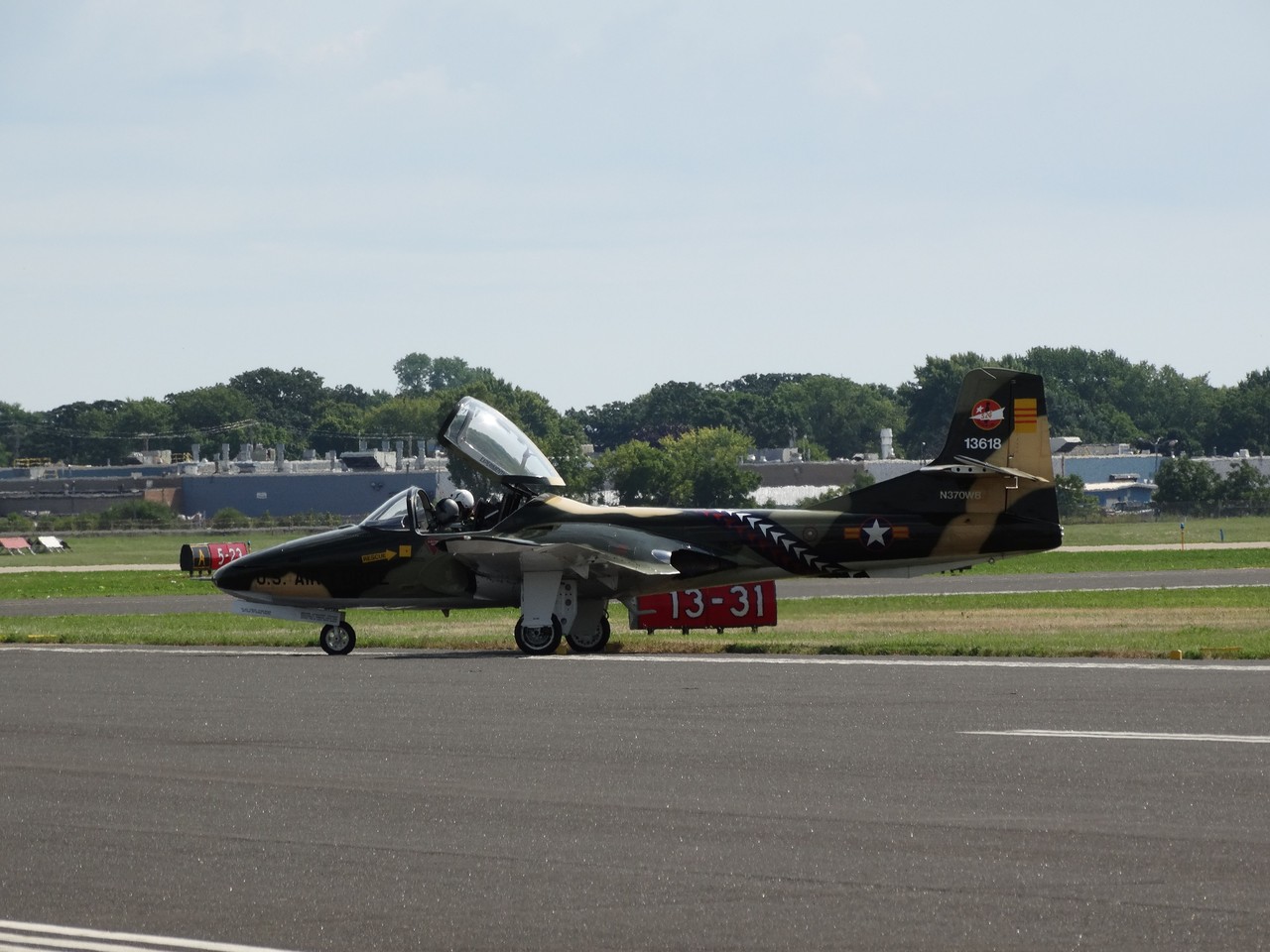
Service History
The T-37 dominated U.S. Air Force pilot training for over five decades, training multiple generations of military aviators from its introduction in 1956 until retirement on July 31, 2009. During its 52-year service life, the aircraft became the backbone of American jet pilot education, with 419 examples still remaining in USAF inventory as of 2006. The trainer's impact extended far beyond American borders, as export variants served with at least 18 foreign air forces, establishing the T-37 as a global standard for jet pilot instruction.
Wartime and Operational History
While the basic T-37 trainer never saw direct combat, its armed derivative, the A-37 Dragonfly, proved itself in the crucible of the Vietnam War from 1967 to 1975. More than 600 A-37 variants were built for counter-insurgency operations, equipped with gun pods, bomb racks, and missile points. The combat-capable T-37C export version served multiple foreign air forces in both training and light attack roles, with operators including Brazil (65 aircraft from 1967-1981), Pakistan, Portugal, Colombia, and Ecuador.
The aircraft's variants reflected its evolution from prototype to combat-ready platform. The program began with two XT-37 prototypes, followed by 444 T-37A production models starting in September 1955. The improved T-37B variant introduced more reliable engines, with 552 new-build aircraft plus conversions of existing T-37A models beginning in 1959.
The Manufacturer
Cessna Aircraft Corporation, founded in 1927 by Clyde Cessna in Wichita, Kansas, developed the T-37 as their Model 318 in response to a 1952 U.S. Air Force requirement. The company had grown from a small aircraft manufacturer into a major producer of general aviation and military aircraft during World War II and the Cold War era. In 1997, Cessna was acquired by Textron Inc. and now operates as Textron Aviation, continuing aircraft production to this day.
Cessna's design team created the T-37 to meet specific USAF requirements emphasizing economy, safety, and effective training. The specifications called for side-by-side seating, tricycle landing gear with a wide 14-foot track, steerable nose wheel, and short landing gear to eliminate the need for boarding ladders. These design elements focused on economical twin-engine training with easy ground handling and full aerobatic capability.
Engine and Technical Details
The T-37 was powered by two Continental J69-T-9 turbojet engines, each producing 920 pounds of thrust. These engines were license-built by Continental-Teledyne based on the French Turbomeca Marboré IIC design. The T-37B variant upgraded to the more reliable J69-T-25A engines, which provided 10 percent more thrust and addressed earlier reliability concerns. Continental produced the J69 series from the early 1950s through the 1970s, powering multiple trainer aircraft types.
The aircraft's most innovative feature was its side-by-side cockpit configuration, which enhanced instructor-student communication and learning effectiveness compared to traditional tandem seating arrangements. Early flight testing revealed handling challenges when the initial XT-37 prototype crashed in a flat spin, leading to critical design modifications including nose strakes and an enlarged tail section.
Pilot Perspective
Pilots affectionately nicknamed the T-37 "Tweet" or "Tweety Bird" due to its distinctive engine sound. The aircraft was specifically designed to provide adequate power for aerobatic training without overwhelming student pilots, making it an ideal platform for transitioning from propeller-driven trainers to jet aircraft. Its forgiving flight characteristics and reliable twin-engine configuration made it exceptionally suitable for primary jet training, contributing to its long service life.
Performance specifications included a maximum speed of 425 mph, a service ceiling between 25,000 and 35,000 feet, and a range of 932 to 1,100 miles depending on configuration. The wide-track landing gear and steerable nose wheel provided excellent ground handling characteristics, essential for training operations.
Production and Legacy
Cessna produced 1,269 T-37 aircraft between 1955 and 1975 at their Wichita, Kansas facilities. Production breakdown included 444 T-37A models, 552 T-37B variants, and 273 T-37C export versions. The first USAF delivery occurred in June 1956, with cadet training beginning the following year in 1957.
As of 2017, T-37s remained in active service with Colombia, Ecuador, and Pakistan, testament to the aircraft's enduring utility and robust construction. Numerous examples survive in private hands and museums throughout the United States. Notable museum aircraft include T-37B 54-2732 at the MAPS Air Museum in Ohio (delivered April 30, 1956), T-37B 60-0188 also at MAPS (delivered December 29, 1961), and T-37B 57-2267 at the Pima Air & Space Museum in Arizona.
The T-37's cultural significance extends beyond its training role, as it marked America's transition to all-jet pilot instruction and influenced trainer aircraft design worldwide. Its pioneering approach to affordable, effective jet training established principles that continue to guide military trainer development today.