
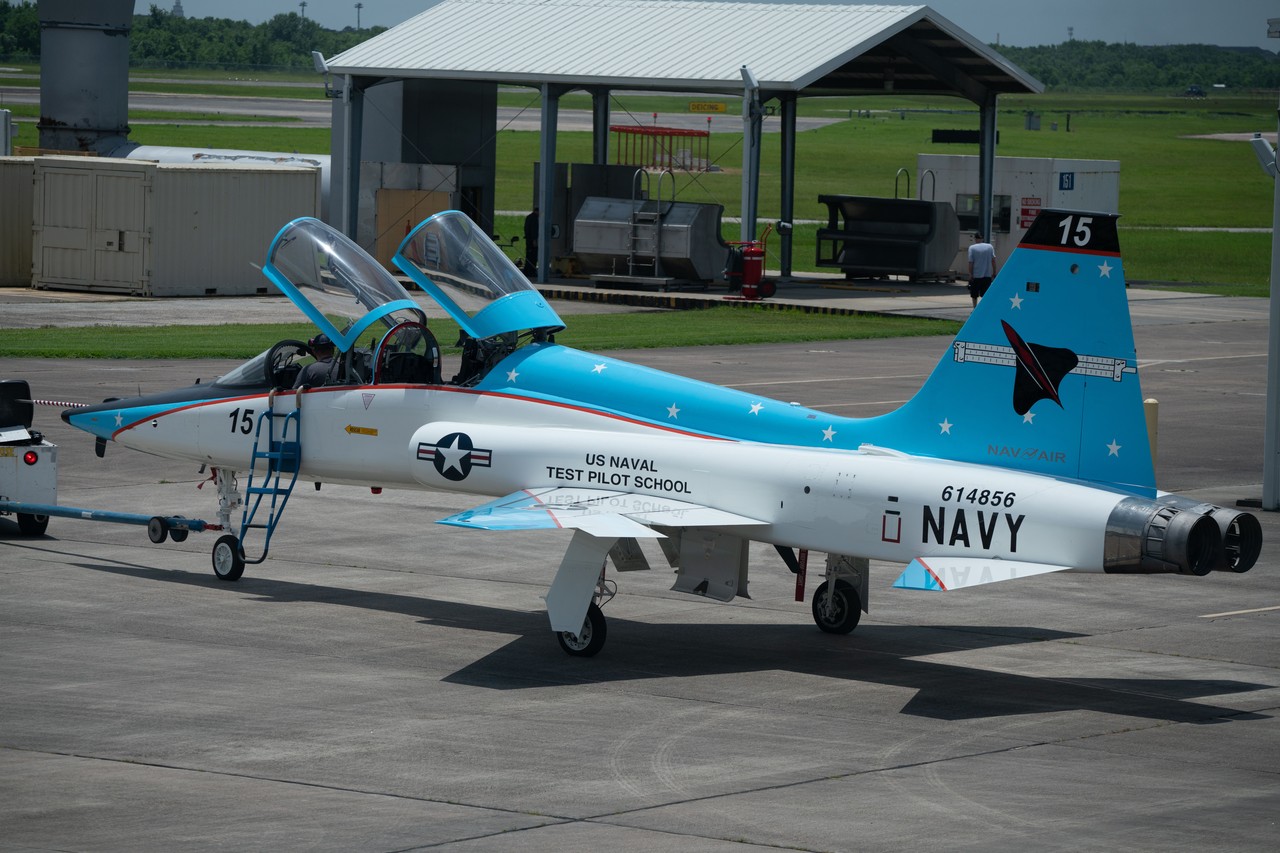
Service History
The T-38 Talon entered United States Air Force service on March 17, 1961, immediately filling a critical gap in supersonic pilot training. By the time production ceased in 1972, Northrop had delivered 1,187 aircraft, making the T-38 the most-produced jet trainer in aviation history. An estimated 50,000 military pilots have trained on the T-38 since its introduction, establishing it as the backbone of American military aviation training for over six decades.
The aircraft's operational versatility extended beyond basic pilot training. From 1978 to 1991, the Strategic Air Command's Accelerated Copilot Enrichment Program utilized T-38s to enhance pilot proficiency for heavy aircraft including the B-52 Stratofortress, B-1 Lancer, SR-71 Blackbird, U-2 Dragon Lady, KC-135 Stratotanker, and KC-10 Extender. This program demonstrated the T-38's effectiveness in preparing pilots for the unique demands of strategic bomber and tanker operations.
Notable Military Variants
The T-38A served as the primary training variant, while the AT-38B featured weapons training capabilities with provisions for a centerline gun pod, rockets, or bombs. The Air Force Thunderbirds flight demonstration team adopted the T-38 from 1974 to 1983, selecting it over the fuel-thirsty F-4 Phantom during the energy crisis following the 1973 OPEC oil embargo.
The Manufacturer
Northrop Corporation developed the T-38 from their N-156 fighter project, which began in 1952 under the leadership of Edgar Schmued, the company's Vice President of Engineering. Schmued's vision reversed the industry trend toward larger, heavier fighters after recognizing the potential of General Electric's compact 400-pound engine producing 2,500 pounds of thrust. This insight led to a lightweight design philosophy that would define the T-38's success.
Northrop Corporation merged with Grumman in 1994 to form Northrop Grumman, which continues as a major aerospace and defense contractor today. The company's other notable aircraft included the F-5 Freedom Fighter, derived from the same N-156 program that spawned the T-38.
Engine and Technical Innovation
Two General Electric J85-5A afterburning turbojet engines power the T-38, each producing between 2,680 and 3,850 pounds of thrust. This twin-engine configuration provides exceptional performance while maintaining safety through redundancy—a critical factor for training aircraft. The engines' compact size and efficient design enabled Northrop to create an aircraft that combined supersonic performance with economical operation.
The T-38's pressurized cockpit accommodates two crew members in tandem seating, typically an instructor pilot and student. Critical components were designed for easy accessibility, contributing to exceptional maintainability and operational availability that reached 75 percent in 2011.
Pilot Perspective
Pilots praise the T-38 for its honest flying characteristics and forgiving nature, essential qualities for training the next generation of military aviators. The aircraft's ability to reach Mach 1.3 provides students with authentic supersonic flight experience, preparing them for advanced fighter and bomber aircraft. Its high-altitude capability and responsive controls offer realistic training scenarios impossible to achieve with subsonic trainers.
The T-38's exceptional safety record has made it a trusted platform for decades of pilot training. Unlike most other nations that rely on high-subsonic trainers, the United States Air Force continues to utilize this dedicated supersonic final trainer, recognizing its unique value in preparing pilots for modern combat aircraft.
Production and Legacy
Northrop won the Air Force competition in the mid-1950s by demonstrating lower lifecycle costs compared to competitors, including proposed two-seat variants of the F-100 Super Sabre. The first production aircraft rolled off Northrop's assembly line in 1961, beginning an eleven-year production run that established the T-38 as an enduring success.
By September 2017, 503 T-38s remained operational with the United States Air Force, with additional aircraft serving NASA and foreign air forces worldwide. The Air Education and Training Command received upgraded T-38C variants in 2001 through the Avionics Upgrade Program, featuring propulsion modernization and enhanced engine components to increase takeoff thrust.
Current Status and Future
The T-38 continues serving as the Air Force's primary supersonic trainer, though replacement plans are underway. In September 2018, the Air Force announced the Boeing-Saab T-7 Red Hawk as a potential successor, with initial operating capability targeted for 2027 and full replacement by 2034.
Preserved examples of the T-38 Talon can be found at the Castle Air Museum, National Air and Space Museum, and other aviation institutions, ensuring this historic aircraft's legacy endures for future generations to study and appreciate.