
Development and Design
The T-4's origins trace to Kawasaki's KA-851 project, initiated under the Japan Air Self-Defense Force's MT-X program to modernize pilot training. Engineering team chief Kohki Isozaki led the design effort, focusing on replacing the aging Lockheed T-33A and Fuji T-1A/B trainers while reducing reliance on the more complex Mitsubishi T-2 for basic instruction. The Japan Defence Agency selected Kawasaki Heavy Industries as prime contractor on 4 September 1981, establishing a unique consortium structure where Mitsubishi Heavy Industries and Fuji Heavy Industries each held 30 percent shares.
Basic design studies concluded in October 1982, with government funding secured for fiscal years 1983 and 1984. Construction of the first prototype began in April 1984, leading to the maiden flight of XT-4 prototype 56-5601 on 29 July 1985. The remaining three prototypes followed by July 1986, validating the design's subsonic performance envelope and training capabilities.
Manufacturing Excellence
Production commenced in fiscal year 1986 at Kawasaki's Gifu facility, with the first production aircraft achieving flight on 28 June 1988. Deliveries to the JASDF began on 20 September 1988, marking the start of a 15-year production run that would establish new standards for Japanese military aircraft programs. Unlike contemporary trainer developments such as the troubled Fairchild T-46 in the United States, the T-4 program delivered aircraft on schedule and under budget.
The consortium approach proved highly effective, combining Kawasaki's leadership with Mitsubishi's aerospace expertise and Fuji's manufacturing capabilities. Final assembly occurred exclusively at the Gifu plant, with components flowing from all three partners. Production concluded in March 2003 after completing 212 aircraft, including the four XT-4 prototypes and 208 production T-4s.
Technical Innovation
Powering the T-4 is the Ishikawajima-Harima F3-IHI-30 turbofan, a low-bypass engine developed specifically for the trainer role. This afterburning-capable powerplant provided reliable performance while meeting strict cost targets, enabling the T-4's efficient operation compared to supersonic predecessors. The engine's integration with the airframe demonstrated Japanese capability in both propulsion and aerodynamic design.
The aircraft's tandem seating arrangement optimizes instructor-student interaction, while the modern airframe incorporates composite materials and advanced manufacturing techniques. These innovations contributed to the T-4's reputation for reliability and cost-effectiveness throughout its service life.
Service History
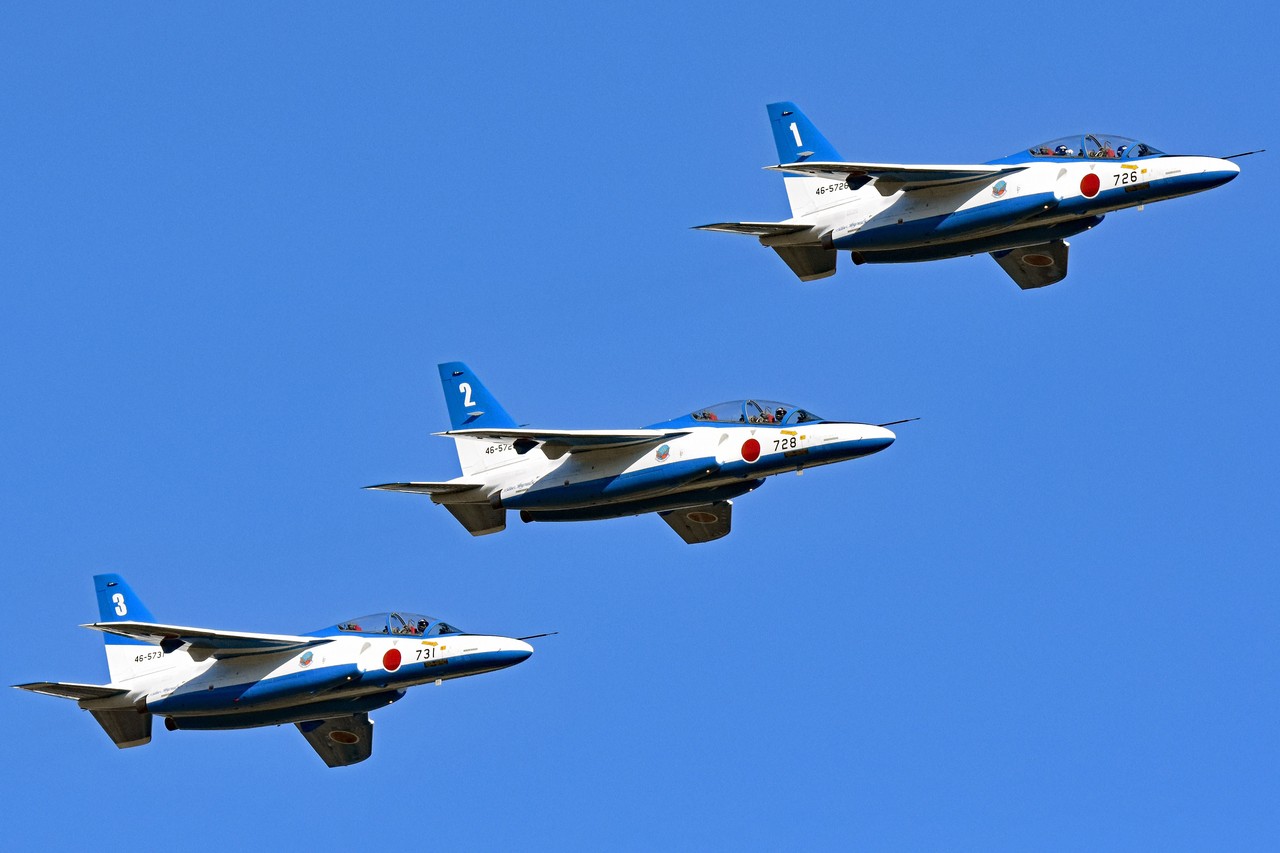
Since entering JASDF service in 1988, the T-4 has served exclusively in the training role, operating from bases including Ashiya and Hamamatsu. The aircraft successfully assumed intermediate and advanced jet training duties previously handled by foreign designs, while also supporting liaison missions with fighter units. Perhaps most visibly, the T-4 equips the prestigious Blue Impulse aerobatic demonstration team, showcasing Japanese aviation prowess at airshows and national events.
The T-4 carries no standard armament, reflecting its dedicated training mission, though provisions exist for light training loads during advanced instruction phases. This peaceful service record aligns with Japan's post-war defense posture, as the aircraft has never seen combat operations.
Manufacturing Legacy
Kawasaki Heavy Industries, founded in 1896, leveraged the T-4 program to demonstrate its evolution from early 20th-century license production to indigenous design capability. The company's aerospace division continues operations today, producing advanced aircraft including the P-1 maritime patrol aircraft. Partners Mitsubishi Heavy Industries and Fuji Heavy Industries (now Subaru Corporation) similarly maintain aviation operations, validating the consortium's long-term success.
The T-4 represents a milestone in Japanese aerospace independence, proving domestic industry could deliver modern military aircraft without foreign technical assistance. This capability foundation supports Japan's continued aerospace development, including participation in international fighter programs.
Current Status
Approximately 200 T-4 aircraft remain in JASDF service after more than three decades of operation, testament to the design's durability and continued relevance. However, the fleet approaches potential retirement as Japan integrates F-35 fighters and considers training system modernization. No export sales occurred due to Japanese restrictions on military hardware exports, limiting the type's global presence.
The T-4's legacy extends beyond pilot training to encompass Japan's aerospace renaissance, demonstrating that efficient program management and realistic requirements can produce successful military aircraft. Its on-time, under-budget delivery contrasted sharply with contemporaneous trainer programs worldwide, establishing benchmarks for future Japanese aviation projects.