
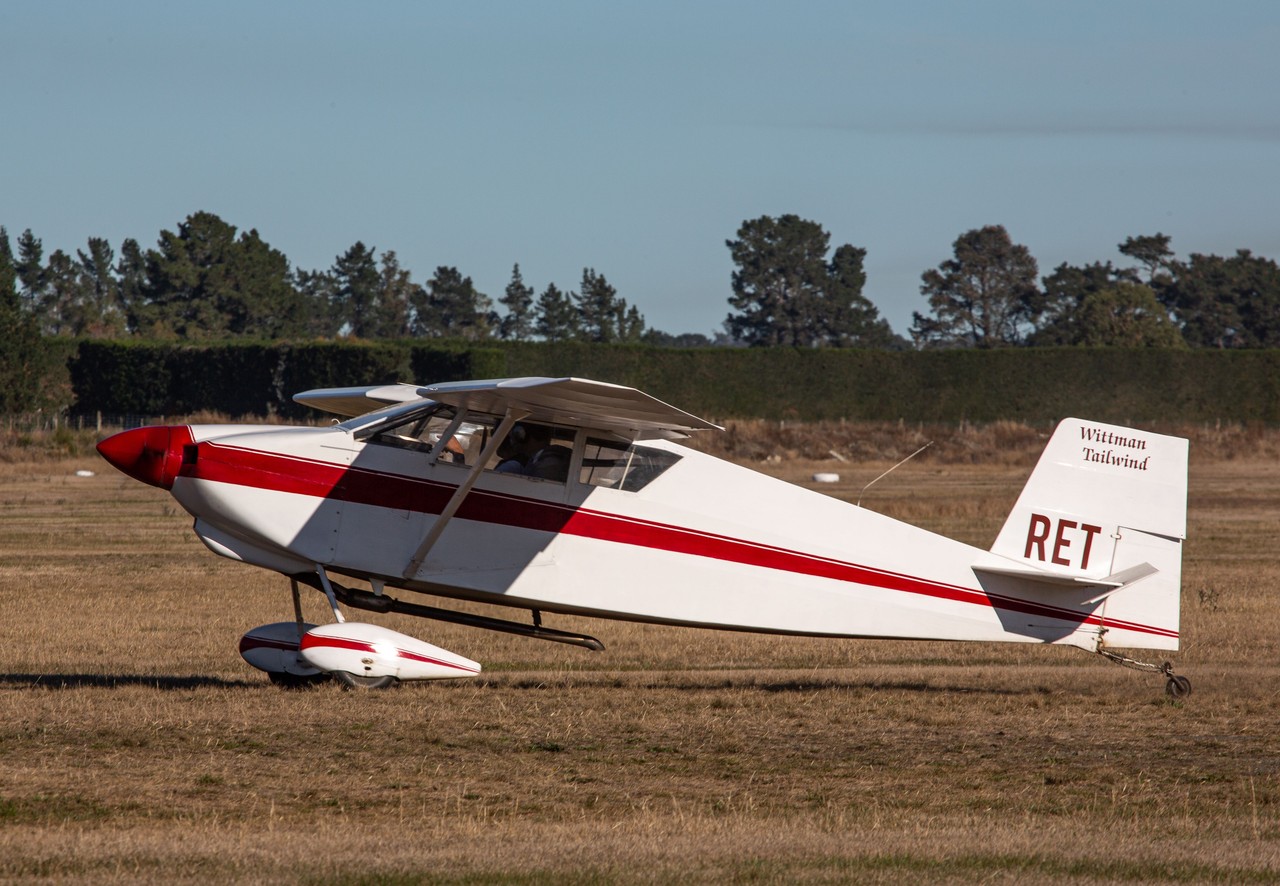
The Homebuilt Revolution
The Tailwind emerged during the early 1950s as Sylvester "Steve" Wittman sought to create a high-performance aircraft that amateur builders could construct in their garages. Wittman, already famous for his air racing exploits since the 1930s, understood that homebuilders wanted more than just a flying project—they wanted superior performance. His prototype, initially called the "Flying Carpet," achieved certification in 1953 as the first FAA Experimental category aircraft approved to carry passengers, establishing a precedent that opened recreational aviation to amateur constructors.
The Tailwind's success built upon lessons learned from Wittman's earlier designs, particularly the Buttercup of 1937. That two-seat aircraft had nearly entered commercial production with Fairchild Aircraft in 1939, but World War II military contracts and the death of Fairchild's president halted civilian production. Ironically, Cessna later adopted the Buttercup's innovative spring steel landing gear system, validating Wittman's engineering approach.
Design Philosophy and Innovation
Wittman's design philosophy centered on achieving maximum performance from minimum weight and power. The W-8 Tailwind measured 19 feet 3 inches in length with a wingspan of 22 feet 6 inches, yet weighed only 700 pounds empty while carrying a 1,300-pound gross weight. This efficiency translated into speed-per-horsepower ratios that embarrassed contemporary factory aircraft.
The aircraft's conventional wood-and-fabric construction might have appeared crude compared to metal factory planes, but Wittman's engineering produced remarkable efficiency. The 90-square-foot wing area provided excellent lift characteristics, while the high-wing configuration offered inherent stability that made the aircraft forgiving for amateur pilots. Jim Clement, who built twelve Tailwinds including the famous N6168X tested by CAFE in 1994, advanced the design with fiberglass cloth reinforcement, epoxy sealing, aluminum control surfaces, and tricycle landing gear options.
The Manufacturer's Legacy
Sylvester Joseph Wittman (1904-1995) operated more as an aviation innovator than a traditional manufacturer. Working from Oshkosh, Wisconsin—later home to the world's largest aviation gathering—Wittman promoted his designs through plans distribution rather than factory production. This approach democratized aircraft ownership, allowing builders to construct sophisticated aircraft at fraction of factory costs.
When Aircraft Spruce & Specialty Company acquired the Tailwind plans rights in January 1996, they ensured the design's survival into the modern era. Based in Corona, California, Aircraft Spruce became the exclusive distributor for plans and materials, supporting builders worldwide. The company continues operating today under its original name, testament to the enduring appeal of Wittman's designs.
Powerplant Evolution
Early Tailwinds utilized Continental C-85 engines producing 85 horsepower, proven powerplants that Continental manufactured from the late 1930s through the 1960s. These reliable inline piston engines provided adequate performance while maintaining the aircraft's light weight philosophy. As more powerful options became available, builders upgraded to 100-135 horsepower Lycoming O-320 or O-300 engines, with Lycoming having produced over 100,000 piston engines since the 1950s.
Some experimental installations pushed boundaries further, including inverted Oldsmobile V8 conversions that delivered up to 180 horsepower. These modifications demonstrated the design's structural integrity and adaptability, though most builders preferred traditional aircraft engines for reliability and parts availability.
International Recognition
The Tailwind's reputation spread beyond American shores during the 1970s when AJEP marketed kits and ready-to-fly versions in the United Kingdom. This international expansion proved that Wittman's design principles translated across cultures and aviation regulatory systems, further cementing the aircraft's reputation as a truly outstanding homebuilt design.
Variant development continued with the W-9, Wittman's personal rebuild featuring a constant-speed propeller, 35-gallon fuel tank, and tricycle landing gear. The W-10 incorporated tapered wingtips and a longer fuselage, stretching to 19 feet 6 inches while maintaining the same wing area but increasing wingspan to 24 feet.
Enduring Legacy
The FAA registry currently lists 376 Wittman aircraft overall, many of which are Tailwinds, with amateur construction continuing as recently as 2006. Individual aircraft like N4FD and N69RN demonstrate the type's longevity, with some examples still flying after six decades of service. The Sun 'n Fun Museum displays a 1965 model, preserving the design for future generations.
The Tailwind's cultural significance extends beyond its technical achievements. It proved that amateur builders could create aircraft rivaling factory production, inspiring the modern homebuilt movement that produces thousands of aircraft annually. Before composite materials revolutionized homebuilding, the Tailwind established efficiency standards that factory aircraft struggled to match, earning its place as a foundational design in recreational aviation history.