
Service History
The Tarragon has established itself as a premium ultralight aircraft serving both civilian and military markets across multiple continents. Dozens of aircraft operate in countries including Italy, Germany, Switzerland, the United States, Mexico, Latvia, Lithuania, Spain, and Belgium. The aircraft gained particular prestige when it attracted customers including an undisclosed Formula 1 pilot and a MotoGP sportsman, emphasizing its appeal to high-performance aviation enthusiasts.
In December 2022, the Tarragon achieved a significant milestone when the Latvian Air Force (Latvijas Gaisa speki) took delivery of its first military variants at Ādaži airfield for pilot training purposes. This marked the aircraft's entry into military service, representing a rare achievement for an ultralight design to gain official military acceptance.
The Manufacturer
SIA Pelegrin emerged from the bankruptcy of the Millennium Master aircraft project, taking over the design and developing it into the Tarragon with assistance from CFM Air. Founded after 2009 in Ādaži, Latvia, the company initially operated under the leadership of chairman Valentin Vasyaks until his death in a motorcycle accident in 2021. CEO Ingemārs Butkevičs, himself a pilot, has led the company's technical development and continues to guide operations today.
The company relocated production around 2020-2021 to expanded facilities at the Freeport of Riga in Mangaļsala, occupying a 4,500 square meter site that enabled increased manufacturing capacity. Pelegrin established international partnerships including Tarragon Aircraft USA, LLC, founded by Michael Cruce and Charles Barth in Pekin, Illinois, which began operations in 2019 to handle American sales and service under FAA experimental aircraft regulations.
Engine & Technical Details
The Tarragon's performance stems from its combination of lightweight construction and powerful engine options. Standard powerplants include the 100 hp EPA Power SA-R917TNi ULM or SA917Ti Turbo Injection, Rotax 912ULS/912iS (100 hp), turbocharged Rotax 914 (115 hp), UL Power 130 hp, or high-performance variants producing 135-145 hp. All engines are four-stroke piston units mounted in tractor configuration.
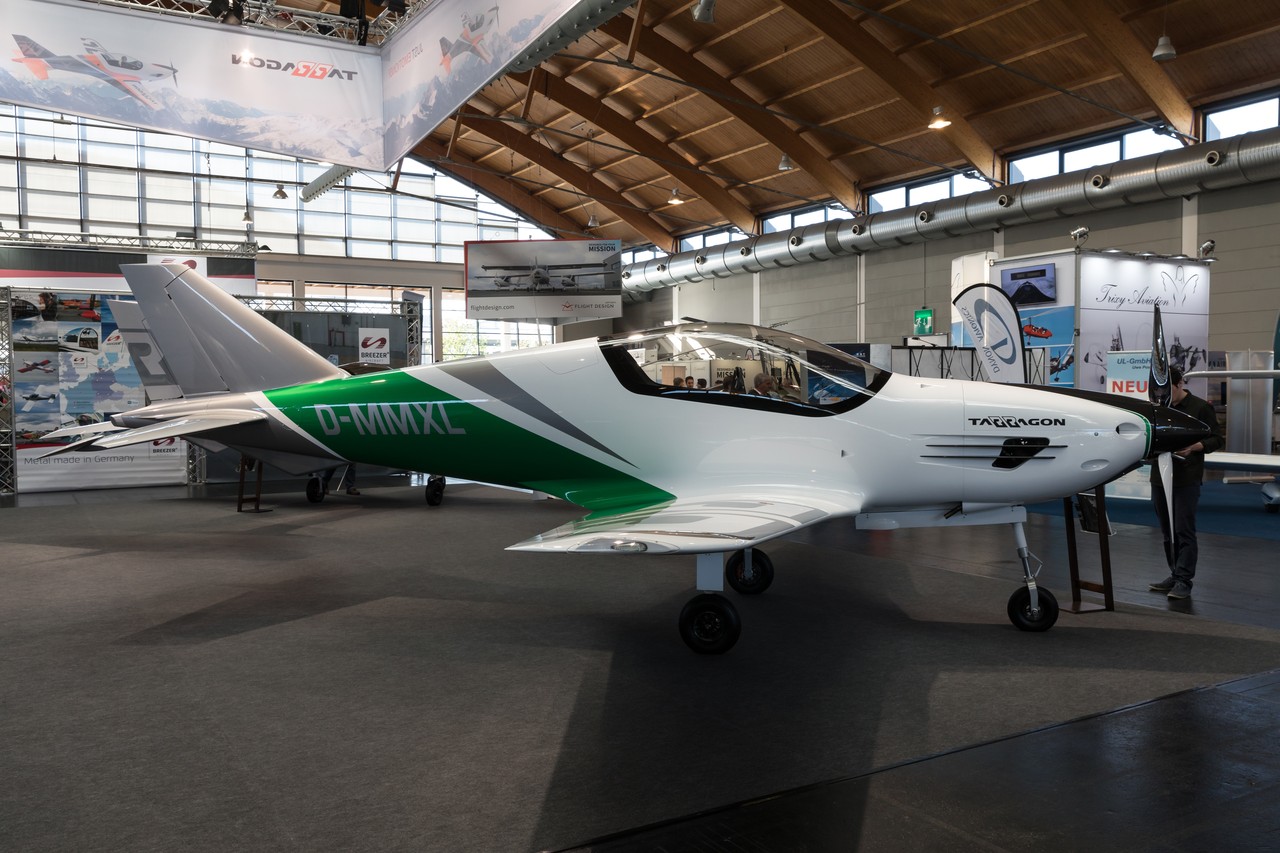
The aircraft's revolutionary design employs pre-preg carbon fiber composite construction throughout, replacing traditional aluminum structure with a cantilever low-wing configuration. Notable innovations include a complex retractable tricycle landing gear system designed and manufactured entirely in-house, an adjustable-pitch propeller, and an integrated ballistic parachute system. The bubble canopy provides excellent visibility for both crew members in the tandem seating arrangement.
Pilot Perspective
Pilots praise the Tarragon for achieving airliner-like performance in an ultralight package. The aircraft cruises at 170-185 mph (275-300 km/h) with exceptional fuel efficiency of just 20 liters per hour. With its 140-liter standard fuel tank, the Tarragon achieves a range of 1,300 km, while an optional 250-liter tank extends endurance to 12 hours.
The aircraft demonstrates impressive short-field performance with takeoff distances of 225 meters and landing rolls of just 150 meters on asphalt surfaces. Stall speed with full flaps is remarkably low at 40 mph (64 km/h), providing excellent low-speed handling characteristics. The service ceiling reaches 3.5 km, giving pilots significant altitude capability for an ultralight design.
Production & Legacy
Development began in 2012 with the first prototype completed in 2014 and production commencing in 2010. While exact production numbers remain undisclosed, Pelegrin has manufactured dozens of aircraft with plans to export at least 10 units annually. The company's focus on exclusivity and custom builds has positioned the Tarragon as a premium product in the ultralight market.
The Tarragon represents Latvia's modern contribution to aviation excellence, following the country's historical aviation heritage exemplified by pioneer Kārlis Irbītis. By combining advanced composite materials with innovative design, the aircraft has demonstrated that small nations can compete in high-technology aviation manufacturing. The successful integration of Italian design influence, manufacturing expertise, and Latvian engineering has created an aircraft that continues Latvia's aviation legacy into the 21st century.