
Service History
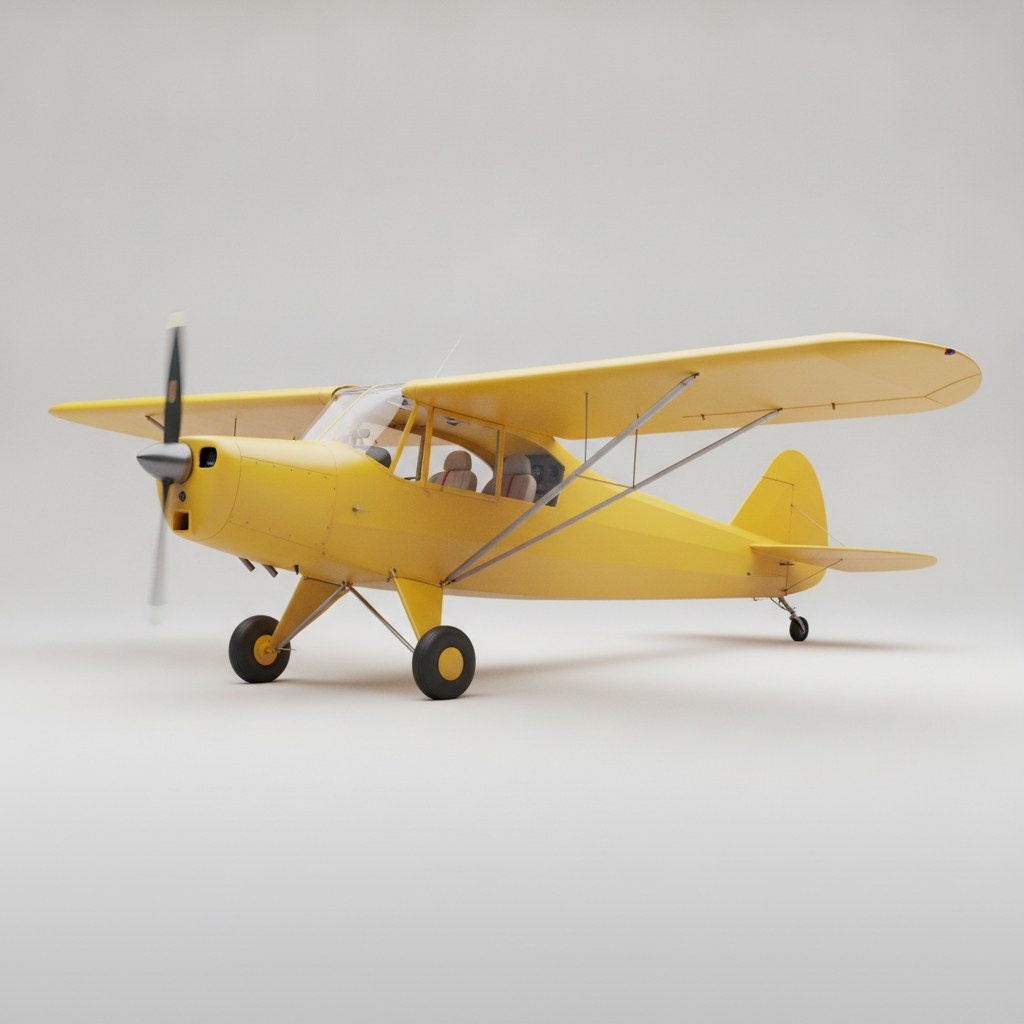
The Taylorcraft Model A revolutionized light aircraft training by introducing side-by-side seating when most competitors offered tandem configurations. By 1938, despite the ongoing Depression, factory output reached 30 aircraft monthly, demonstrating remarkable market acceptance. The design's affordability and practical features captured significant market share, with 356 units delivered in 1937 alone.
Post-war production exploded with the BC-12D variant, achieving nearly 4,200 aircraft built primarily in 1946. This surge made Taylorcraft one of the dominant general aviation manufacturers during the civilian aviation boom following World War II.
Wartime Service
World War II transformed the Taylorcraft into a military workhorse as the L-2 Grasshopper. The U.S. Army Air Corps ordered between 1,980 and 2,200 L-2 variants, featuring tandem seating for liaison, reconnaissance, and artillery spotting missions. Unlike the civilian side-by-side configuration, military versions adopted tandem cockpits for operational efficiency.
Production diversification included 250 TG-6 training gliders and 25 LBT glide bombs manufactured in 1944, showcasing the design's adaptability. Civilian production ceased in 1941 to accommodate military contracts, resuming only after war's end.
The Manufacturer
Clarence Gilbert Taylor founded the Taylor-Young Airplane Company in 1935, renaming it Taylorcraft Aviation Corporation in 1939. Taylor, a self-taught engineer, had previously worked with Taylor Brothers Aircraft, which produced approximately 350 E-2 Cubs by 1936. His departure led to the competing Taylorcraft design, specifically engineered to surpass the Piper Cub's capabilities.
The company endured multiple bankruptcies and ownership changes. A devastating 1946 factory fire contributed to financial difficulties, resulting in a bankruptcy auction on March 4, 1947. Subsequent ownership included Charles and Dorothy Feris (1965-1985), Charles Ruckle (1985-1986), and Harry Ingram, who established Taylorcraft Aviation in La Grange, Texas, in 2002.
Manufacturing locations shifted throughout the company's history: initial production at Pittsburgh-Butler Airport, primary operations at Alliance, Ohio (summer 1936), Conway, Pennsylvania (post-1949), returning to Alliance (1970s-1980s), briefly at Lock Haven, Pennsylvania (1985-1986), and finally Texas operations from 2002.
Engine & Technical Innovation
The Model A initially featured Continental A-40 engines producing 40 horsepower, later upgrading to the A-50 with 50 horsepower overhead-valve configuration. The highly successful BC-12D variant utilized the Continental A-65-8A, delivering 65 horsepower and establishing the combination as a transformative force in light aviation.
Later variants embraced more powerful engines: the F-21 (1980) incorporated Lycoming O-235 engines producing 118 horsepower, while the final F-21B featured 180-horsepower Lycoming O-360 powerplants. These upgrades enabled enhanced performance and expanded operational capabilities.
The basic tube-and-fabric construction philosophy remained consistent throughout production, emphasizing simplicity, maintainability, and cost-effectiveness. Design innovations included practical features like conventional landing gear and straightforward control systems appealing to training operations and private owners.
Performance & Pilot Experience
The F-21 variant achieved 110-knot cruise speeds, representing substantial performance improvements over early models. The BC-12D earned reputation for reliable short-field capabilities, making it suitable for diverse operational environments. The 180-horsepower F-21B extended operational envelope into bush flying applications.
Pilots appreciated the side-by-side seating arrangement for instruction and dual operations, contrasting favorably with tandem competitors. The design's forgiving flight characteristics and robust construction contributed to widespread training adoption.
Production Legacy
Total Taylorcraft production exceeded 8,000 aircraft across all variants, including military versions. Peak production occurred during 1946 with BC-12D manufacturing, while sporadic production continued through variants including the Model 19 (late 1940s), F-19 (1970s), F-21A (1983), and F-21B (1986-1990).
Production officially ended at Alliance, Ohio, in 1994, with limited restart efforts in Texas during 2002. The design's longevity—spanning from 1936 through 1994—demonstrates remarkable adaptability across nearly six decades of aviation evolution.
Hundreds of Taylorcrafts remain airworthy today, particularly 1946 BC-12D variants valued for affordable ownership costs. The active Taylorcraft.org community maintains technical support and historical documentation, preserving the aircraft's legacy in contemporary general aviation. Many examples continue serving in primary training roles and recreational flying, testament to the original design's enduring practicality and C.G. Taylor's engineering vision.