
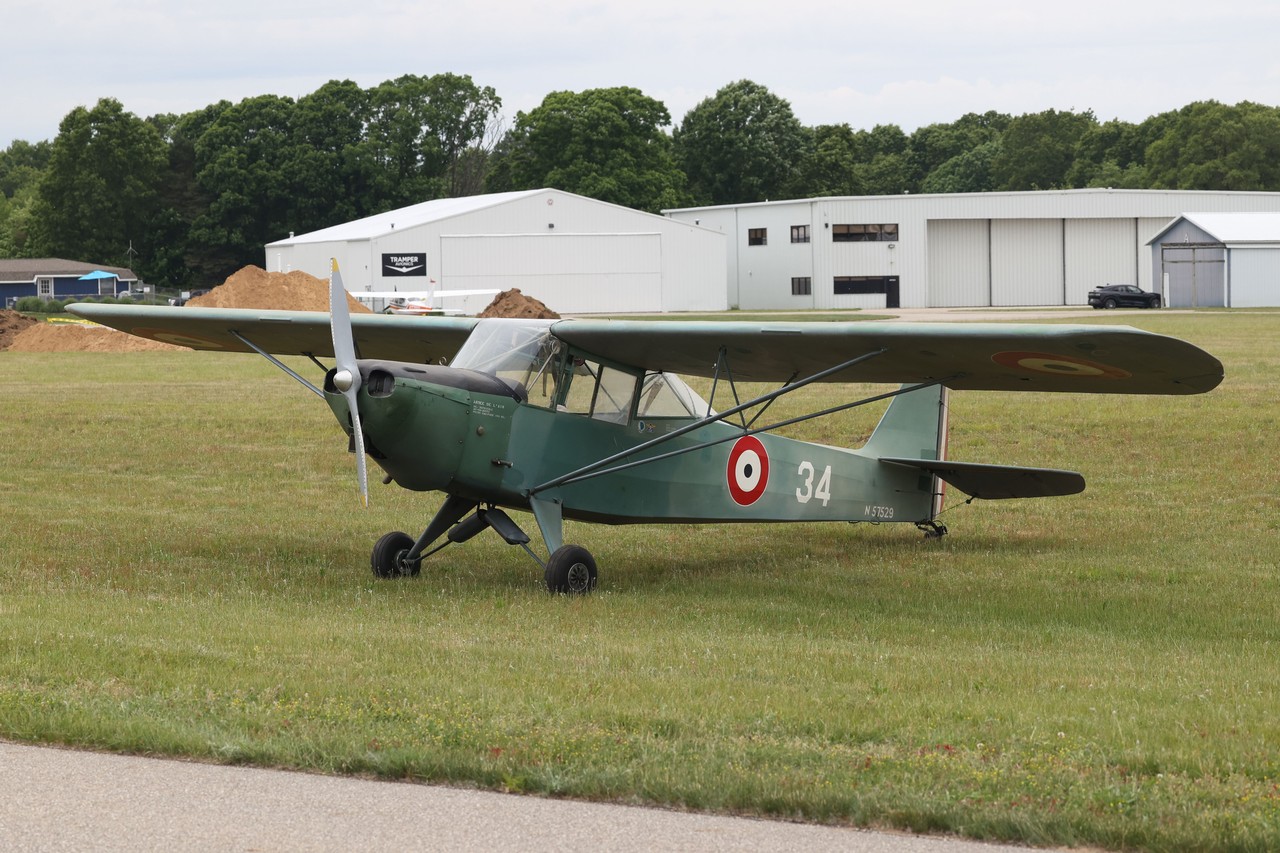
Military Service and the L-2 Grasshopper
The Model D's greatest contribution came through its military variant, the L-2 Grasshopper. Initially designated O-57 before the April 1942 redesignation, more than 1,726 L-2s served the U.S. Army Air Forces throughout World War II. These aircraft excelled in liaison duties, artillery spotting, and reconnaissance missions across all theaters of operation. The tandem seating arrangement, initially chosen to meet Civilian Pilot Training Program requirements, proved ideal for military observation work where the rear-seat observer needed an unobstructed view.
During 1941 Army maneuvers, the L-2 demonstrated outstanding performance despite initial military resistance to light aircraft in combat roles. The type's ability to operate from short, unprepared strips made it invaluable for forward observation posts and communication between ground units and headquarters.
The Taylorcraft Company Legacy
C. Gilbert Taylor founded the company as Taylor Aviation Company in Butler, Pennsylvania, in 1935 after his departure from what became Piper Aircraft. By 1937, production had moved to Alliance, Ohio, where the factory achieved an impressive output of 75 aircraft per month by 1938. W.C. Young's investment that same year provided crucial capital for expansion.
The company's trajectory took a devastating turn in 1946 when a factory fire in Alliance led to bankruptcy, effectively ending the original Taylorcraft era. However, Taylor's determination saw him acquire the company assets in 1949, reestablishing operations as Taylorcraft, Inc. in Conway, Pennsylvania. This resurrection proved short-lived, with only a small number of BC-12D and 85D models produced before Taylor sold the type certificates to Univair.
Design Philosophy and Innovation
C. Gilbert Taylor, a self-taught engineer, designed the Model D to compete directly in the lucrative Civilian Pilot Training Program market dominated by the Piper J-3 Cub. His approach involved adapting the successful side-by-side Model B's wings and tail surfaces to a new, nine-inch-longer fuselage configured for tandem seating. This clever engineering reduced development costs while creating an aircraft specifically tailored for training requirements.
The Model D incorporated several cost-saving innovations including simplified landing gear, an open cowl for easier maintenance access, and dual control sticks. The NACA 23012 airfoil provided gentle handling characteristics essential for student pilots, while the overall design emphasized economy and reliability over performance.
Engine and Technical Specifications
The standard DC-65 variant utilized the Continental A65-8, a four-cylinder horizontally opposed air-cooled engine producing 65 horsepower. This powerplant, driving a two-bladed fixed-pitch wooden propeller, proved exceptionally reliable in service. Alternative engine options included the Franklin 4AC-176 in the DF-65 variant and the Lycoming O-145-B2 in the DL-65, though the Continental remained the most popular choice.
The aircraft's 35-foot 5-inch wingspan provided excellent low-speed handling, while the 22-foot 9-inch length kept hangar requirements modest. The tandem cockpit arrangement placed both occupants under a single greenhouse canopy, maximizing visibility for training and observation missions.
Production Achievement and Variants
Taylorcraft's production success with the Model D was remarkable for a relatively small manufacturer. Civilian production began in February 1941, with approximately 200 units completed before military contracts dominated the production line. The total production run of 3,170 aircraft included 1,726 standard L-2s, plus 253 ST-100 and 250 TG-6 glider variants developed for U.S. Navy evaluation.
The company received its Type Approval on November 25, 1941, validating the design's airworthiness. This certification enabled both civilian sales and military procurement, establishing the foundation for the aircraft's widespread adoption.
Current Status and Legacy
From the 1,350 Model D aircraft on the civilian register in 1948, fewer than 250 remain airworthy today. This dramatic decline reflects the post-war aviation industry's shift toward side-by-side seating configurations exemplified by the BC-12 series. The surviving aircraft represent a vanishing link to the era when simple, economical designs could achieve both commercial success and military significance.
The Model D's influence extended internationally through licensing agreements, most notably with Taylorcraft Aeroplanes Ltd., established in Leicestershire, England, in 1938. This partnership led to the development of the Auster series, which served British and Commonwealth forces throughout World War II and beyond, demonstrating the fundamental soundness of Taylor's original design concept.