
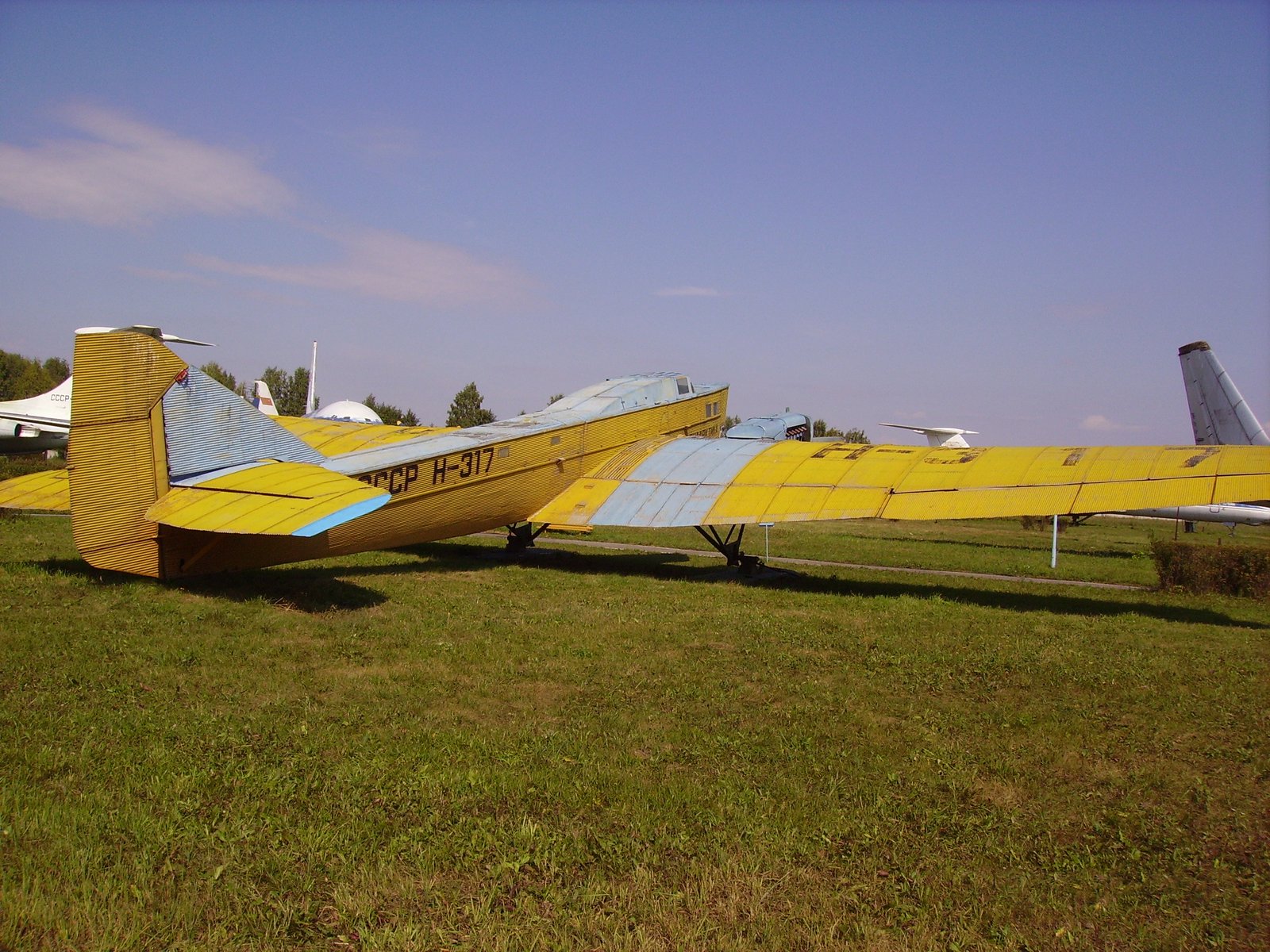
The Tupolev TB-1, designated as the ANT-4 by the design bureau, was a landmark achievement in Soviet aviation, serving as the first all-metal twin-engine heavy bomber to enter service in the USSR. Developed under the leadership of chief designer Andrei Nikolaevich Tupolev within the TsAGI (Central Aerohydrodynamic Institute) collective, the aircraft first flew in 1925. Its construction was highly influential, utilizing duralumin with corrugated skin and a semi-monocoque structure, a design approach that reflected contemporary German Junkers influence while adapting it to Soviet requirements.
Production of the TB-1 was concentrated in Moscow, primarily at State Aviation Plant No. 22 (GAS-22), with some additional production occurring in other Moscow-area or Nizhny Novgorod facilities. While the exact total number of airframes built is not firmly established in open sources, estimates generally range in the mid- to high-200s, including prototypes and civil conversions. Serial production for military bombers took place between 1929 and 1932. Historically, Plant No. 22 is linked to the industrial lineage of the Khrunichev State Research and Production Space Center, although the modern Khrunichev entity focuses on space systems rather than the TB-1.
Technically, the TB-1 was powered by two liquid-cooled inline piston engines. Early prototypes utilized imported BMW VI engines, while production models used Soviet-built versions designated as M-5 or M-17. These 12-cylinder V-type engines typically provided power in the 500–700 hp class per engine. The aircraft featured a crew of five to six, including a pilot, co-pilot, navigator, radio operator, and gunners. With a wingspan of approximately 28 meters and a length of 18 meters, it could reach a maximum speed of roughly 200–210 km/h and had a range of 1,000–1,200 km. Its military configuration included 7.62 mm machine guns in dorsal, ventral, and nose positions, and a bomb load of 1,000–2,000 kg, with some variants modified to carry torpedoes.
In service, the TB-1 operated with the Workers’ and Peasants’ Red Air Fleet and later the VVS RKKA. Beyond its role as a heavy bomber, it was converted for civil use by Dobrolet and Aeroflot, transporting 10–15 passengers or cargo to remote regions. It was particularly vital for arctic supply missions and polar exploration. By World War II, the TB-1 was largely obsolete and relegated to training and transport roles. Today, the legacy of the TB-1 is preserved through static exhibits, including a specimen at the Central Air Force Museum at Monino.