
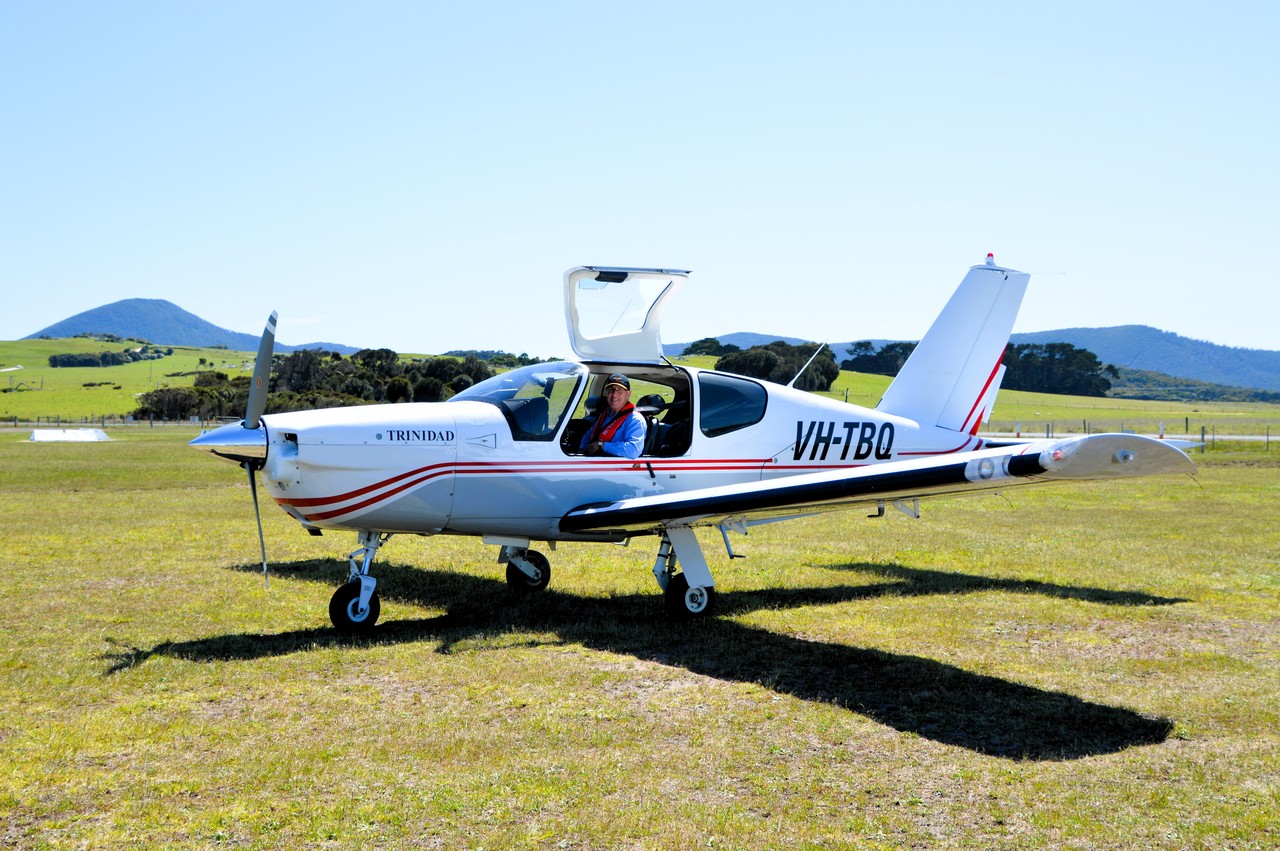
Design Excellence from France
The TB-20 Trinidad emerged as the flagship of SOCATA's ambitious Caribbean series, which debuted at the 1977 Paris Air Show. Engineers at the French manufacturer designed four related aircraft—the TB-9 Tampico, TB-10 Tobago, TB-20 Trinidad, and TB-21TC turbocharged Trinidad—sharing common fuselage, wing, and empennage components to maximize production efficiency. The Trinidad represented the pinnacle of this family, featuring retractable landing gear and positioning itself as a sophisticated European alternative to American singles like the Piper Arrow and Cessna 182RG.
SOCATA's design team emphasized modern aerodynamics and cabin comfort, incorporating sleek European styling with distinctive features including a forward-swinging canopy and gullwing doors. The aircraft's monocoque construction with reinforced glass fiber cabin required only 600 man-hours per airframe, demonstrating remarkable manufacturing efficiency for its era.
Certification and Market Entry
French certification authorities approved the TB-20 in December 1981, with production commencing immediately at SOCATA's Tarbes facility. The aircraft earned its name from this location—"TB" standing for "Tarbes Built." American pilots received their first opportunity to purchase the Trinidad following FAA certification in 1984, with initial U.S. deliveries occurring in late summer 1983.
The Trinidad filled a specific niche in general aviation, offering performance between traditional single-engine aircraft and light twins. Its spacious cabin accommodated five occupants while maintaining the operational simplicity of single-engine flight, appealing particularly to owner-pilots including physicians, engineers, and business professionals requiring reliable IFR cross-country capability.
Manufacturing Heritage
SOCATA's lineage traced back to the legendary Morane-Saulnier Company, founded in 1911 by aviation pioneers Léon Morane and Raymond Saulnier. This heritage company merged into Sud Aviation in 1966, then became part of Aérospatiale in the late 1960s, with the general aviation division operating as SOCATA (Société de Construction d'Avions de Tourisme et d'Affaires). Through subsequent aerospace industry consolidations, Aérospatiale merged into EADS (now Airbus), before SOCATA found its current home with the Daher group, operating today simply as Daher.
Powerplant and Performance
The Trinidad's impressive performance stemmed from its Lycoming IO-540-C4D5D engine, a fuel-injected six-cylinder powerplant displacing 541.5 cubic inches and producing 250 horsepower. This Textron-manufactured engine, featuring dual fuel pumps and smooth injection systems, provided the reliability essential for serious IFR operations. Overhaul intervals extended to 2,000 hours or 12 years, offering excellent operational economics.
With its constant-speed propeller, the TB-20 achieved cruise speeds between 152 and 163 knots while consuming 12.5 to 15.9 gallons per hour at typical power settings. The aircraft's 88.8-gallon fuel capacity enabled ranges approaching 1,200 nautical miles, making it suitable for extended cross-country flights. Service ceiling reached 20,000 feet, with initial climb rates of 1,180 to 1,200 feet per minute.
Pilot Experience
Pilots praised the Trinidad's European refinement and solid cross-country performance. The aircraft rotated at 68 KIAS, with optimal climb speeds of 95 KIAS and stall characteristics beginning at 59 KIAS in landing configuration. Wing loading of 24.1 pounds per square foot and power loading of 12.3 pounds per horsepower provided balanced handling characteristics appreciated by instrument-rated pilots.
The spacious cabin, a hallmark of the Caribbean series design philosophy, offered comfort levels uncommon in single-engine aircraft of the era. Maximum useful load exceeded 1,080 pounds in most configurations, allowing full fuel and four occupants for typical missions.
Production Legacy
SOCATA continued TB-20 production through the early 2000s, with variants like the Trinidad GT accepting orders around 2000. While exact Trinidad production numbers remain unspecified, approximately 1,750 aircraft from the entire Caribbean series reached completion by the mid-1990s, representing significant success for a European manufacturer entering the American-dominated general aviation market.
Many TB-20s remain active today, valued for their durability and low corrosion risk. Recent market listings show well-maintained examples, such as a 1985 aircraft with serial number 487 accumulating 2,461 hours while maintaining excellent condition. This longevity demonstrates the fundamental soundness of SOCATA's design and manufacturing quality.
The Trinidad's significance extends beyond mere production numbers, representing France's successful entry into high-performance single-engine aviation during an era of American market dominance. Its blend of European styling, advanced aerodynamics, and reliable performance established benchmarks for international general aviation manufacturers seeking to compete with established American designs.