
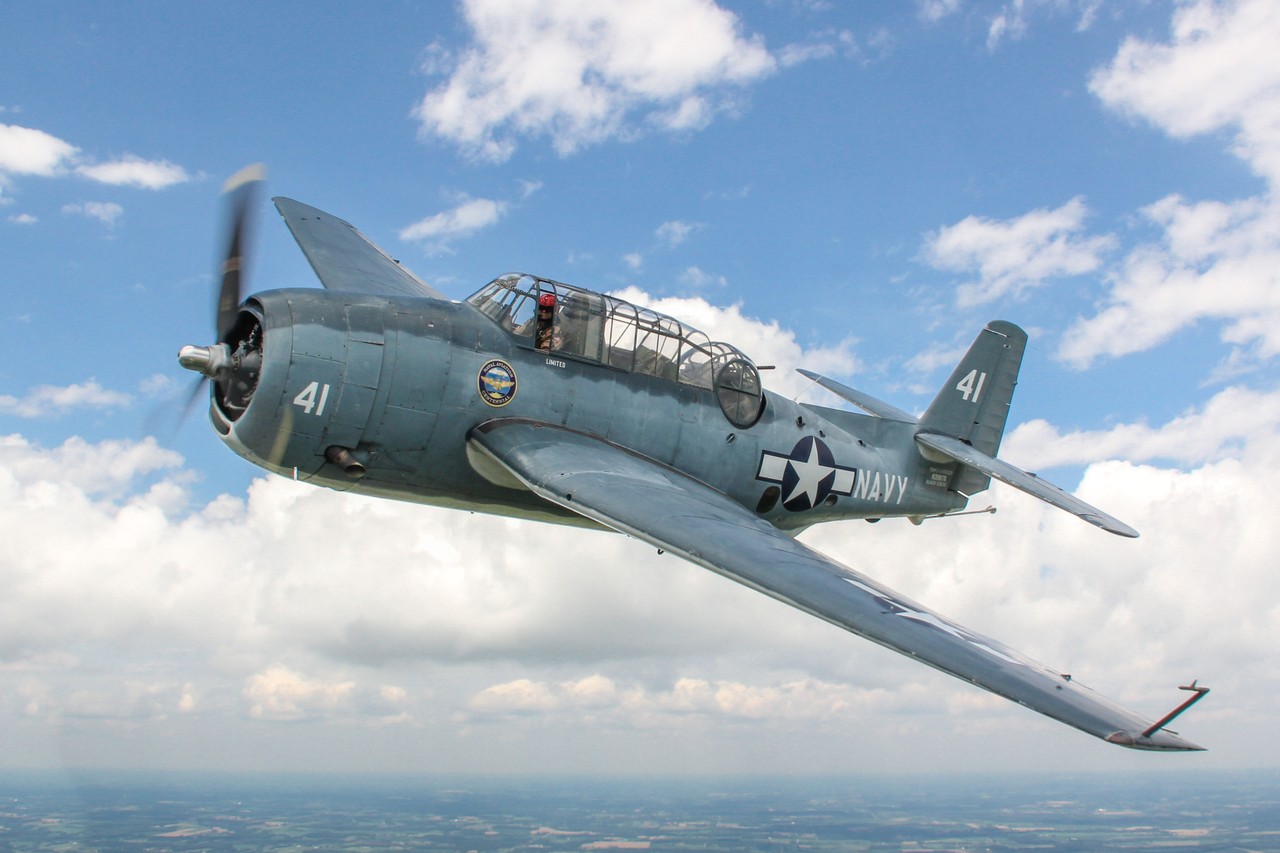
Combat Debut and Early Service
The Avenger entered combat at the Battle of Midway in June 1942 with devastating initial results. Six TBF-1s from Torpedo Squadron Eight (VT-8) launched an unescorted attack against the Japanese fleet, with five aircraft shot down and only one returning to base. Despite this inauspicious beginning, the Avenger quickly proved its worth as American pilots developed better tactics and gained fighter escort support.
Throughout the Pacific Theater, Avengers became the backbone of carrier-based torpedo and dive bombing operations. The aircraft's large internal bomb bay could accommodate either a single Mark 13 torpedo weighing 2,000 pounds or up to 2,500 pounds of conventional bombs. Beyond its primary strike role, variants equipped with radar served in reconnaissance and later as airborne early warning platforms, extending the Navy's surveillance capabilities.
Notable Service Members
Future President George H.W. Bush flew TBM Avengers as the youngest naval aviator in 1944 at age 20. On September 2, 1944, Bush's aircraft was shot down during an attack on Chichijima Island, but he was rescued by the submarine USS Finback after parachuting into the Pacific. His experience exemplified the dangerous missions flown by thousands of young Avenger crews throughout the war.
Manufacturing Marvel
Leroy Grumman's design team created the Avenger to meet stringent Navy requirements for a carrier-based torpedo bomber. The aircraft featured innovative hydraulic wing-folding mechanisms, allowing efficient storage aboard aircraft carriers. Grumman's "Sto-Wing" technology, previously developed for the F4F Wildcat, was adapted with hydraulic actuation for the larger Avenger.
Production began at Grumman's facilities, but the company's focus shifted to manufacturing F6F Hellcat fighters in 1942. General Motors' Eastern Aircraft Division took over Avenger production, re-engineering the design for assembly-line manufacturing. The automotive giant's plant in Ewing, New Jersey, near Trenton-Mercer Airport, became the primary production center, with sub-assemblies manufactured in Tarrytown, Baltimore, and Bloomfield facilities.
Production Variants and Technical Evolution
Of the 9,837 to 9,900 total Avengers built, Grumman produced 2,291 TBF models while General Motors manufactured 7,546 TBM variants—representing approximately 75 percent of total production. The TBF-1 was the initial production model, followed by the TBF-1C which incorporated additional fuel tanks in the wings, effectively doubling the aircraft's range to over 1,000 miles.
The TBM-3 became the most numerous variant with 4,600 examples built, featuring the more powerful Wright R-2600-20 Cyclone engine, additional armor protection, wing-mounted rockets, and radar equipment. These improvements transformed the Avenger from a simple torpedo bomber into a versatile multi-role aircraft.
Engine and Performance
All Avengers were powered by Wright R-2600 Cyclone 14-cylinder radial engines, manufactured by Wright Aeronautical. This reliable powerplant, developed in the late 1930s, proved well-suited for demanding carrier operations. The supercharged engine enabled the TBM-3 to achieve maximum speeds of approximately 275 miles per hour, with a service ceiling exceeding 30,000 feet.
The three-man crew consisted of a pilot, radioman/bombardier who also operated the ventral gun position, and a dorsal turret gunner. Defensive armament included forward-firing .50-caliber machine guns, a powered dorsal turret, and a ventral gun position for protection against fighter attacks.
Grumman Aircraft Legacy
Grumman Aircraft Engineering Corporation, founded in 1929, established itself as a premier naval aircraft manufacturer through innovative designs like the Avenger. The company continued operations until 1994, when it merged with Northrop to form Northrop Grumman, which remains a major aerospace contractor today. Grumman's folding-wing expertise and robust construction techniques became hallmarks of successful carrier aircraft design.
Post-War Service and Preservation
Avengers continued serving with the U.S. Navy into the 1960s, transitioning from front-line combat aircraft to training and utility roles. The type saw limited use in naval reserve squadrons as advanced trainers before retirement from military service.
Today, dozens of Avengers remain airworthy worldwide, maintained by private owners and museums. Notable examples include TBM-3E BuNo. 53454 at the Military Aviation Museum in Virginia Beach, Virginia, delivered on May 26, 1945. These survivors serve as flying monuments to the aircraft that helped secure Allied victory in the Pacific, carrying forward the legacy of the young airmen who flew dangerous missions in defense of freedom.