
Design and Development
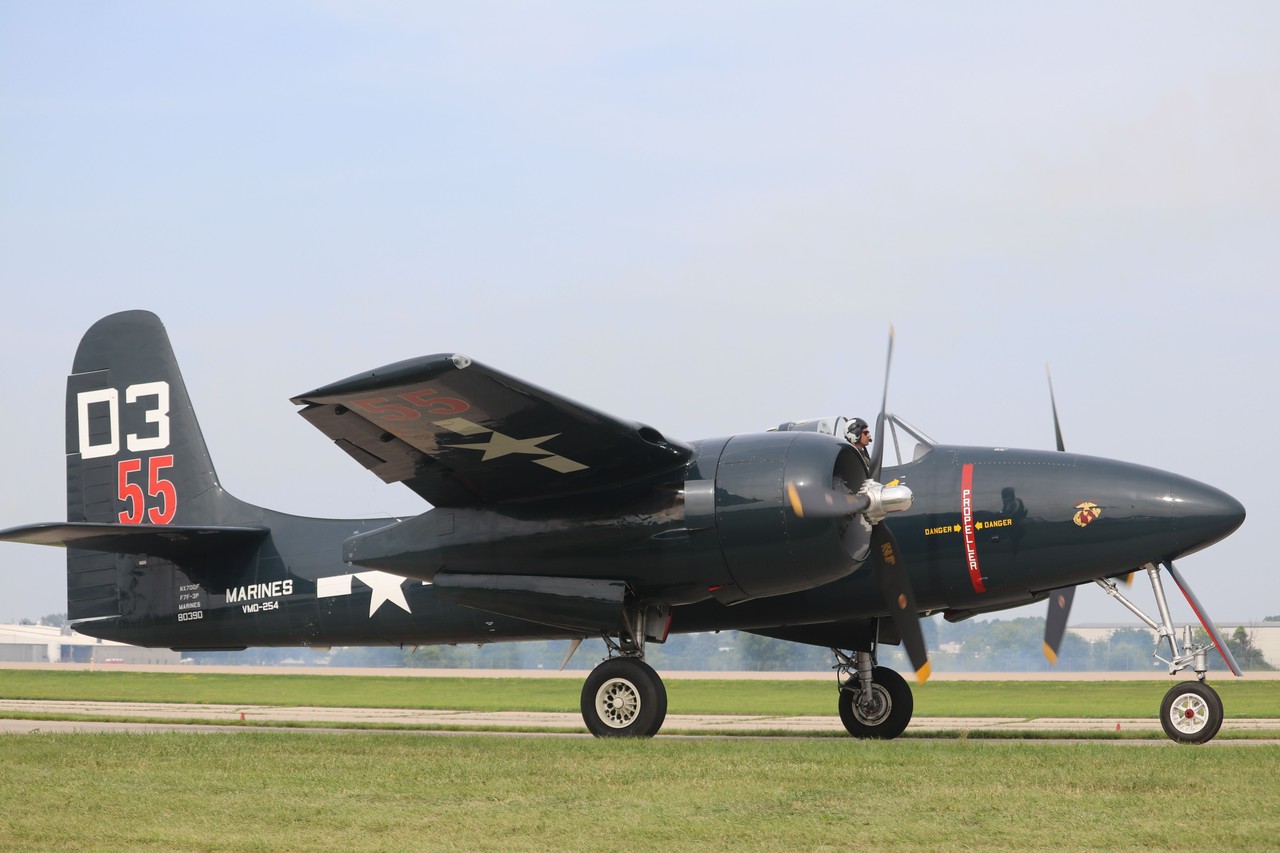
The F7F Tigercat emerged from Grumman's ambitious vision to create a carrier-based fighter-bomber capable of devastating ground attacks while maintaining air superiority. Led by chief engineer Leroy Grumman and project engineer Bob Hall, the design team built upon lessons learned from their earlier XF5F-1 Skyrocket twin-engine fighter. The aircraft featured revolutionary tricycle landing gear, stubby wings optimized for carrier operations, and formidable armament consisting of four 20mm cannons and four .50-caliber machine guns.
Two prototype XF7F-1 aircraft were constructed, with the first taking flight on December 2, 1943. The design objectives centered on operations from the new Midway-class carriers, providing the Marine Corps with a powerful platform for Pacific theater ground support missions.
Production History
Production began in April 1944 at Grumman's Bethpage, New York facility, continuing until late 1946. Despite initial Navy orders for 1,500 aircraft and a Marine Corps contract for 500, the war's end led to significant cancellations. Only 365 Tigercats were ultimately completed across six major variants.
The first 34 aircraft were F7F-1 single-seat fighter-bombers, delivered beginning April 29, 1944. Production then shifted to the F7F-2N two-seat night fighter variant, with 65 built. The most numerous version proved to be the F7F-3 single-seat fighter-bomber, with 189 manufactured featuring upgraded R-2800-34W engines. Sixty F7F-3N night fighters followed, while only 13 F7F-4N carrier-capable night fighters with arresting hooks were completed.
Powerplant
Twin Pratt & Whitney R-2800 Double Wasp radial engines powered the Tigercat, each producing 2,100 horsepower in later variants. These air-cooled 18-cylinder double-row radials represented the pinnacle of piston engine technology, featuring exceptional reliability and power-to-weight ratios. The R-2800 series, which entered production in 1940, ultimately saw over 125,000 engines manufactured across all variants, powering iconic aircraft including the P-47 Thunderbolt.
Military Service
Despite its wartime development, the F7F arrived too late for World War II combat operations. Marine squadrons VMF-312 and VMF-324 reached Okinawa on August 13, 1945, just as hostilities ended. The aircraft's intended carrier operations proved problematic due to structural issues and deck length requirements, relegating most Tigercats to land-based operations.
The Korean War from 1950 to 1953 provided the Tigercat's combat debut. Operating primarily from land bases, F7F squadrons conducted ground support missions and night interdiction operations. Specialized variants included the F7F-3P photo reconnaissance version and F7F-3E electronic reconnaissance variant, expanding the aircraft's operational flexibility beyond pure fighter-bomber roles.
The Manufacturer
Grumman Aircraft Engineering Corporation operated from 1929 to 1967, establishing itself as a premier naval aircraft manufacturer. The company pioneered carrier aviation with legendary designs including the F4F Wildcat and TBF Avenger, emphasizing the durability and reliability essential for naval operations. Grumman merged with Northrop in 1994, forming Northrop Grumman Corporation, which remains a major defense contractor today.
Performance and Specifications
The Tigercat measured 45 feet 4 inches in length with a 51-foot 6-inch wingspan and stood 16 feet 7 inches tall. Its 435 square feet of wing area provided excellent maneuverability despite the aircraft's substantial 25,720-pound maximum takeoff weight. Performance figures included a maximum speed of 460 mph, service ceiling of 40,354 feet, and range of 1,181 miles. The aircraft's impressive climb rate of 4,530 feet per minute demonstrated the power available from its twin R-2800 engines.
Legacy and Preservation
Approximately eight airworthy F7F Tigercats remain active today, testament to the aircraft's robust construction and enduring appeal among warbird enthusiasts. Notable examples include an F7F-3N displayed at the Planes of Fame Air Museum in Chino, California, and an F7F-3 preserved at the Pima Air & Space Museum.
The Tigercat's historical significance extends beyond its limited production numbers. As the world's first production twin-engine carrier fighter featuring tricycle landing gear, it influenced post-war naval aviation development and demonstrated Grumman's innovative approach to military aircraft design. Though it missed extensive combat service, the F7F represented a crucial evolutionary step in carrier-based aviation technology.