
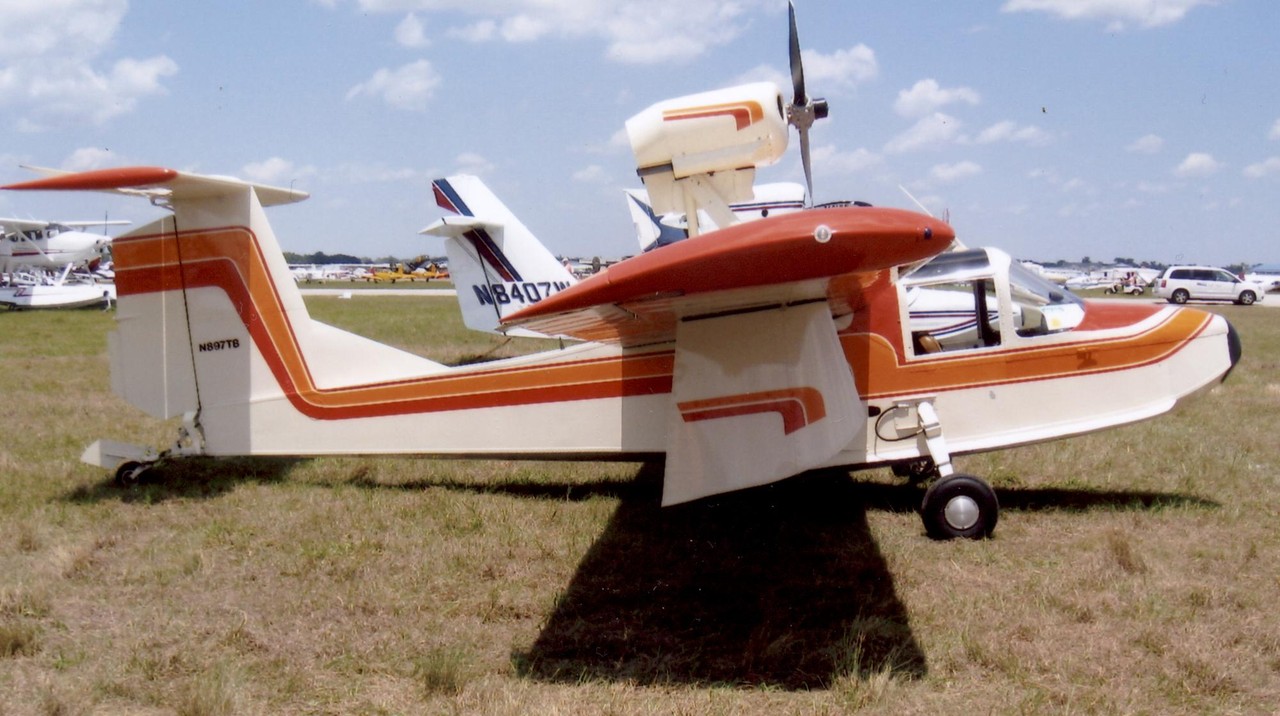
Design and Development
David B. Thurston conceived the TSC-1 Teal following his successful work on the Grumman G-65 and Colonial Skimmer amphibians. His design philosophy centered on creating an affordable, all-metal amphibian for recreational pilots who wanted the versatility of land and water operations. The prototype TSC-1, registered N1968T and carrying construction number 1, made its maiden flight in June 1968 from Thurston Aircraft's facility in Sanford, Maine.
The Teal's distinctive T-tail configuration and cantilever wing design set it apart from contemporary amphibians. Thurston employed a semi-monocoque aluminum fuselage with fiberglass foredeck and cabin top, combining structural efficiency with manufacturing practicality. The aircraft featured D-spar metal wings, steel-spring main landing gear, and an integral tailwheel that doubled as a water rudder. This innovative approach earned the aircraft its type certificate on August 28, 1969.
Production History
Thurston Aircraft Corporation began production with 15 TSC-1A models and three TSC-1A1 variants, upgrading six earlier TSC-1As during the process. The first production aircraft, N2002T construction number 2, was delivered at the end of 1969, marking the beginning of commercial operations. Financial pressures forced Thurston to sell the design rights to Schweizer Aircraft Corporation in early 1972.
Schweizer, renowned for their all-metal sailplane construction expertise, relocated production to Elmira, New York, and built 12 TSC-1A2 Teal II aircraft between 1972 and 1976. These later models featured slotted flaps, increased gross weight to 2,200 pounds for both land and water operations, and an extended wingspan. When Schweizer decided to focus on their core sailplane business, they sold the Teal project to Teal Aircraft Corporation in 1976.
Teal Aircraft Corporation, initially based in Markham, Ontario, before moving to St. Augustine, Florida, produced seven Marlin 150 variants. However, financial difficulties halted production permanently after construction number 38, ending the Teal's manufacturing run at just 38 aircraft over seven years.
Engine and Performance
All Teal variants were powered by the Lycoming O-320-A3B, a 150-horsepower four-cylinder horizontally-opposed air-cooled engine. This powerplant, part of Lycoming's successful O-320 family that has seen over 100,000 units produced since the 1950s, provided reliable operation essential for amphibious aircraft operations. The flat-four configuration offered smooth running characteristics and proven durability in marine environments.
The early TSC-1 models carried 20 Imperial gallons of fuel in a single tank, while the improved TSC-1A1 featured two 19-gallon wing tanks for extended range. The aircraft's gross weight varied by variant, with the TSC-1A1 certified at 2,200 pounds on land and 2,100 pounds for water operations, reflecting the additional structural loads imposed by water landings.
Notable Aircraft and Operations
Several Teal aircraft gained distinction through unique ownership or circumstances. Aircraft N2011T, later re-registered as N501ME, was purchased by Apple Records in July 1970 for delivery to the Beatles in the Bahamas. The band's breakup in 1970 cancelled these plans, leaving the aircraft stored at the Thurston factory for decades. In 2022, the aircraft was donated to the Massachusetts Air and Space Museum in Mansfield, Massachusetts, where pilot Mike DuPont flew it to its new home.
Another notable example, VH-AMU construction number 28, was assembled and test-flown in Camden, New South Wales, in 1974. Registered to Keith Woodward Pty Ltd, this aircraft operated from Bathurst until Cyclone Alby destroyed it at Albany on April 4, 1978. The wreckage was subsequently exported to Norway for parts recovery.
The Manufacturer Legacy
Thurston Aircraft Corporation, established in 1966, operated for less than a decade before financial pressures ended its independence. Schweizer Aircraft Corporation, which assumed production, was itself acquired by Sikorsky in 2000 and later became part of Lockheed Martin. In the mid-1990s, International Aeromarine of Fort Erie, Ontario, acquired rights to rebuild existing Teals and marketed the improved Teal 3 with tricycle landing gear.
David Thurston continued his amphibian design work, creating the TA-16 Seafire prototype in 1982. This larger aircraft featured a 250-horsepower Lycoming O-540 engine but remained a one-off design, later offered in kit form as the Trojan.
Current Status
Of the 38 Teals constructed, at least one example remained airworthy as of 2022. The small production run and specialized nature of amphibian operations have made surviving Teals rare and valuable among vintage aircraft enthusiasts. The type represents an important chapter in American light amphibian development, bridging the gap between larger commercial flying boats and modern light sport amphibians.