
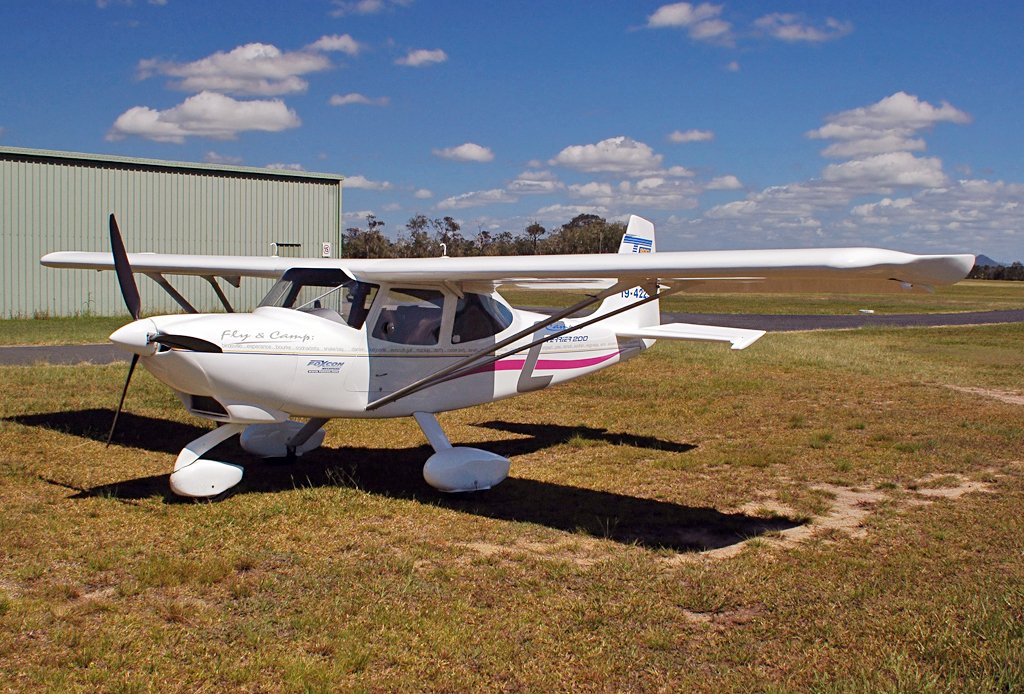
The Manufacturer
Foxcon Aviation & Research Pty Ltd emerged in 1995 under the leadership of designer Helmut Kley, who recognized the potential for transforming traditional aircraft construction through advanced composite materials. Based in Mackay, Queensland, the company established itself with a clear mission: manufacturing extremely competitive high-performance light aircraft at affordable prices. Kley's vision centered on taking an original Terrier lightplane design and completely redesigning it using modern composite construction methods, incorporating climate-controlled vacuum bag molding capability and sophisticated sandwich construction molding jigs.
Design Evolution and Technical Innovation
The Terrier's development represented a significant leap from conventional aluminum construction to advanced composites. Kley's redesign utilized vacuum-molded composite materials specifically engineered for maximum strength at minimum weight, a philosophy that would define the aircraft's performance characteristics. The wing incorporates a Chris Mark 4 airfoil across its 8.7-meter span, with integrated flaps to enhance low-speed handling characteristics crucial for light-sport aircraft operations.
The aircraft's configuration follows proven design principles: a strut-braced high-wing layout provides excellent stability and ground handling, while the fixed tricycle landing gear simplifies operations for recreational pilots. The enclosed cockpit houses two occupants side-by-side, with the Terrier 200C variant featuring innovative bench seats that fold into a 200 by 105-centimeter bed for camping operations.
Production History and Variants
Foxcon Aviation launched production with the Terrier 100 in the late 1990s, establishing the all-composite, two-seat configuration that would define the series. The current Terrier 200, manufactured at the company's Seaforth facility near Mackay, represents the evolution of this design philosophy with refined systems and expanded engine options.
The Terrier 200C addresses a unique market niche with its convertible seating arrangement, transforming the aircraft into a camping platform for remote-area operations. Optional float equipment further expands operational capability, allowing water-based operations that capitalize on Australia's extensive coastline and inland waterways.
Development continues with the four-seat Terrier 400, though this variant has not yet entered production. This larger aircraft represents Foxcon's ambition to expand beyond the light-sport category while maintaining the composite construction expertise that defines the company.
Engine Configuration and Performance
The Terrier's powerplant selection reflects the evolution of light aircraft propulsion over two decades. Initial 2012 offerings included four engine options: the 80-horsepower D-Motor LF26, 100-horsepower Rotax 912ULS, 100-horsepower Subaru EA 81, and 116-horsepower Lycoming IO-233-LSA. By 2015, market demands had narrowed the selection to two proven powerplants: the Subaru EA 81 and Rotax 912ULS, both producing 100 horsepower.
The standard Subaru EA 81 represents an innovative approach to aircraft propulsion, adapting automotive technology for aviation use. This four-cylinder, liquid-cooled, four-stroke engine produces 75 kilowatts (101 horsepower) while offering the reliability and parts availability associated with automotive powerplants. The liquid cooling system provides consistent operating temperatures crucial for composite airframe longevity.
Operational Characteristics
With an empty weight of 340 kilograms and maximum gross weight of 600 kilograms, the Terrier 200 provides a useful load of 260 kilograms, accommodating two occupants plus 88 liters of fuel capacity. The aircraft's dimensions—6.10 meters long, 8.7 meters wingspan, and 2.30 meters high—position it ideally within light-sport aircraft regulations while maximizing internal volume.
The Terrier's compliance with US light-sport aircraft rules opens international markets while maintaining operational simplicity. Pilots appreciate the aircraft's stable handling characteristics derived from its high-wing configuration and the reliability of automotive-derived propulsion systems.
Current Status and Legacy
Foxcon Aviation continues production from its Queensland facility, with examples registered in Australia and New Zealand. Company founder Helmut Kley operates registration VH-ULI, demonstrating continued confidence in his design. The aircraft represents a successful transition from traditional construction methods to modern composite techniques within the recreational aviation market.
The Terrier's significance extends beyond its individual success to represent the broader transformation of light aircraft manufacturing. By proving that advanced composite construction could be economically viable for small-scale production, Foxcon Aviation established a template that numerous manufacturers would subsequently follow. The company's persistence in developing this technology, maintaining production for nearly three decades, demonstrates the viability of specialized composite aircraft manufacturing in the modern aviation market.