
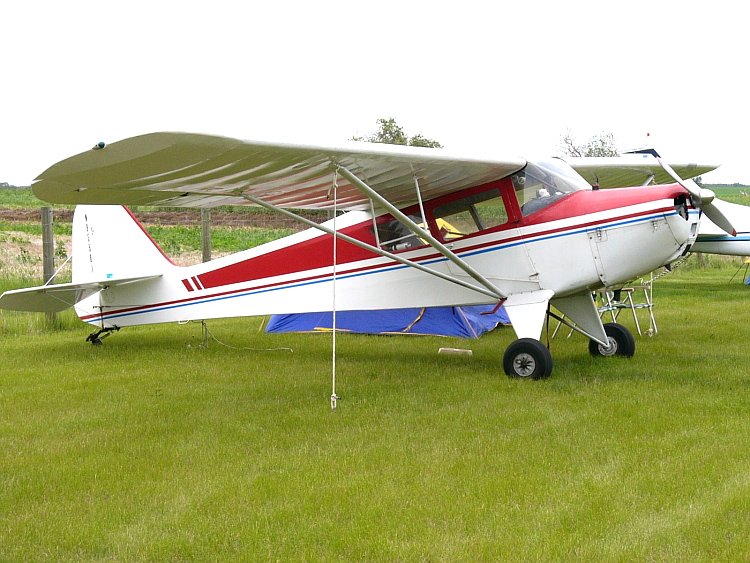
Revival of a Classic Design
The F-21 emerged during a challenging period for general aviation, representing Charles Feris's ambitious attempt to modernize the beloved Taylorcraft formula. When Feris acquired the Taylorcraft type certificates in 1971, he established operations in Alliance, Ohio, drawing upon veteran engineers and craftsmen from C.G. Taylor's original company. The F-21 evolved directly from the earlier F-19 Sportsman, incorporating lessons learned from decades of light aircraft operations.
Production and Variants
Taylorcraft Aviation Corporation manufactured three distinct F-21 variants between 1980 and 1990. The original F-21 accounted for 22 aircraft built from 1980 to 1985, followed by six F-21A models produced between 1982 and 1984. The final iteration, the F-21B, saw 15 examples completed from 1985 to 1990, featuring enhanced capabilities including wing-mounted fuel tanks and a higher 1,750-pound gross weight.
The Alliance factory employed traditional "rag and tube" construction methods, utilizing a welded steel tube fuselage framework covered with fabric. This time-tested approach kept manufacturing costs manageable while providing the structural durability essential for bush operations and rough-field work.
The Taylorcraft Legacy
Taylorcraft's heritage traced back to 1935 when Clarence Gilbert Taylor founded the original company in Lock Haven, Pennsylvania. The wartime years brought significant production with models like the DCO-65 L-2 Grasshopper serving military training and liaison roles. Despite producing thousands of aircraft, including 356 Model A examples in 1937 alone, the original company faced bankruptcy in the post-war transition.
The corporate lineage passed through multiple hands before reaching Charles and Dorothy Feris in 1971. Their Alliance operation successfully produced the F-19 series before developing the more powerful F-21. When Aircraft Acquisition Corporation assumed control in November 1989, production was already winding down. The Alliance facility finally closed in 1994, though the type certificates eventually found their way to Harry Ingram's Taylorcraft Aviation in La Grange, Texas, by 2002.
Engineering and Performance
The F-21's Textron Lycoming O-235-L2C engine delivered 118 horsepower through a six-foot Sensenich 72CK-O-50 fixed-pitch metal propeller. This powerplant, part of the venerable O-235 series that entered production in the late 1940s, provided the reliability essential for utility operations while enabling a competitive 125-mph maximum speed.
The F-21B variant demonstrated impressive capabilities for its class, achieving a 750-foot-per-minute climb rate and requiring only 425 feet for takeoff and landing over a 50-foot obstacle. With 42 gallons of wing-mounted fuel, the aircraft delivered a 732-mile range at 75 percent power. The airframe utilized the NACA 23012 airfoil and incorporated hydraulic brakes, representing significant modernization over earlier Taylorcraft designs.
Operational Service
Unlike its wartime predecessors, the F-21 served exclusively in civilian roles as a private touring and utility aircraft. The type attracted pilots seeking affordable, rugged performance similar to Maule designs but with classic Taylorcraft handling characteristics. Optional equipment included Aqua Model 1500 floats, expanding operational versatility for bush operations.
By 2014, 34 F-21s remained active on the U.S. Civil Register, comprising 18 original F-21s, three F-21As, and 13 F-21Bs. One notable example, a 1988 model, found an unusual home as a display prize at the Stardust Casino in Las Vegas. International operations remained limited, though VH-OSF reached Australia in 1986, arriving at Jandakot Airport, Perth.
Design Philosophy
The F-21 embodied Feris's vision of combining 1980s technology with proven 1940s design principles. The development team included "Taylorcraft old timers" who brought decades of experience from C.G. Taylor's original organization. Their objective centered on creating an affordable, dependable aircraft capable of handling both recreational flying and serious utility work.
Innovations included metal belly skinning on later variants, new wing spar designs, and structural enhancements that permitted higher gross weights. The F-21B's 1,750-pound maximum takeoff weight and 200-pound baggage capacity reflected these improvements while maintaining the fundamental high-wing, conventional-gear configuration that defined the Taylorcraft identity.
Legacy and Continuing Influence
The F-21's limited production run of 43 aircraft reflected broader challenges facing general aviation manufacturers during the 1980s liability crisis. Despite modest numbers, the type succeeded in preserving Taylorcraft's engineering heritage and demonstrating continued demand for traditional, affordable light aircraft.
Taylor Kits of West Virginia marketed homebuilt versions during the 1990s, extending the design's influence into the experimental aircraft community. The type certificates remain active under modern Taylorcraft Aviation management, ensuring parts availability and technical support for remaining examples. This ongoing stewardship reflects the enduring appeal of C.G. Taylor's original vision, adapted for contemporary pilots seeking authentic flying experiences in an increasingly complex aviation environment.