
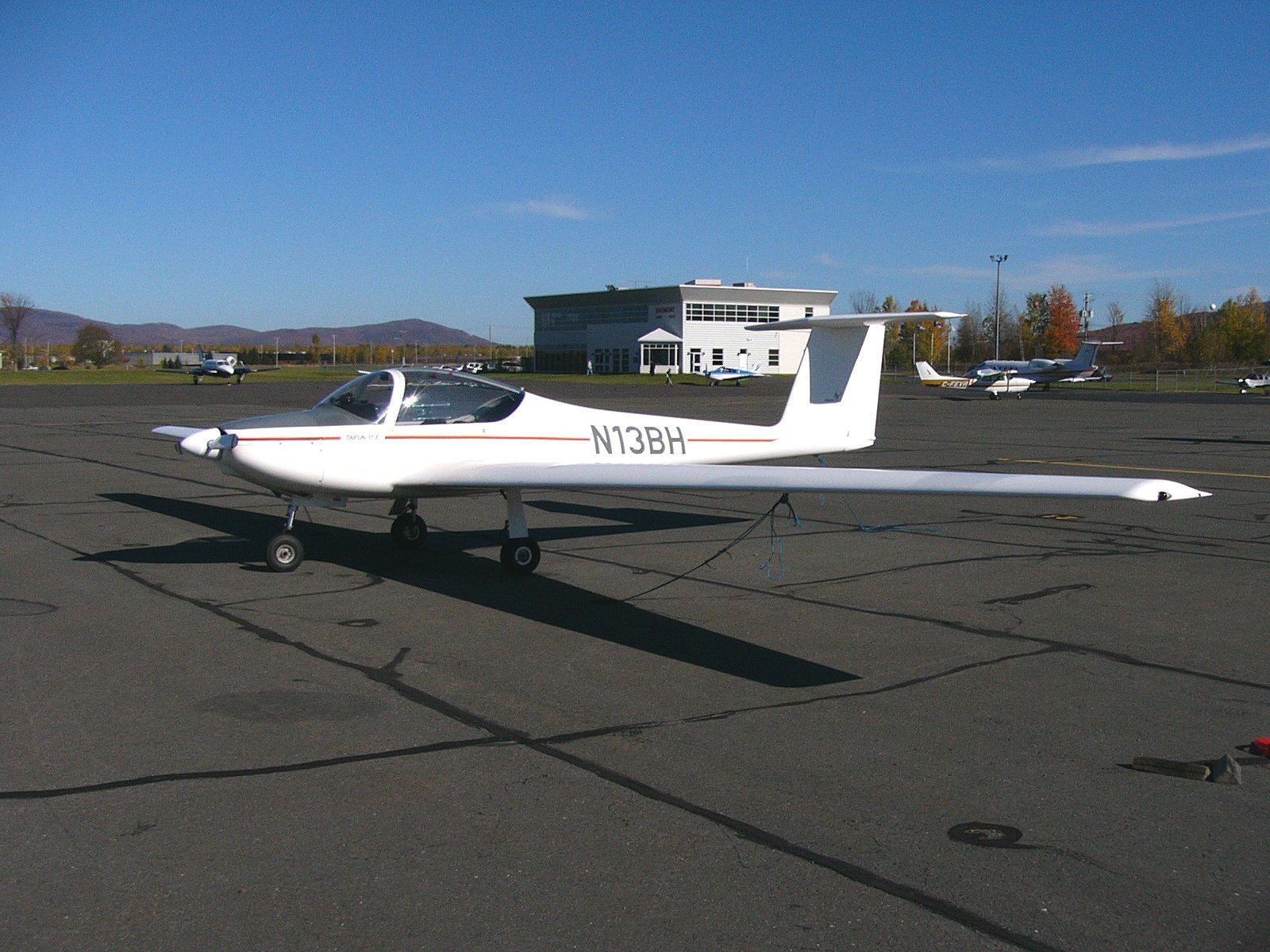
Development and Design Philosophy
The Taifun emerged during the early 1980s as Valentin Flugzeugbau GmbH sought to create the ideal touring motor glider (TMG) for European soaring enthusiasts. The company's engineers designed the aircraft around a simple premise: deliver the soaring performance of a competition sailplane while providing the independence of powered flight. This dual capability would revolutionize personal soaring by allowing pilots to launch without ground crew or tow aircraft.
The prototype D-KONO took to the skies on February 28, 1981, showcasing an innovative all-composite construction that was still relatively uncommon in the gliding world. The design team chose a low-wing cantilever configuration with a distinctive T-tail, which provided excellent control authority during both powered and soaring flight while keeping the horizontal stabilizer clear of propeller wash.
Technical Innovation and Performance
The Taifun's most remarkable achievement was its ability to match pure glider performance while retaining practical powered flight capabilities. With its 17-meter wingspan and Wortmann FX-67-K-170 airfoil section, the aircraft achieved a glide ratio of 30:1 at 105 km/h—performance that rivaled dedicated competition sailplanes of the era. The minimum sink rate of just 0.95 m/s at 75 km/h allowed pilots to exploit the weakest thermal activity.
Powered performance proved equally impressive. Early production aircraft featured the 80-horsepower Limbach L2000EB engine, a Volkswagen-derived flat-four that provided reliable service while maintaining the aircraft's clean aerodynamic lines. Later variants upgraded to the 90-horsepower Limbach L2400EB, and some Taifun 17E II models could accommodate the more modern Rotax 914 engine. The nose-mounted powerplant drove a 1.6-meter Mühlbauer MTV-1-A variable-pitch propeller that could feather completely for soaring flight.
With power available, the Taifun could cruise at 220 km/h and achieve a remarkable range of 1,250 kilometers. The aircraft's 90-liter fuel capacity provided excellent endurance for cross-country touring, while its 5,000-meter service ceiling opened up high-altitude wave soaring opportunities.
Production Variants and Evolution
Valentin produced four distinct variants during the Taifun's production run. The main Taifun 17E formed the backbone of production with its 17-meter wingspan and Limbach engine installation. The improved Taifun 17E II, also known as the WI Taifun 17 EII, incorporated hydraulic landing gear operation and Schempp-Hirth airbrakes, along with the option for Rotax powerplant installation.
The company also developed a Taifun 12E variant with a reduced 12-meter wingspan that qualified the aircraft for the light aircraft category. Only two examples of this shorter-span model were built, as most customers preferred the superior soaring performance of the full-span version. An ambitious Taifun 11S project envisioned a four-seat touring aircraft with fixed landing gear and a Lycoming O-235 engine, but this variant never progressed beyond the planning stage.
Operational Success and Pilot Appeal
The Taifun found its primary market among private pilots and soaring clubs seeking the ultimate cross-country machine. Its side-by-side seating arrangement made it ideal for instruction and passenger flights, while the folding wing design allowed convenient hangar storage alongside conventional aircraft. The manually retractable tricycle landing gear provided excellent ground handling characteristics compared to the tailwheel configuration common on many motor gliders.
Pilots praised the Taifun's docile handling qualities and impressive structural strength, with design limits of +5.3/-2.65 g allowing confident thermaling and aerobatic maneuvering. The never-exceed speed of 250 km/h in smooth air (reduced to 185 km/h in turbulence) provided adequate margins for high-speed cruise and emergency descents.
Manufacturing Legacy
Valentin Flugzeugbau GmbH specialized in composite motor glider construction, with the Taifun representing their most successful design. The company completed production after building exactly 136 aircraft, though the specific end date remains undocumented. The relatively small production run reflected the specialized nature of the motor glider market rather than any design deficiencies.
Today, many Taifuns remain active in the European soaring community, with examples like D-KOKA (construction number 1003) continuing to operate from German airfields. The Deutsches Museum Flugwerft Schleissheim near Munich preserves one example for future generations, recognizing the type's significance in motor glider development.
Historical Impact
The Taifun arrived at a pivotal moment in soaring history, when composite construction was transforming glider performance and motor gliders were gaining acceptance as practical cross-country machines. Its combination of pure glider performance with reliable self-launch capability influenced subsequent designs and helped establish the touring motor glider category that continues to flourish today. While never achieving the production numbers of pure gliders or conventional aircraft, the Taifun proved that compromise need not mean mediocrity in aviation design.