
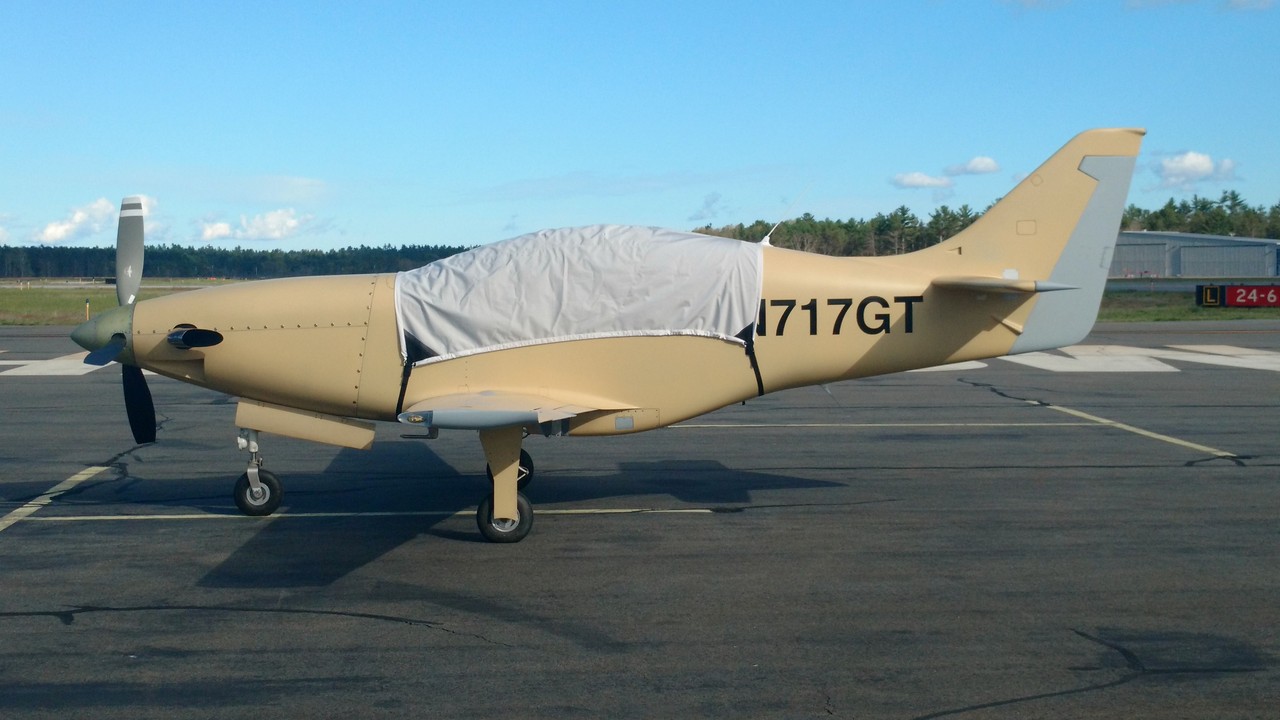
Revolutionary Kit Aircraft Design
Jeff Ackland's vision at Performance Aircraft produced what many considered the ultimate expression of homebuilt aviation performance. The Legend prototype, which made its debut at the 1998 Oshkosh AirVenture, represented a radical departure from traditional kit aircraft design philosophy. Rather than prioritizing ease of construction, Ackland's team focused on creating a carbon-fiber reinforced polymer airframe that could achieve fighter-like performance characteristics while remaining within the experimental amateur-built category.
The aircraft's transformation from piston to turbine power in 1999 marked a pivotal moment in kit aviation history. The original prototype, registered as N620L and assigned serial number 001, demonstrated that amateur builders could successfully integrate sophisticated turboprop engines previously reserved for certified commercial aircraft. This conversion opened new possibilities for civilian pilots seeking military-style performance without the restrictions of certified aircraft categories.
Manufacturing Evolution and Corporate Transitions
Performance Aircraft's original operations in Olathe, Kansas, established the foundation for what would become a complex corporate evolution. When the company ceased operations in the early 2000s, the Legend design passed through multiple ownership changes before finding stability under Legend Aircraft of Winnsboro, Louisiana. The critical revival came on January 1, 2018, when a new management team, partnering with Innovative Wings and AS9100-certified VX Aerospace, announced resumed kit production.
The post-2018 manufacturing approach incorporated lessons learned from nearly two decades of builder feedback. Legend Aircraft implemented significant design improvements including increased fuel capacity, upgraded landing gear systems, and aft-shifted wing positioning optimized for turbine engine installations. Components now originated from multiple specialized suppliers: VX Aerospace provided fuselage and wing structures from Morganton, North Carolina, while Innovative Wings contributed modifications from their Calgary facility.
Turbine Engine Integration Challenges
The Turbine Legend's engine options reflect both the opportunities and complexities of turboprop conversion. The Walter M-601, producing 540 to 720 horsepower depending on variant, served as the prototype's powerplant but revealed significant reliability issues at altitude. One documented case resulted in a gear-up landing when the Walter engine failed to maintain power during high-altitude operations, highlighting the critical importance of engine selection for this demanding airframe.
Subsequent builders gravitated toward the Garrett TPE331-10, despite its higher acquisition cost. Modified to produce 1,100 shaft horsepower with a 7,000-hour time between overhaul interval, the TPE331 enabled true speeds exceeding 370 knots true airspeed. The installation required sophisticated engineering solutions, including King Air-style exhaust stacks with venturi cooling and forward-mounted battery placement for proper center of gravity management. General Electric's H-75 engine, rated at 750 shaft horsepower, found application in the military Venom variant but remained less common among civilian builders.
Performance Characteristics and Pilot Experience
The Turbine Legend's performance envelope places it among the fastest amateur-built aircraft ever created. With a maximum speed of 356 mph and cruise speeds of 334 mph at 25,000 feet, the aircraft rivals many certified turboprops costing significantly more. The 6,500 feet per minute climb rate and 35,007-foot service ceiling provide genuine high-altitude capability, while the +6/-4 G loading limits accommodate aggressive maneuvering.
Former F-104 pilot Jeff Abbott's modifications to Canadian-registered C-GUTT, completed by Innovative Wings in 2003, demonstrated the aircraft's appeal to experienced military pilots seeking similar performance in civilian hands. The tandem seating arrangement with dual controls provides an authentic fighter-like cockpit environment, while the 8.0 aspect ratio wing design balances high-speed efficiency with acceptable low-speed handling characteristics.
Limited Production and Continuing Legacy
Exact production numbers remain undocumented, but confirmed examples include the original prototype, a 2000 JC-100 built by Toys-4-Boys, Abbott's 2003 Canadian example, and a Garrett-powered aircraft under construction in Tyabb, Victoria, Australia, as of 2015. The kit-based production model inherently limits total numbers, with each aircraft requiring substantial builder commitment and significant financial investment for turbine engine acquisition and installation.
The military Venom variant, featuring increased fuel capacity of 550 liters, full digital instrumentation, and Fowler flaps, demonstrated the design's adaptability for light attack roles in export markets. However, no confirmed military operators have been documented, and the variant appears to remain in development status.
Legend Aircraft's current operations focus on pressurized prototype development, with plans for an 8,500-foot cabin altitude capability at Flight Level 280. Additionally, the company announced intentions to develop a piston-powered version specifically for Reno Air Racing competition, potentially bringing the Legend design to a broader audience of performance-oriented builders.
Cultural Impact on Experimental Aviation
The Turbine Legend's significance extends beyond raw performance numbers to its demonstration that amateur builders could successfully integrate military-grade powerplants and achieve professional-level results. The aircraft helped establish turbine conversions as a viable path for experimental aviation, influencing subsequent designs and proving that composite construction techniques could produce airframes worthy of expensive turboprop engines. Today, with prototype N620L still flying and new kit production resumed, the Turbine Legend continues to represent the pinnacle of high-performance homebuilt aviation.