
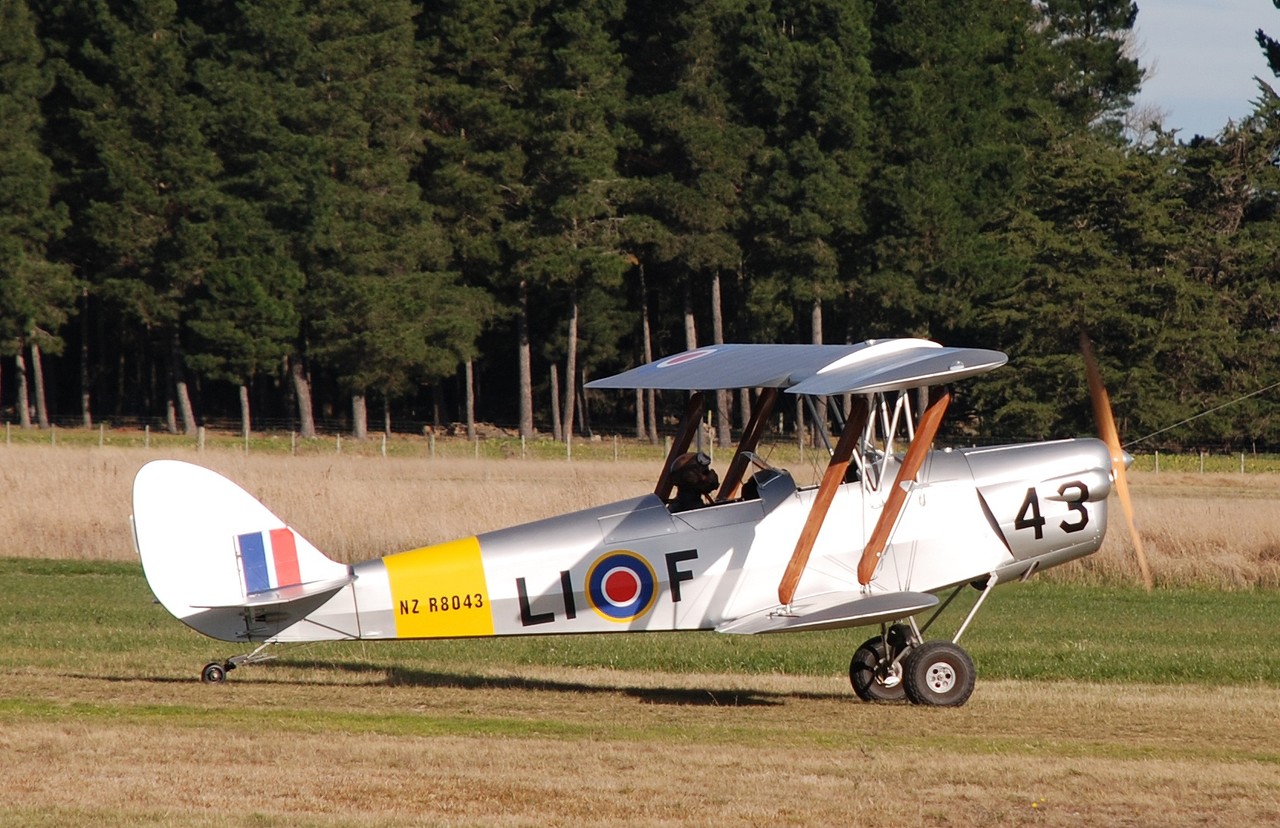
Development and Design
The Fisher R-80 Tiger Moth emerged in 1994 as Fisher Aircraft's ambitious project to democratize vintage aviation. Rather than requiring the substantial investment needed to own an original Tiger Moth, the company created an 80% scale replica that amateur builders could construct from plans or kits. The design philosophy centered on maintaining the authentic Tiger Moth flying experience while incorporating modern lightweight engines and construction techniques accessible to homebuilders.
The aircraft's wooden framework construction mirrors traditional methods, with doped fabric covering stretched over the structure. Interplane and cabane struts provide the characteristic biplane appearance, while bungee-suspended main landing gear delivers the classic taildragger configuration. Pilots access the cockpit through the lower wing, just as in the original Tiger Moth design.
Manufacturing and Production
Fisher Flying Products initially operated from Edgeley, North Dakota, before relocating operations to Woodbridge, Ontario, Canada, in the early 2000s. The company continues producing R-80 kits today, with estimated build times ranging from 600 to 1,000 hours for amateur constructors. By late 2011, more than 24 examples were actively flying worldwide.
In 2000, Fisher introduced the RS-80 variant featuring a steel fuselage framework instead of the standard wooden construction. This variant offered enhanced durability and increased maximum takeoff weight to 1,350 pounds, though production ceased around 2008. The steel fuselage option attracted builders seeking greater structural longevity, particularly in harsh operating environments.
Engine Options and Performance
The R-80's powerplant flexibility represents one of its most appealing characteristics for builders. The airframe accommodates engines from 56 to 115 horsepower, with the manufacturer recommending the higher end of this range for optimal performance. Popular engine choices include the Norton NR642/AE 100R Wankel rotary producing 75-100 horsepower from its single-rotor 294-404 cubic centimeter displacement.
Automotive conversions have proven particularly successful, including the Suzuki G13B/G13A series delivering approximately 100 horsepower through four-cylinder twin-cam configurations with Raven reduction drives. The Rotax 912, UL Power 107-horsepower direct-drive unit, and Walter Mikron 50-horsepower engine provide additional certified options for builders seeking proven reliability.
The aircraft's 45-liter fuel capacity provides reasonable range for local touring and training flights. Design load factors of +6.0G and -3.0G demonstrate the structural integrity built into the scaled-down airframe, making it suitable for basic aerobatic maneuvers within appropriate weight and balance limits.
Global Operations
Registration records reveal significant international appeal for the R-80. New Zealand shows particularly strong adoption, with at least six aircraft registered between 2005 and 2016. Examples include ZK-LAS active as of 2015, ZK-LIF continuing operations from 2007, and ZK-DSW2 completed in 2016.
Australian builders have embraced the design equally, with documented aircraft including VH-BKS (construction number TM72) registered in December 2013, and experimental category registrations 19-5045 (construction number 1) from May 2007, 19-7462 (construction number TM55) from June 2010, and 19-8602 (construction number TM81) from March 2015.
United States operations include NX34TM, now displayed at the Tillamook Air Museum in Oregon, demonstrating the aircraft's cultural significance in preserving aviation heritage through accessible replicas.
Safety Record and Incidents
Like many experimental aircraft, the R-80 has experienced operational challenges. ZK-NOX suffered a fatal accident on April 1, 2017, attributed to engine failure during flight operations. Australian registration 19-7462 crashed in 2015, highlighting the importance of proper engine selection and maintenance in experimental aircraft operations.
These incidents underscore the critical nature of powerplant reliability in single-engine aircraft, particularly when operating from short or remote airfields typical of recreational flying operations.
Cultural Impact and Legacy
The Fisher R-80 serves a unique role in aviation preservation by making Tiger Moth-style flying accessible to contemporary pilots without requiring the substantial investment of original aircraft ownership. While lacking the historical significance of its World War II-era inspiration, the R-80 enables new generations to experience open-cockpit biplane flying.
The aircraft qualifies as Experimental Amateur-Built in the United States, ultralight category in Canada, and Experimental Light Sport Aircraft classification, providing regulatory flexibility for builders across different jurisdictions. This versatility has contributed to its international appeal among homebuilders seeking vintage flying experiences.
Continued production by Fisher Flying Products ensures ongoing availability of kits and support for existing aircraft, maintaining the R-80's position as an accessible entry point into vintage-style aviation for recreational pilots worldwide.