
Military Service Excellence
The Twin Pioneer proved its worth during some of Britain's most challenging military operations in the 1960s. The Royal Air Force ordered 39 aircraft, built between 1958 and 1959, deploying them extensively during the Malayan Emergency and the later confrontation in Borneo. In August 1959, No. 78 Squadron RAF at Khormaksar received Twin Pioneers to supplement their single-engine Pioneer aircraft. By early 1968, 209 Squadron maintained nine Twin Pioneers on strength, testament to the aircraft's operational value in remote theaters.
The aircraft's ability to operate from jungle clearings and rough strips made it indispensable for resupply missions and troop transport in Southeast Asia. However, RAF service ended relatively quickly when the Short Range Conversion Unit at Odiham was disbanded in July 1967, with all Twin Pioneers withdrawn from service approximately 18 months later. The Royal Malayan Air Force and Royal Ceylon Air Force also operated the type, recognizing its unique capabilities for operations in undeveloped regions.
Scottish Aviation's Bold Venture
Scottish Aviation Limited began design work on the Twin Pioneer in 1954, developing it as a twin-engine variant of their successful single-engine Pioneer. Manufacturing took place at Prestwick Airport in Scotland, which served as both factory and flight test center. The company invested heavily in a worldwide sales campaign, sending demonstrator aircraft to Switzerland, Africa, Central and South America, Italy, India, Southeast Asia, and Australia.
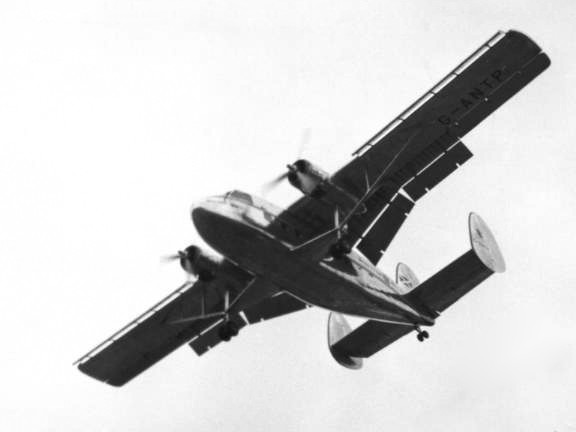
The prototype, registered G-ANTP, made its maiden flight at Prestwick on June 25, 1955. Scottish Aviation showcased the aircraft at the September 1955 Society of British Aircraft Constructors Show at Farnborough, where it demonstrated remarkable short-field performance that impressed aviation professionals worldwide.
Engineering Innovation and Setbacks
The Twin Pioneer featured advanced STOL technology for its era, incorporating leading-edge slats and Fowler flaps combined with a wide undercarriage for exceptional short-field performance. The high-wing cabin monoplane design included a distinctive triple fin and rudder assembly with fixed tailwheel undercarriage, optimized for operations from rough surfaces.
However, the aircraft faced serious challenges in 1957 when two fatal accidents resulted from fatigue failures causing outer wing panels to detach in flight. This crisis forced Scottish Aviation to undertake extensive structural redesign, significantly impacting sales momentum and the aircraft's commercial prospects. Despite these improvements, the early accidents cast a shadow over the Twin Pioneer's reputation.
Powerplant Evolution
The Twin Pioneer utilized different radial piston engines across its production variants. The prototype and Series 1 aircraft were powered by Alvis Leonides 503/514 nine-cylinder air-cooled radial engines producing 540-560 horsepower. Series 2 aircraft, built exclusively for the American market, featured Pratt & Whitney R-1340 Wasp radial engines delivering 600 horsepower. The final Series 3 variant employed Alvis Leonides 531 radial engines generating 640 horsepower.
This powerplant flexibility allowed Scottish Aviation to adapt the aircraft for different markets and operational requirements, though the relatively modest production numbers meant economies of scale remained limited throughout the program.
Commercial Success in Specialized Roles
Beyond military service, the Twin Pioneer found success as a commercial transport for operations where conventional aircraft could not venture. Oil exploration companies, including Rio Tinto Finance and Exploration Limited, operated Twin Pioneers as survey aircraft in remote locations. The Austrian and Swiss government survey departments purchased aircraft for mapping and survey work in mountainous terrain.
The aircraft's generous cabin accommodated bulky survey equipment or up to 14 passengers, making it valuable for companies operating in areas without developed airport infrastructure. Australian Iron and Steel Pty operated a Twin Pioneer marked as "Yampi Pioneer" throughout Western Australia, while the Iraq Petroleum Company briefly leased aircraft for exploration support. Three Twin Pioneers served with the 'Kroonduif' operation in Dutch New Guinea, demonstrating the aircraft's global reach.
Production Legacy and Survivors
Scottish Aviation produced 87 Twin Pioneers between 1955 and approximately 1975, representing a modest but significant achievement for a specialized aircraft type. The 20-year production run reflected steady demand for STOL capability, though the aircraft never achieved mass production status. The first production aircraft was delivered on April 28, 1956, with peak production occurring in the early 1960s.
One Twin Pioneer served for many years as a STOL training aircraft with the Empire Test Pilot School at RAE Farnborough, educating a generation of test pilots in short-field operations. Several aircraft survive today, including VH-AIS in Australia, noted for its colorful operational history, and construction number 586, donated to the Historical Aircraft Restoration Society.
The Twin Pioneer's legacy lies in demonstrating that twin-engine reliability could be combined with exceptional short-field performance, paving the way for later STOL transport aircraft designs and establishing the viability of specialized aircraft for remote operations.