
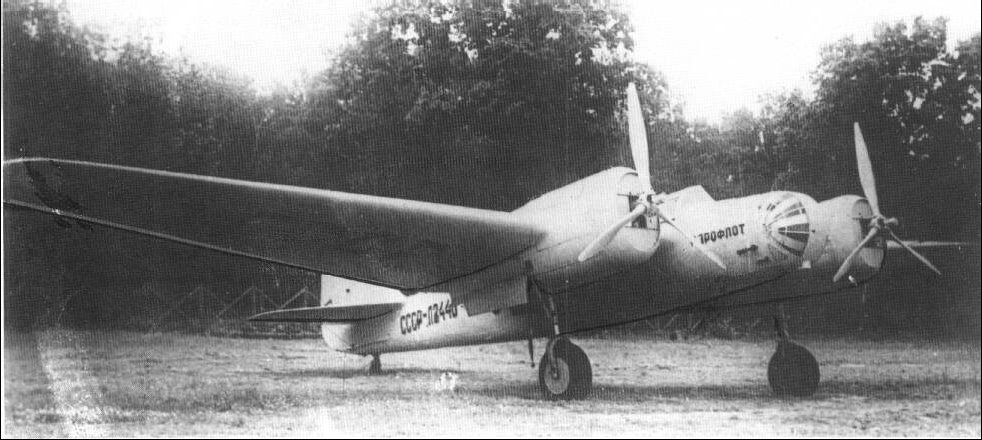
Designed under the leadership of Andrei Nikolayevich Tupolev at the Central Aero-Hydrodynamic Institute (TsAGI), the Tupolev SB (originally designated ANT-40 or TsAGI-40) represented a significant leap in Soviet aviation. Development began in 1933, and the prototype first flew in 1934. The aircraft was notable for its all-metal, stressed-skin construction and retractable landing gear, features that were advanced compared to the fabric-covered biplanes of the era. Its design focused on speed, with an initial project goal of 330 km/h; however, early production models exceeded this, reaching speeds of approximately 400 km/h, which allowed the bomber to outpace many contemporary fighters.
Serial production commenced in 1936 and continued through 1941. The primary manufacturing centers were State Aircraft Factory No. 22 in Moscow and the Irkutsk Aviation Plant (Factory No. 125), the latter of which commissioned its main workshops on August 24, 1934, and listed the SB as its first production aircraft. A total of 6,831 aircraft were built within the USSR, though license-built versions known as the Avia B-71 were also produced in Czechoslovakia.
Technically, the SB was powered by liquid-cooled V-12 piston engines produced by Klimov. Early variants utilized the M-100 and M-100A (derived from the Hispano-Suiza 12Y) providing 750–860 hp, while later versions employed the M-103 (approximately 960 hp) or the M-105 (1,050–1,100 hp). These engines propelled the three-seat bomber to maximum speeds between 400 and 450 km/h, with a service ceiling of 8,000 to 9,000 meters and a range of up to 2,300 km depending on the configuration. Armament consisted of 7.62 mm ShKAS machine guns in dorsal, ventral, and nose positions, with a bomb load capacity between 600 and 1,000 kg.
The SB saw extensive combat across multiple theaters. It operated in the Spanish Civil War starting in autumn 1936, where its speed allowed it to fly without fighter cover. It was supplied to China for use against Japanese forces starting in late 1937 and participated in the Battles of Lake Khasan (1938) and Khalkhin Gol (1939). It also served during the Winter War (1939–1940) and was the primary front-line bomber for the Soviet Air Force at the start of the German invasion in June 1941. While initially formidable, it was eventually supplanted by more modern aircraft as German fighters like the Messerschmitt Bf 109 became more prevalent. Beyond military use, the SB was employed in limited civil roles as a trainer and for fast mail or cargo transport. While many wrecks exist, there are no confirmed airworthy examples remaining today.