
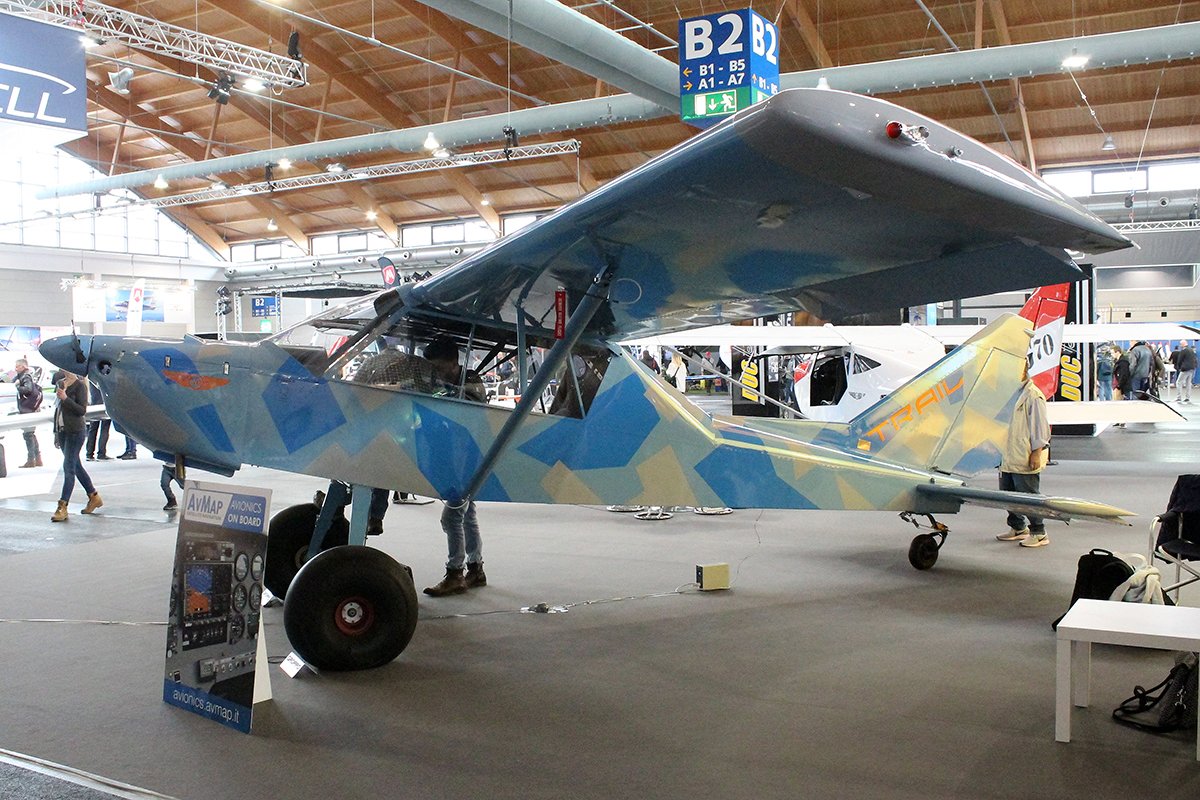
Design and Development
Nando Groppo, drawing from decades of experience in microlight manufacturing since 1982, designed the Trail as his latest refinement in a series of rugged sport aircraft. The Trail derived from his earlier Groppo XL tricycle-gear variant, sharing the same aerodynamics, dimensions, and engine options while incorporating a conventional taildragger landing gear configuration. Groppo's design objectives centered on creating a robust, versatile aircraft suitable for sport flying, utility work, farm strips, and serious backcountry operations.
The Trail made its public debut at AERO Friedrichshafen in April 2009, quickly garnering attention for its all-metal construction and innovative folding capabilities. Unlike many modern light sport aircraft that rely heavily on composite materials, Groppo chose aluminum wings and a chrome-molybdenum steel fuselage frame with riveted aluminum skin. The wings fold 90 degrees to lie alongside the fuselage, while the tailplane also folds, reducing the aircraft's transport width from its 27-foot 11-inch wingspan to just 8 feet 11 inches.
Production and Manufacturing
Production began around 2005 at the Ing. Nando Groppo srl factory in Italy, where the Trail shared a mixed production line with the company's G70 model. By late 2010, approximately 50 units had been completed, with production accelerating to reach 112 aircraft by 2013. Of these, 75 were flying across 11 countries, with many delivered as kit aircraft requiring approximately 500 hours of assembly time.
The company's kit approach proved popular in international markets, with 37 additional kits under construction in Germany, France, the United Kingdom, and Russia as of late 2012. Each kit arrives in wooden containers with the front fuselage pre-welded and powder-coated, requiring only basic sheet metal skills to complete. High demand led to plans for doubling the production line capacity.
Engine Options and Performance
The Trail accommodates several flat-four piston engines in the 80-horsepower class, with the Rotax 912UL and 912ULS serving as the most popular choices. Alternative powerplants include the Jabiru 2200, Sauer S 2400 UL, Westlake A80, and the top-tier Rotax 914 configuration with a three-blade E-Props propeller. The Sauer engines, derived from Volkswagen automotive origins and manufactured in Germany, offered cost-conscious builders a reliable air-cooled option producing approximately 85 horsepower.
With the Rotax 912ULS installation, the Trail achieves a maximum cruise speed of 124 miles per hour, making it well-suited for cross-country flights while maintaining excellent short takeoff and landing characteristics essential for backcountry operations. The aircraft's 70-liter fuel capacity provides substantial range for extended adventures.
International Market Penetration
While the Trail gained significant recognition in Europe with over 115 aircraft flying by 2015, it remained relatively unknown in the United States market. Lone Palm Aero in Bushnell, Florida, served as the primary U.S. distributor, working to introduce American pilots to what aviation journalists called "the LSA world's best kept secret."
In the United Kingdom, Sprite Aviation (later Spruce Aviation) began marketing the Trail in 2010, completing the first UK prototype as a fast-build kit in early 2011. This aircraft, registered as G-RPPO, made its maiden flight in February 2011 at Turweston airfield with an LAA-approved pilot at the controls. The first UK registration occurred in December 2010, marking the beginning of the Trail's expansion beyond continental Europe.
Design Innovations and Capabilities
The Trail's rough-field capabilities extend well beyond typical light sport aircraft through several key innovations. Optional 27.5-inch bush wheels transform the aircraft for serious backcountry operations, while extended leaf-spring landing gear absorbs the punishment of unimproved strips. Piano-hinged ailerons and single lift struts simplify maintenance while maintaining structural integrity under demanding conditions.
For safety-conscious operators, an optional ballistic parachute system provides additional protection. The tandem seating arrangement places both occupants along the aircraft's centerline, optimizing weight and balance while providing excellent visibility for both pilot and passenger.
Legacy and Current Status
By the 2020s, Ing. Nando Groppo srl continued active production under the Groppo Avio name, with new aircraft deliveries ongoing. The Trail's reputation as an affordable, durable alternative to more expensive light sport aircraft established its niche in the European market, where pilots appreciated its combination of traditional taildragger characteristics with modern manufacturing techniques.
The aircraft's influence extends beyond its immediate market success, demonstrating that all-metal construction and folding capabilities could be successfully integrated into the light sport aircraft category. Notable examples continue flying today, including D-MDSZ based at Dolmar airfield in Germany, representing the growing community of Trail operators who have discovered Nando Groppo's well-engineered contribution to recreational aviation.