
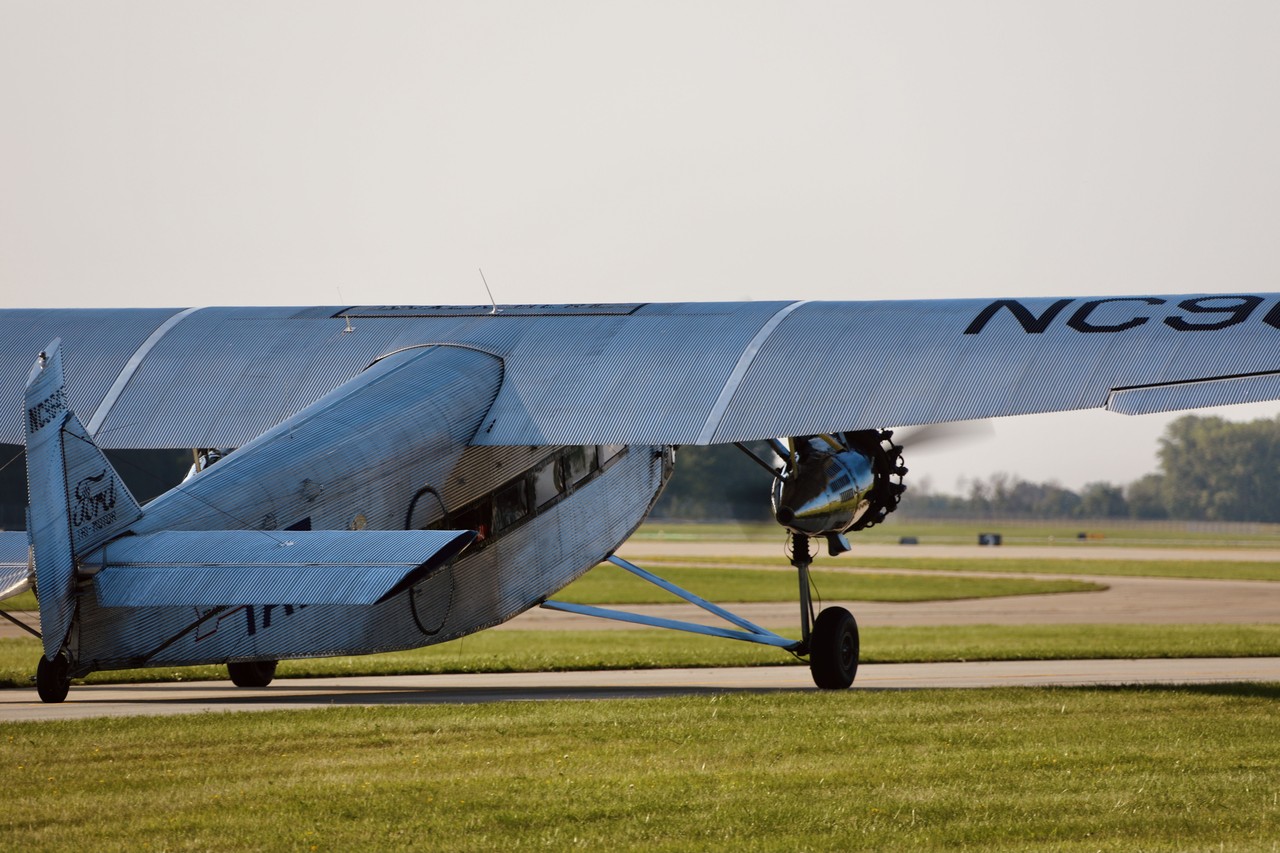
Commercial Aviation Pioneer
The Ford Tri-Motor dominated American commercial aviation during the late 1920s and early 1930s, with over 100 airlines worldwide operating the type. Major carriers including American Airways, Pan American Airways, Eastern Air Transport, and Transcontinental Air Transport relied on the Tri-Motor to establish reliable passenger service across the United States. The aircraft's multi-engine design provided unprecedented safety for passengers, as it could continue flying even with one engine failure—a crucial capability that built public confidence in commercial aviation.
At the height of its success, Ford's Aircraft Division had become the world's largest manufacturer of commercial airplanes. The company applied Henry Ford's revolutionary assembly line techniques to aircraft production, achieving a peak output of 25 planes per month in June 1929. This industrial approach made the Tri-Motor affordable for airlines while maintaining consistent quality across all 199 aircraft produced.
Design Innovation
William Bushnell Stout led the design team that created this groundbreaking aircraft, initially through his Stout Metal Airplane Company before Ford's acquisition in 1925. The Tri-Motor's corrugated aluminum construction, inspired by German Junkers designs, represented a major advancement over fabric-covered aircraft of the era. This all-metal approach provided superior durability and weather resistance, though it led to patent disputes that prevented European exports.
The aircraft evolved through two main variants: the smaller 4-AT model and the larger 5-AT. Early 4-AT models used Wright J-6 Whirlwind engines producing 220-300 horsepower each, while the definitive 5-AT variant featured three Pratt & Whitney Wasp R-1340 radial engines generating 420 horsepower each. The reliable Wasp engines, which entered production in 1926 and eventually saw over 75,000 units built, provided the power needed for safe commercial operations.
The Ford Motor Company Era
Ford Motor Company, founded by Henry Ford in 1903, entered aviation by acquiring Stout's company and designs in 1925. The automotive giant brought mass production expertise to aircraft manufacturing at their Dearborn, Michigan facility near Ford Airport. However, the Great Depression devastated aircraft sales, forcing Ford to cease commercial aircraft production on June 7, 1933, after building exactly 199 Tri-Motors comprising 79 4-AT models and 117 5-AT variants.
During World War II, Ford returned to aviation by producing thousands of Consolidated B-24 Liberator bombers at their massive Willow Run plant in Michigan. However, the company never resumed commercial aircraft manufacturing, focusing instead on their core automotive business where they remain a major manufacturer today.
Performance and Operations
The Ford 5-AT Tri-Motor measured 48 feet 4 inches in length with a crew of two pilots. Its high-wing configuration provided excellent stability and ground clearance, while wing compartments offered additional luggage storage space. With a service ceiling of 17,900 feet and range of 570 miles, the aircraft proved ideal for domestic airline routes.
Passengers appreciated the Tri-Motor's safety record and reliability, though they endured considerable noise and vibration from the three radial engines. The spacious cabin could accommodate up to 17 passengers in the 5-AT variant, representing luxury travel for its era despite the mechanical cacophony.
Notable Service and Legacy
The Ford Tri-Motor achieved fame beyond commercial aviation through several historic flights. Admiral Richard Byrd selected a Ford 5-AT for his 1929 South Pole expedition, demonstrating the aircraft's reliability in extreme conditions. In 1962, a Tri-Motor became the first aircraft to land at the newly opened Washington Dulles Airport, cementing its place in aviation history.
Commercial operators continued flying Tri-Motors well into the jet age, with Island Airlines providing Lake Erie island service until 1983—nearly 60 years after the type's introduction. This remarkable longevity testified to the aircraft's robust construction and enduring utility.
Today, approximately 15-18 Ford Tri-Motors remain airworthy, carefully maintained by organizations like the Experimental Aircraft Association for airshow demonstrations and passenger flights. Notable preserved examples include Admiral Byrd's South Pole aircraft at the Henry Ford Museum in Dearborn, Michigan, and a Ford 5-AT at the National Air and Space Museum in Washington, DC.
The Tri-Motor's cultural impact extends beyond aviation museums, appearing in Hollywood films like Howard Hughes' 1930 epic "Hell's Angels" and earning the affectionate nickname "Tin Goose." While more advanced aircraft like the Douglas DC-2 and Boeing 247 eventually superseded it in 1934, the Ford Tri-Motor established the foundation for modern commercial aviation by proving that all-metal, multi-engine passenger aircraft could operate safely and profitably.