
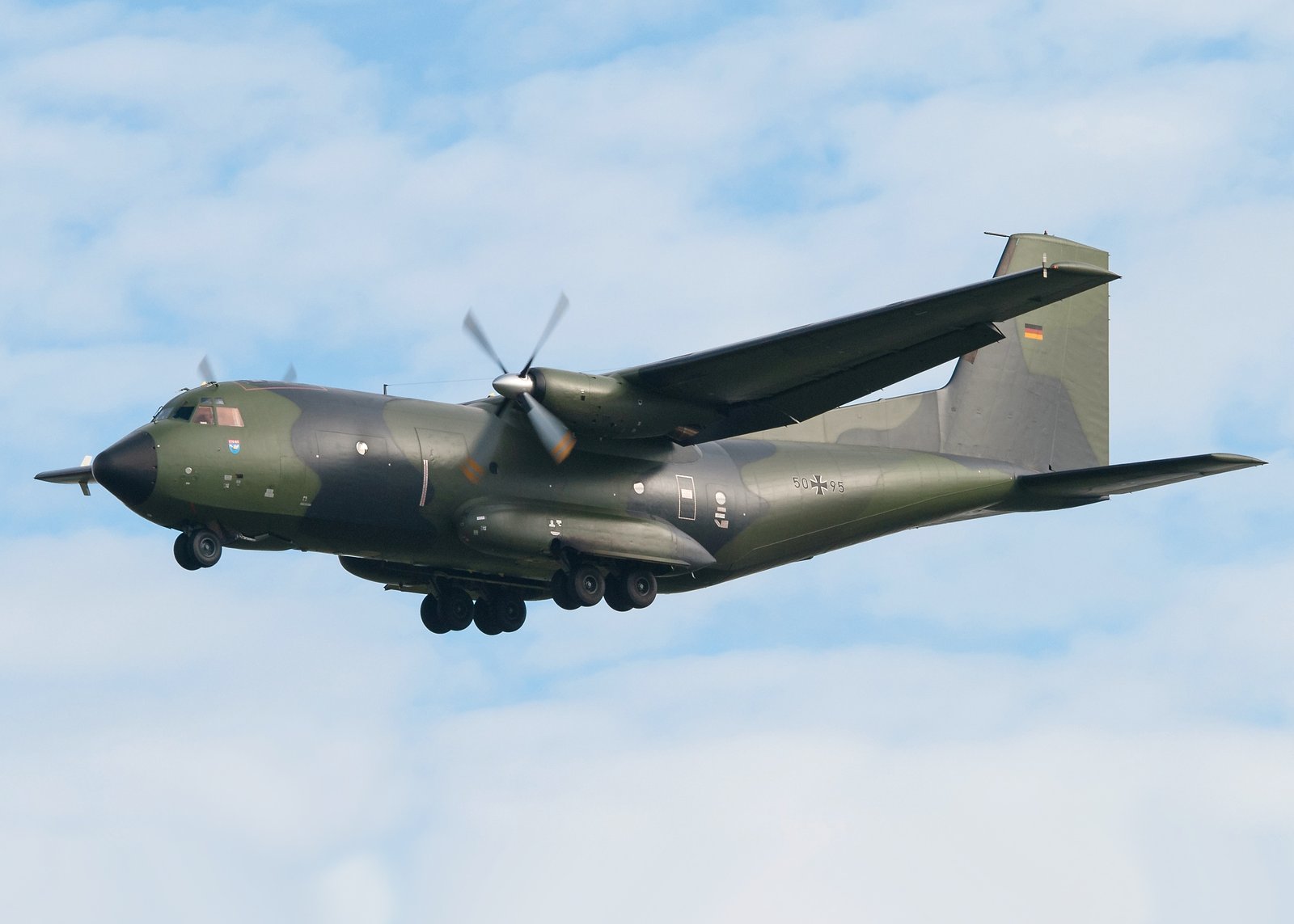
The Transall C-160 was conceived in the late 1950s and early 1960s to meet a joint requirement from the French Air Force and the German Luftwaffe for a medium tactical transport capable of replacing the Nord 2501 Noratlas. To achieve this, the Transporter Allianz (Transall) consortium was formed, consisting of Nord Aviation in France, and Vereinigte Flugtechnische Werke (VFW) and Hamburger Flugzeugbau (HFB) in Germany, with Blume-Leichtbau also contributing. This collaboration prefigured the integrated European aerospace structure later seen in Airbus.
Designed for rugged, front-line operations, the C-160 features a high-wing configuration and a pressurized cargo cabin. It is specifically engineered for short takeoff and landing (STOL) capabilities, allowing it to operate from unpaved runways as short as 650 to 700 meters. The aircraft is equipped with a rear loading ramp and a large two-piece cargo door, facilitating the airdrop of paratroops and the drive-on loading of vehicles. In terms of capacity, the cabin can hold up to 93 soldiers, 66 fully equipped paratroopers, or 62 stretcher patients with medical staff.
The prototype first flew on February 25, 1963, followed by the first German flight at Lemwerder near Bremen on May 25, 1963. Series production ran from 1965 to 1985, resulting in a total of 214 aircraft, including prototypes. Power is provided by two Rolls-Royce Tyne RTy.22 / Mk.22 turboprop engines, each delivering between 4,222 kW and 4,270 kW. These engines enable a maximum speed of approximately 513 km/h and a service ceiling of up to 8,230 meters.
Entry into service occurred in 1967 for France and 1968 for Germany, where the Luftwaffe received its first aircraft on April 30, 1968. Beyond standard transport, the C-160 proved highly versatile; German aircraft were equipped with firefighting kits between 1983 and 1988, and other units were adapted for aerial refueling and electronic reconnaissance (SIGINT/ELINT). The aircraft also served in Turkey and South Africa. The C-160 remained a staple of the Bundeswehr longer than any other aircraft type, with the final German units withdrawn in 2021. They have been progressively replaced by the Airbus A400M since approximately 2013.