
Development and Design
The TT-1 Pinto emerged from the U.S. Navy's ambitious Project All-Jet, which sought to revolutionize pilot training by replacing traditional piston-engine trainers with jets from the very beginning of flight instruction. Robert McCulloch and Temco's design team began work on the Model 51 in the early 1950s, targeting the military's need for an economical jet trainer that could replace workhorses like the T-34 Mentor and AT-6 Texan.
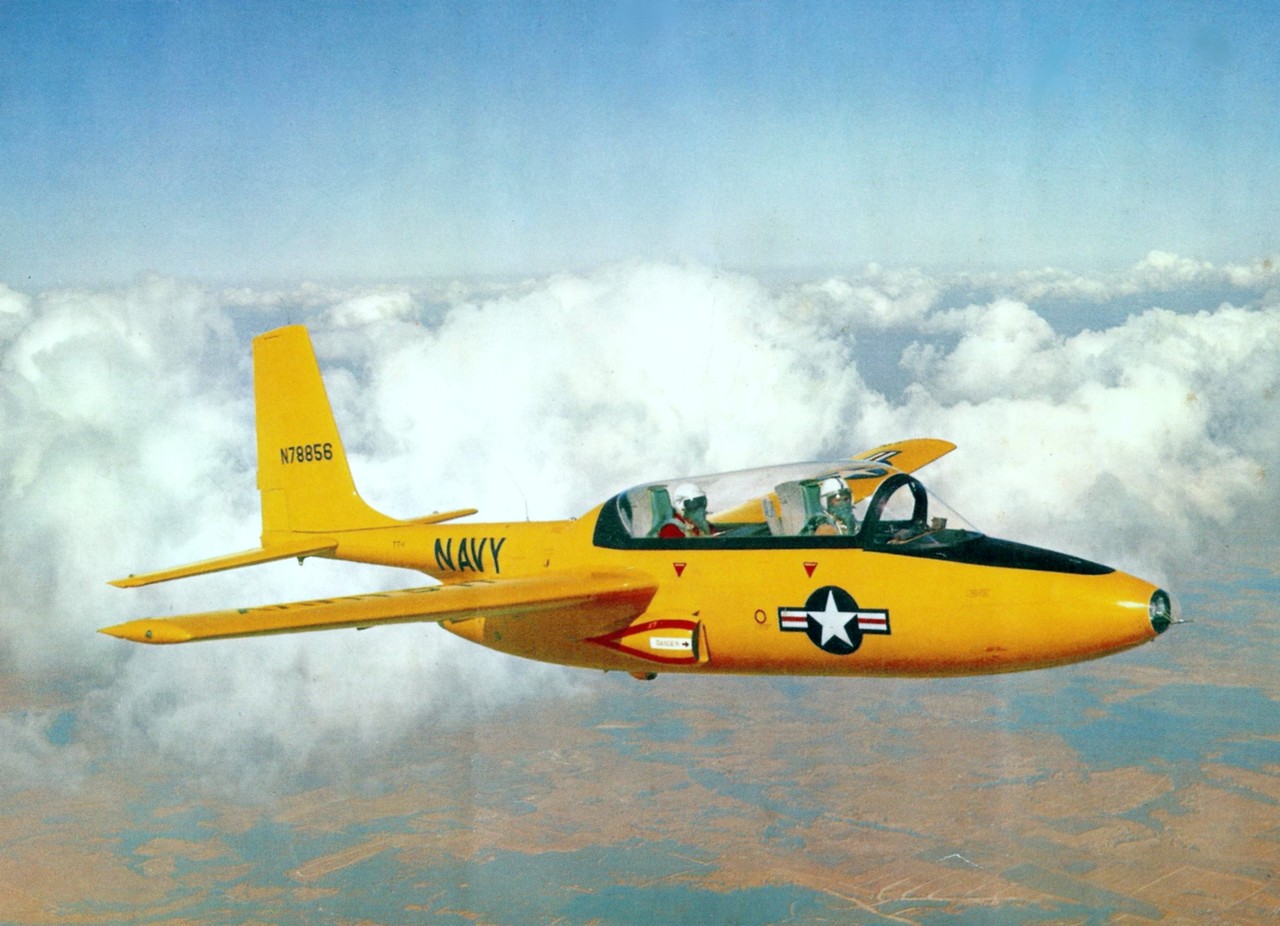
The design incorporated several advanced features for primary training: tandem ejection seats, liquid oxygen system, speed brakes, and structural limits of +9G to prepare students for the demanding world of jet aviation. The aircraft featured exceptional visibility through its long, clear canopy and included jet-appropriate instrumentation in a compact, cost-effective package.
Service History
The first production TT-1, bearing Bureau Number 144223, took to the skies on December 2, 1957, with test pilot Marty Collis at the controls. Deliveries began in July 1957, with all 14 aircraft entering service with the U.S. Naval Air Training Command at two primary locations: Saufley Field in Pensacola, Florida, and the Naval Air Test Center at Patuxent River, Maryland.
From 1957 to 1960, the Pinto served as the test platform for determining whether beginning pilots could successfully transition directly to jets without prior piston-engine experience. While the concept proved viable and several evaluation incidents were overcome, the aircraft's limitations became apparent during operational testing. The TT-1's single hour of endurance severely restricted training time, and the Continental J69 engine provided marginal power, particularly problematic during critical "wave off" maneuvers that simulated aircraft carrier approaches.
By the end of 1960, the Navy concluded that while all-jet primary training was feasible, the TT-1 lacked the performance characteristics necessary for a successful program. The project was terminated, and the aircraft were retired from military service.
The Manufacturer
Texas Engineering & Manufacturing Company was founded in 1946 and quickly established itself as an innovative aircraft manufacturer. The company began by producing the Globe GC-1A Swift and later subcontracted work on North American's AT-6/SNJ production lines. Temco demonstrated remarkable engineering speed with their piston-powered Temco Plebe, which was designed, built, and flown in just 75 days during the late 1940s.
Operating primarily through the 1950s and 1960s from facilities in Dallas, Texas, with flight testing later moved to Majors Field in Greenville, Temco was acquired in 1960 by Ling-Temco-Vought (LTV). The company's aircraft division influenced later aerospace developments through successors like Vought, though the Temco name no longer exists in today's aviation industry.
Engine and Technical Innovation
The TT-1's powerplant was a Continental Motors J69-T-9 turbojet, a license-built version of the French Turbomeca Marboré II. Continental had acquired the license in 1952, and the J69 became widely used in American military projects, most notably powering the highly successful Cessna T-37 Tweet trainer and the Ryan Firebee drone series. The engine proved reliable for small jets and trainers, though its 920 pounds of thrust was ultimately insufficient for the Pinto's demanding training requirements.
The aircraft's tricycle landing gear and mid-wing configuration provided stable handling characteristics suitable for student pilots, while the tandem seating arrangement allowed effective instructor oversight during training flights.
Post-Military Life and Legacy
Following retirement from Navy service, several TT-1s found their way into civilian hands. In 1968, one aircraft was significantly modified by AJI as the T-610 Super Pinto, receiving a General Electric CJ610 engine that boosted maximum speed to 450 knots. A planned Philippine Air Force project for local T-610 production during the 1980s ultimately collapsed during the Marcos era.
As of recent records, at least one or two TT-1s remain airworthy. Bureau Number 144223, the first production aircraft, was still flying as late as 2006, and the Commemorative Air Force has acquired a Pinto for preservation. The National Naval Aviation Museum displays an example, re-engined for improved endurance, while surviving aircraft have appeared at airshows including Planes of Fame in 1988 and Arizona Airfest in 1989.
Historical Significance
Though the TT-1 Pinto's military career was brief and its production limited, it holds the distinction of being America's first primary jet trainer. The lessons learned from its evaluation directly influenced the development of more successful programs and contributed to the eventual adoption of the T-37 Tweet, which incorporated twin J69 engines and proved highly successful with over 1,000 aircraft produced. The Pinto represents an important milestone in the evolution of military pilot training, demonstrating both the promise and challenges of transitioning to all-jet instruction programs during the Cold War era.