
Service History
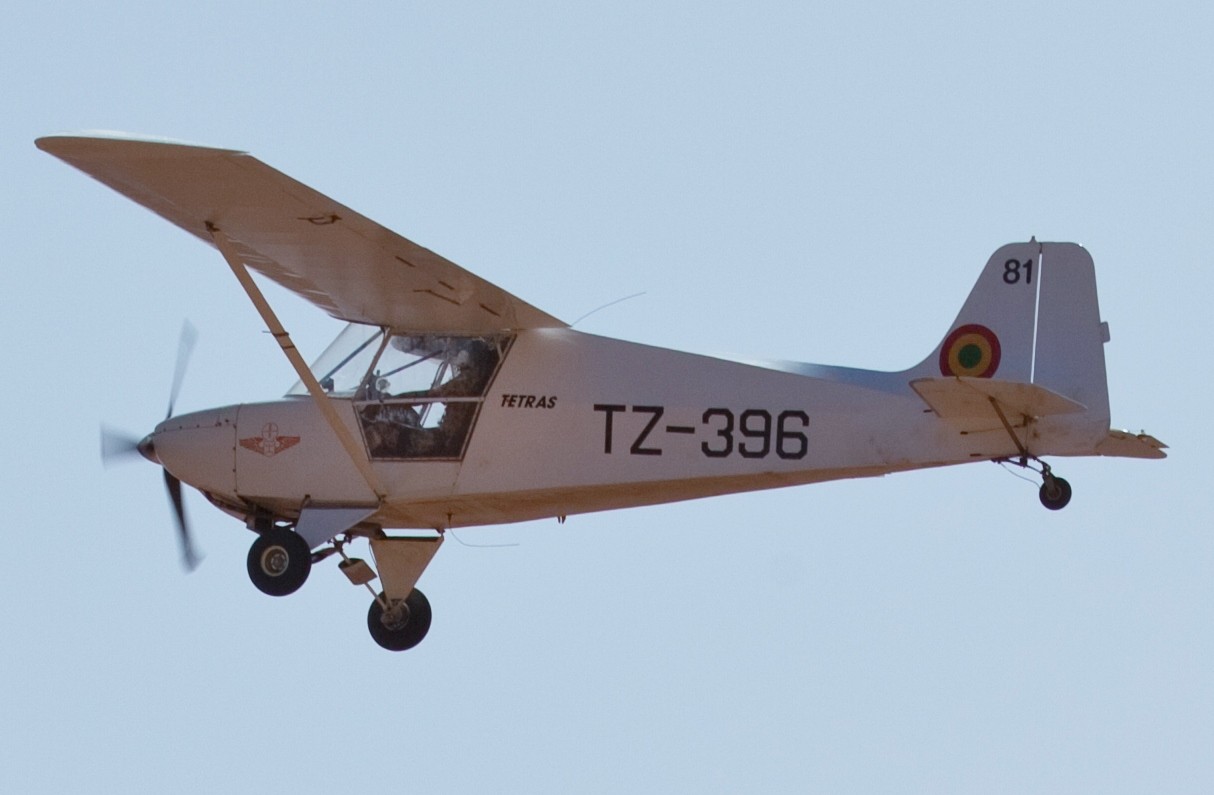
The Tetras carved out a distinctive niche in both civilian ultralight aviation and African military training operations. By 2010, approximately 150 aircraft had rolled out of Humbert Aviation's Ramonchamp facility, serving operators across multiple continents. The aircraft's dual nature as both a recreational ultralight and military trainer demonstrated the versatility of modern composite construction techniques applied to the light aircraft market.
Four African air forces adopted the Tetras for basic training and utility roles, with Niger receiving eight 912SCM variants around 2008, Mali operating seven aircraft as of 2011, Madagascar fielding three examples with registrations 5R-MNQ, 5R-MNR, and 5R-MNT, and Guinea receiving at least five aircraft as French donations. However, operational challenges emerged, with Niger losing two aircraft to crashes in 2010 and 2011, reducing their active fleet to three aircraft with three in storage by 2018.
The Manufacturer
Humbert Aviation established itself in the ultralight market through the Tetras program, beginning production in 1992 from their facility in the Vosges region of eastern France. The company made its public debut at the 1992 RSA Rally at Moulins, launching commercial marketing efforts in 1994. Unlike many ultralight manufacturers that focused exclusively on kit sales, Humbert Aviation offered both factory-completed aircraft and builder kits, broadening their market appeal.
The company demonstrated remarkable longevity in the volatile ultralight market, maintaining continuous production for over three decades. Their Ramonchamp facility became the exclusive source for all Tetras variants, with no licensing agreements or subsidiary production facilities established elsewhere.
Engine Evolution and Technical Innovation
The Tetras powerplant evolution reflected broader industry trends toward standardization and reliability. Initial aircraft featured the 54 kW Humbert-Volkswagen HW 2000, a custom automotive conversion producing 72 horsepower. By 1998, Humbert Aviation transitioned to Austrian-manufactured Rotax engines, offering the 60 kW Rotax 912 UL generating 80 horsepower or the more powerful 74 kW Rotax 912 ULS rated at 98 horsepower.
The aircraft's composite wing represented advanced construction for the ultralight category, featuring an aluminum frame filled with Styrofoam core and fabric covering. This straight, non-tapered wing incorporated the NACA 23012 airfoil, aluminum ailerons, and three-position flaps. Single lift struts braced each wing to the lower fuselage, creating an efficient high-wing configuration optimized for stability and short-field performance.
Performance Characteristics
Pilots found the Tetras offered respectable performance within ultralight limitations, achieving a maximum speed of 194 km/h and cruise speed of 180 km/h at 75 percent power and 3,048 meters altitude. The aircraft's 55 km/h stall speed with flaps extended provided comfortable approach characteristics, while its 7.5 meter-per-second rate of climb delivered adequate short-field capability.
With standard 60-liter fuel capacity, the Tetras achieved 700-kilometer range, though operators in markets outside France could specify 85-liter tanks for extended missions. The aircraft's 256-kilogram empty weight allowed 194 kilograms of useful load within the standard 450-kilogram maximum takeoff weight, expandable to 495 kilograms where regulations permitted.
Variant Development
Humbert Aviation expanded the Tetras family through six distinct variants addressing different market segments. The initial Tetras A gave way to the Tetras B in 1998, standardizing on Rotax powerplants with either 80 or 100-horsepower options. The BS variant specifically featured the 912 ULS engine for enhanced performance.
In 2007, Humbert introduced three short-span variants marketed through 2009. The Tetras CS featured a wing shortened by 600 millimeters and 912 ULS power, while the CT offered tricycle landing gear with the standard 912 UL engine. The CTS combined tricycle gear with 100-horsepower power, representing the line's most sophisticated configuration.
Production Legacy
The Tetras production run, while modest by airline standards, represented significant success within the specialized ultralight market. Manufacturing continued beyond 2010, though exact final production numbers remain undocumented. Several accidents occurred during the type's service life, including incidents involving aircraft 62-ABT in June 2003, 63-MI in April 2002, and 46-PN in April 2003, though the overall safety record reflected typical ultralight operations rather than design deficiencies.
Today, surviving Tetras aircraft continue serving in both recreational and training roles, their composite construction providing longevity advantages over traditional fabric-and-tube ultralight designs. The type's significance lies in demonstrating that European ultralight manufacturers could successfully compete with established Austrian and German producers while serving both civilian and military markets simultaneously.