
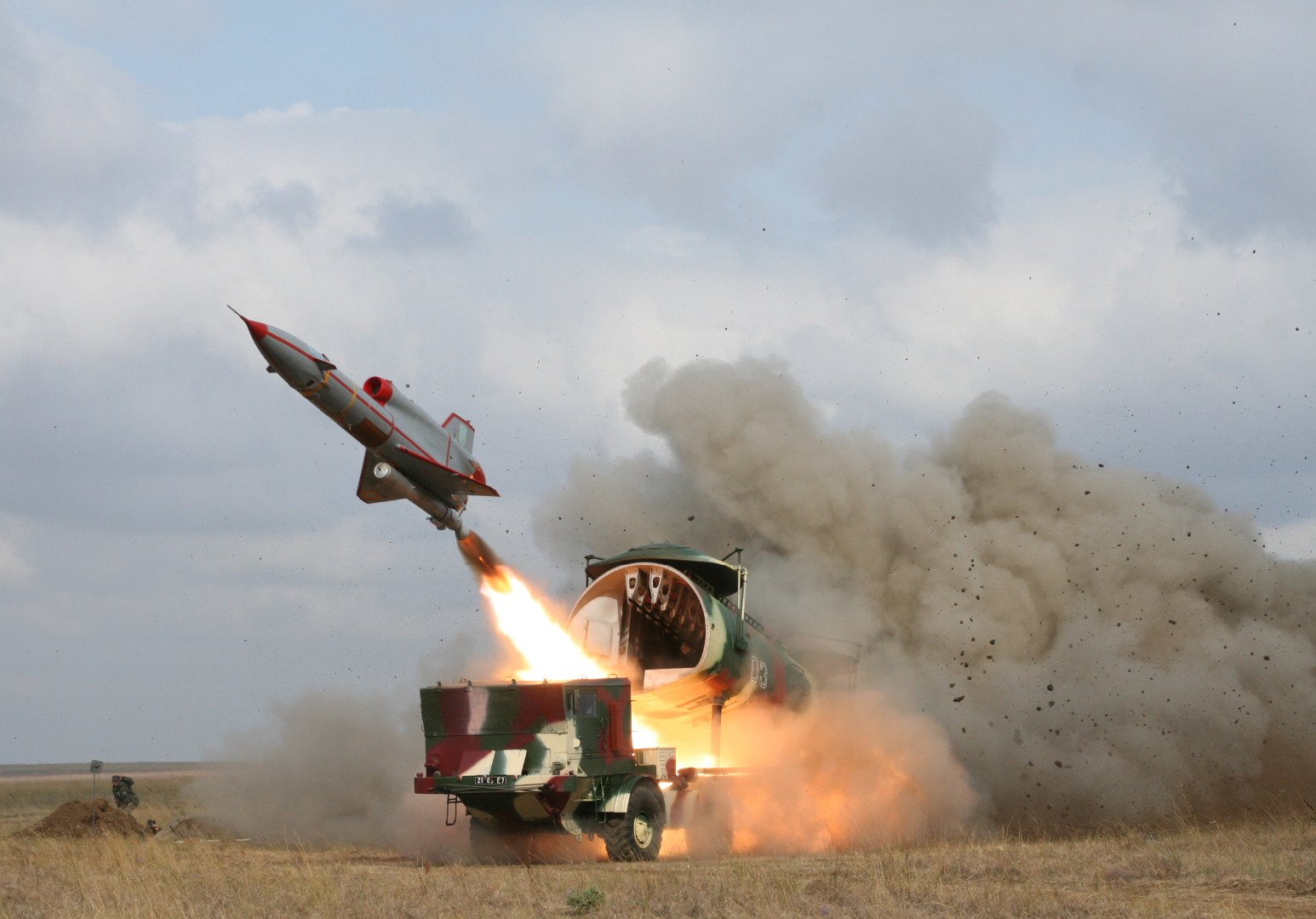
The Tupolev Tu-143 was developed by the Tupolev OKB as a specialized unmanned reconnaissance aircraft intended for short-range tactical intelligence gathering. Designed to operate at low-to-medium altitudes, the aircraft featured a unique operational cycle: it was launched from a truck using a rocket booster, cruised using a turbojet engine, and was recovered via parachute. The Tu-143 first flew in December 1970, and while it began entering service during the 1970s, the Soviet Army officially adopted the system in 1982.
Production of the Tu-143 took place at the Voronezh Aviation Plant (also known as VASO) in Voronezh, Russia, between 1973 and 1989. Production records indicate that approximately 950 to 1,000 aircraft were manufactured during this period. The aircraft was powered by a turbojet engine, identified in records as the Izotov TR3-117 or Klimov TR3-117, which provided 640 kgf of thrust. This propulsion system allowed the drone to reach a maximum speed of 950 km/h.
Throughout its service life, the Tu-143 and its derivatives were deployed extensively. The baseline reconnaissance version was known as the Tu-143 or VR-3 Reis (Rejs). In 1982, an improved version designated the Tu-243 Reis-D began to appear. Additionally, a target drone variant, the M-143 (or VR-3VM), was introduced in 1985. The aircraft saw active combat use by Soviet forces during the Soviet–Afghan War and was utilized by Syria for reconnaissance missions over Lebanon and Israel during the 1982 Lebanon War.
Beyond the Soviet Union, the Tu-143 was exported to several allies, including Romania, Bulgaria, Czechoslovakia, Syria, and Iraq. Following the dissolution of the Soviet Union, the aircraft continued to be operated by successor states such as Russia, Ukraine, and Belarus, as well as North Korea. While many operators have since retired the fleet, some units remained in use into the 2010s and 2020s. Several examples of the Tu-143 are currently preserved in museums, marking its legacy as a cornerstone of Cold War-era unmanned aerial reconnaissance.