
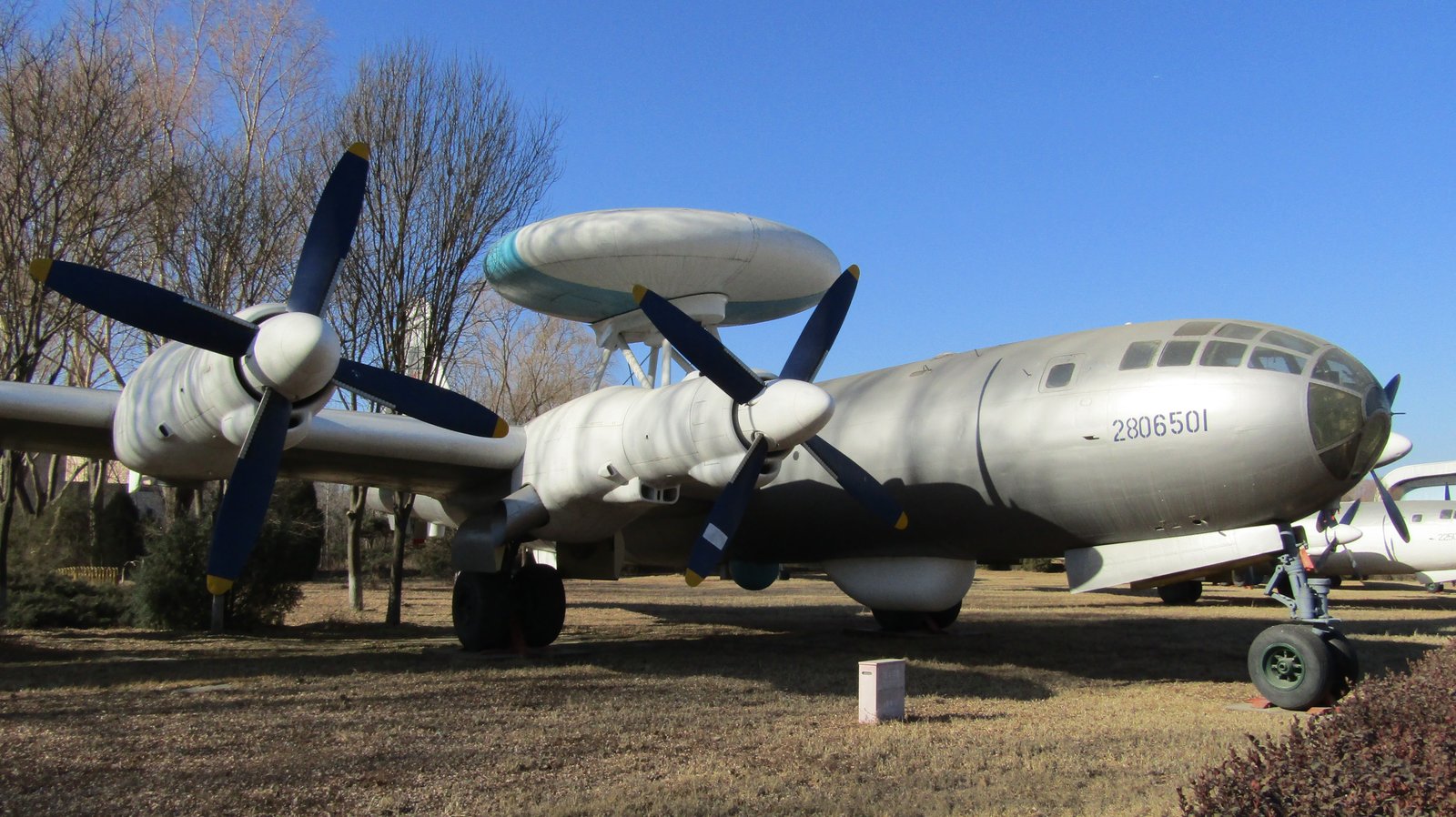
The Tupolev Tu-4 was a pivotal aircraft in Soviet aviation history, representing the USSR's first credible capability for long-range strategic bombing. The aircraft was developed by the Tupolev Design Bureau (OKB-156) under the leadership of Andrei Nikolayevich Tupolev. The project was a massive reverse-engineering effort based on four American Boeing B-29 Superfortresses that had been interned in the Soviet Far East in 1944. Soviet engineers, including A.M. Cheremukhin and L.L. Kerber, meticulously recreated the aircraft, adapting the original American designs to metric dimensions and substituting Soviet components for the engines, avionics, and weaponry.
Technically, the Tu-4 introduced several advancements to the Soviet fleet, most notably a fully pressurized crew compartment for high-altitude operations and remote-controlled, radar-aimed defensive gun turrets. The aircraft was powered by four Shvetsov ASh-73TK 18-cylinder two-row air-cooled radial engines, which featured turbocharging and produced approximately 2,300 to 2,400 hp for takeoff. These engines drove four-blade constant-speed propellers. The resulting aircraft had a wingspan of approximately 43.1 meters and a maximum takeoff weight of roughly 60 to 61 tonnes.
Mass production occurred between 1947 and 1952, with the first prototype flying on May 19, 1947. Production was centered at the Kazan Aircraft Plant (Plant No. 22, now the Kazan Aircraft Production Association) and the Omsk Aircraft Plant (Plant No. 166). It is estimated that approximately 847 aircraft were built. The Soviet Air Force utilized the Tu-4 as a strategic bomber, with the Tu-4A variant specifically designed for nuclear weapon delivery. Other variants included the Tu-4R for reconnaissance and early airborne early-warning (AEW) configurations. Beyond the USSR, the People's Republic of China operated the Tu-4, using it as a platform for early-warning experiments.
While the Tu-4 did not see combat during World War II, it was the cornerstone of Soviet strategic aviation in the early Cold War. Its legacy lies in the technological experience gained by Soviet industry in constructing large pressurized airframes and complex defensive systems, which directly informed later indigenous designs such as the Tu-16 and Tu-95. Today, very few examples survive, with a notable static display located at the Central Air Force Museum at Monino.