
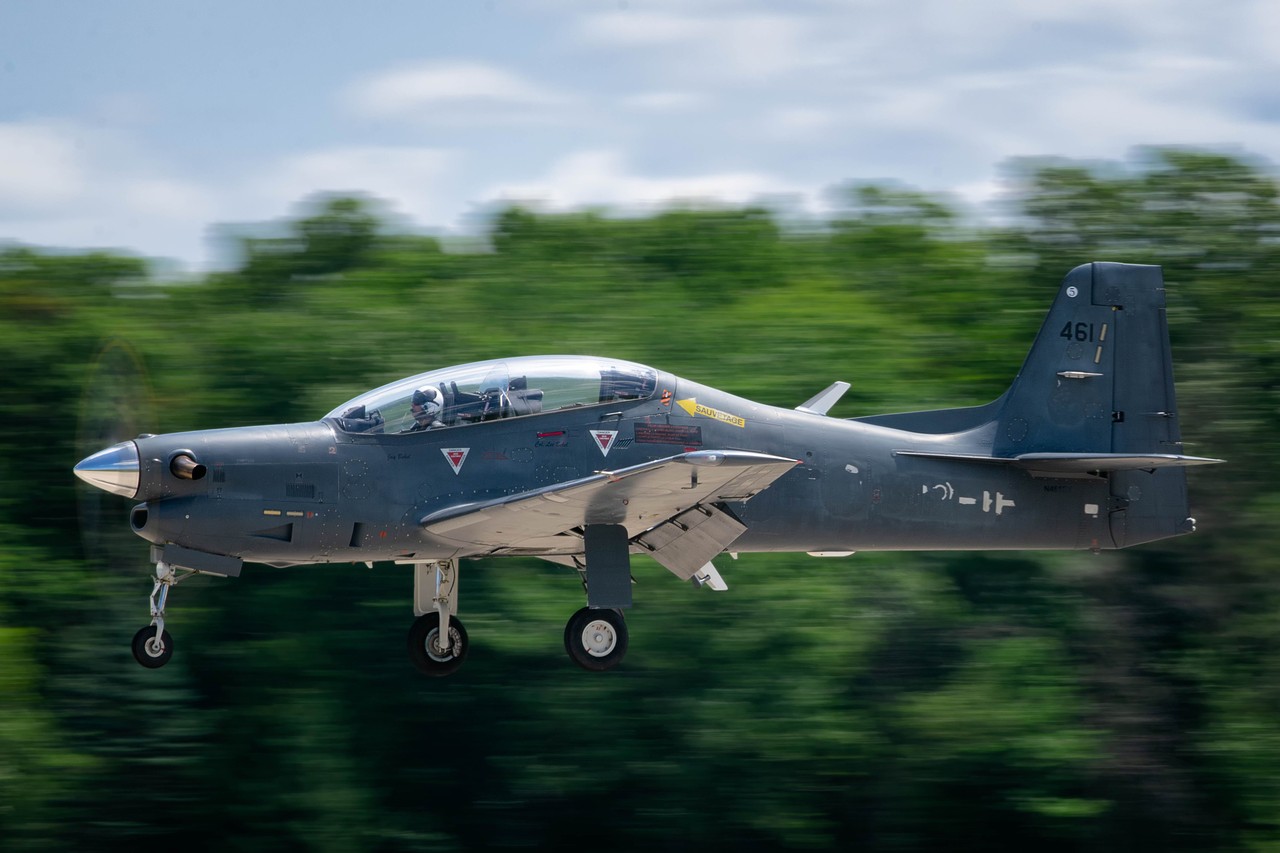
Development and Design
The EMB-312 Tucano emerged from Brazil's ambitious goal to develop an indigenous basic trainer for the Brazilian Air Force. Development began in January 1978 under the leadership of engineer Joseph Kovacs, with Embraer receiving a contract for two flying prototypes and two test airframes on December 6, 1978. The design team faced the challenge of creating an aircraft that met stringent FAR Part 23 Appendix A, military, and CAA Section K specifications while incorporating innovative features rarely seen in basic trainers.
The first prototype, bearing Brazilian Air Force serial 1300, took flight on August 16, 1980, followed by the second prototype (serial 1301) on December 10, 1980. A production-standard third prototype (PP-ZDK) flew on August 16, 1982, validating the design's readiness for full-scale manufacturing.
Technical Innovation
The Tucano broke new ground by incorporating a turboprop powerplant in a basic trainer role, where piston engines had traditionally dominated. The aircraft featured remarkable capabilities including inverted flight capability for up to 10 minutes during testing, though operationally limited to 30 seconds. Other innovations included anti-detonation fuel tank foam for safety and a lightweight aluminum alloy wing equipped with single-slotted flaps.
The standard EMB-312 utilized a single 559-kilowatt (750-shaft-horsepower) Pratt & Whitney Canada PT6A-25C turboprop engine, driving a Hartzell HC-B3TN-3C three-blade constant-speed fully feathering reversible-pitch propeller. The aircraft featured single-lever throttle and propeller control, simplifying pilot workload. Integral wing tanks held 694 liters of fuel, with provisions for 660-liter ferry tanks extending range for delivery flights.
Production and Export Success
Embraer manufactured the Tucano at its São José dos Campos facility in Brazil, with initial deliveries to the Brazilian Air Force beginning on September 29, 1983. The Brazilian Air Force received 118 units designated T-27 by September 1986, with an additional 10 ordered in 1990. Production continued into the early 1990s for export customers, with Embraer building at least 504 units.
The aircraft achieved remarkable export success, finding customers in 16 countries. Major operators included Egypt with 40 units plus 14 kits delivered in 1989, Argentina with 30 aircraft, Venezuela with 31, Peru with 20, Honduras with 12, and Paraguay with 6. By 1991, Embraer had delivered 396 of 507 firm orders, with 115 additional options pending.
Licensed Production and Variants
The Royal Air Force selected a modified version produced under license by Short Brothers in Northern Ireland. The Short Tucano featured a more powerful 820-kilowatt (1,100-shaft-horsepower) Garrett TPE331-12B engine with a four-bladed Hartzell propeller. Short delivered 130 T.Mk 1 variants to the RAF, plus Mk.51 aircraft to Kenya and Mk.52 variants to Kuwait. Short's production ran until 1995, producing over 155 aircraft across three variants.
The Manufacturer
Embraer was founded in 1969 as a state-owned enterprise by the Brazilian government, building upon indigenous design efforts from the 1960s and experience with licensed production of foreign aircraft. The company underwent privatization in 1994, followed by partial re-nationalization in 2006. Embraer expanded through strategic acquisitions, including a majority stake in Shorts (formerly Short Brothers) in the 1990s. Today, Embraer operates as a major global aerospace manufacturer producing commercial, military, and executive aircraft.
Service History and Legacy
The Tucano served primarily in the basic training role, though some variants included underwing hardpoints for light stores. The aircraft equipped training units worldwide, with the RAF operating their Short Tucanos until October 2019. The design proved its durability and effectiveness, with over 100 aircraft remaining in service as of 2025.
The total production of all Tucano variants, including licensed production by Short Brothers, reached 664 aircraft. Notable preserved examples include Short T1 Tucano ZF513 at the Pima Air & Space Museum, marked in RAF No. 72 Reserve Squadron colors from Linton-on-Ouse.
The EMB-312's success established Brazil as a credible aircraft exporter and provided the foundation for the later EMB-314 Super Tucano, which achieved even greater international success. The aircraft marked a significant milestone in Brazilian aviation history and demonstrated that emerging aerospace nations could compete successfully in international markets.