
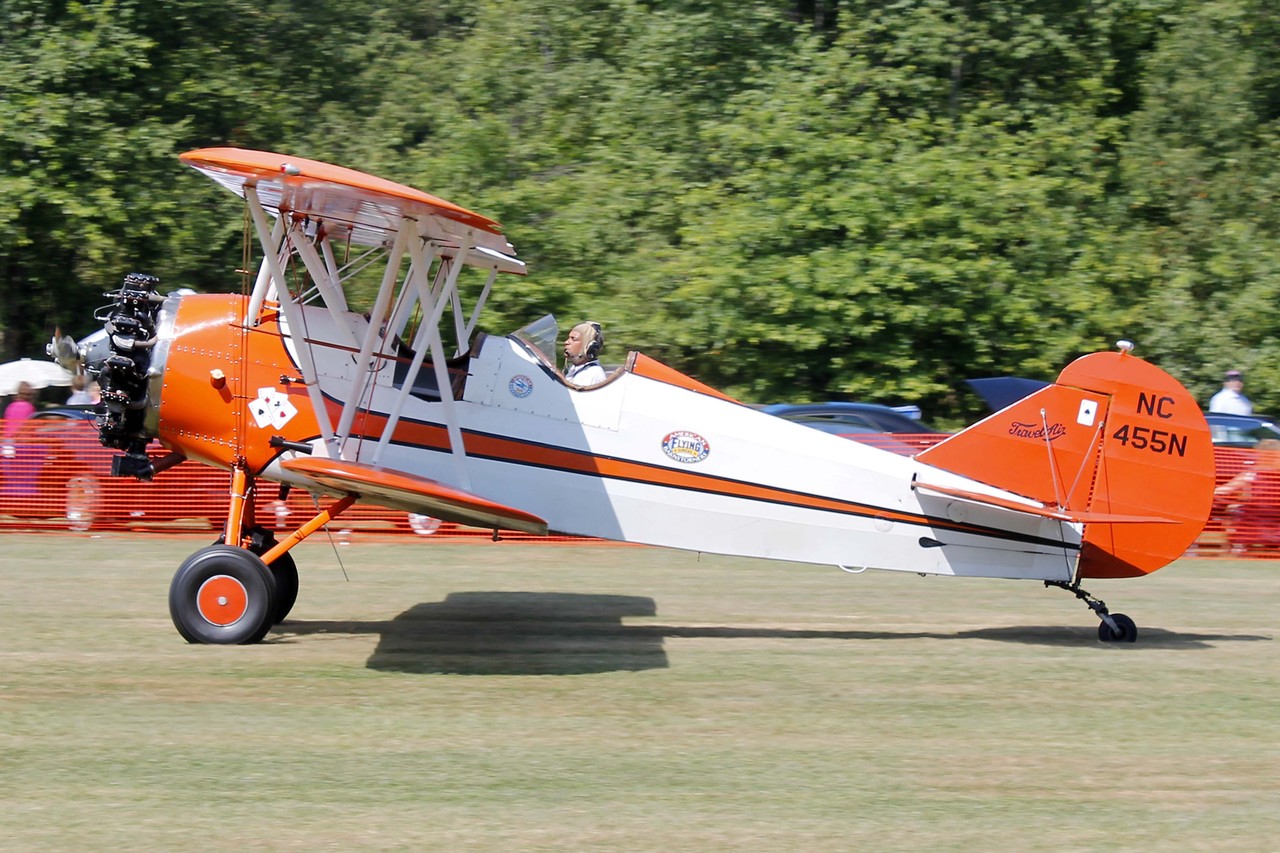
The Golden Age Representative
The Travel Air 4000 emerged during aviation's most romantic period, when Travel Air Manufacturing Company dominated American aircraft production more than any other manufacturer between 1924 and 1929. Lloyd Stearman, the aircraft's chief designer, collaborated with company co-founders Walter Beech, Clyde Cessna, and Bill Snook to create what became the definitive civilian touring aircraft of its era. The design objectives centered on producing a practical executive transport suitable for the burgeoning sport flying market that characterized the pre-Depression boom years.
Manufacturing Excellence
Travel Air Manufacturing Company, formed in January 1925 by former Swallow Aircraft Manufacturing Company employees, experienced meteoric growth during the 4000's production period. Starting with a modest 900-square-foot factory and six employees, the company expanded dramatically to employ 650 workers operating two shifts in a state-of-the-art production facility by 1929. The company built 14 Model 4000s during 1927, with production continuing through 1929 when approximately 100 aircraft had been completed, including two conversions from earlier Model 2000s.
The aircraft received type certificate ATC-32 in April 1928, legitimizing its commercial operations. However, Travel Air's remarkable success story ended abruptly when the Great Depression forced the company's absorption into Curtiss-Wright Aeronautical Corporation in 1930, marking the end of an independent manufacturer that had produced over 1,000 biplanes during its brief but prolific existence.
Engine Configurations and Performance
The Travel Air 4000's versatility stemmed largely from its adaptability to various Wright radial engines. Initially powered by the Wright J-5 Whirlwind—the same reliable 220-horsepower, 9-cylinder radial engine that propelled Charles Lindbergh's Spirit of St. Louis—the aircraft later accommodated multiple engine options. From late 1928 onward, Travel Air applied the Model 4000 designation to aircraft equipped with various air-cooled radials, including the 165-horsepower Wright J-6 Whirlwind on the E-4000 variant and the powerful 320-horsepower Wright R-760 Whirlwind on the D4000 Speedwing.
This engine flexibility allowed the aircraft to achieve a maximum speed of 125 mph while maintaining the docile handling characteristics that made it popular among civilian pilots. The aircraft's construction combined welded steel tube fuselage construction with wooden wings, creating a robust yet relatively lightweight structure weighing 2,001 pounds fully loaded.
Specialized Variants and Applications
The 4000's basic design spawned numerous specialized variants addressing specific market demands. The Model BM-4000 represented a dedicated mailplane conversion, with at least seven aircraft built or converted by replacing the front passenger cockpit with a mail compartment. The Model D4000 Speedwing, built in 1928, featured shorter, thinner wings that improved speed performance for racing applications.
Perhaps most notably, Parks Air College created the Model L-4000 in 1941 by retrofitting existing Model 4000s with Lycoming R-680-B4 engines, dual controls, and folding blind-flying hoods for training purposes. Other variants included the Model B9-4000 with Wright J-6-9 engines and outrigger undercarriage, and the lightened Model D-4-D with reduced-span wings.
Civil Service and Notable Operations
The Travel Air 4000 found its primary market among private owners and aerial sightseeing businesses that capitalized on America's growing fascination with aviation. Bill Shank, one of America's first civilian airmail pilots, became the first owner of the Travel Air E-4000 (registration NC648H) built in July 1929. The Shank family operated this aircraft from Indianapolis, Indiana, for nearly three decades, demonstrating the type's remarkable longevity and reliability.
The aircraft frequently appeared at air races and aerobatic competitions throughout the 1920s and 1930s, where its graceful appearance and solid performance made it a crowd favorite. The three-seat configuration—pilot in the rear cockpit with two passengers forward—provided an ideal arrangement for the barnstorming and pleasure flying operations that defined civilian aviation during this period.
Surviving Legacy
Today, several Travel Air 4000s survive in museums and private collections, serving as tangible links to aviation's golden age. The EAA Museum displays E-4000 NC648H, the same aircraft once owned by the Shank family, while the Shuttleworth Collection in England maintains a flying D4000 Speedwing registered N8115. These preserved examples continue to represent the classic round-engine biplane aesthetic that defined American general aviation during the brief but influential period before the Great Depression transformed the industry.
The Travel Air 4000's significance extends beyond its modest production numbers, embodying the optimistic spirit of late-1920s American aviation when manufacturers like Travel Air briefly dominated world aircraft production through innovative design and aggressive expansion, only to vanish when economic reality ended aviation's first golden age.