
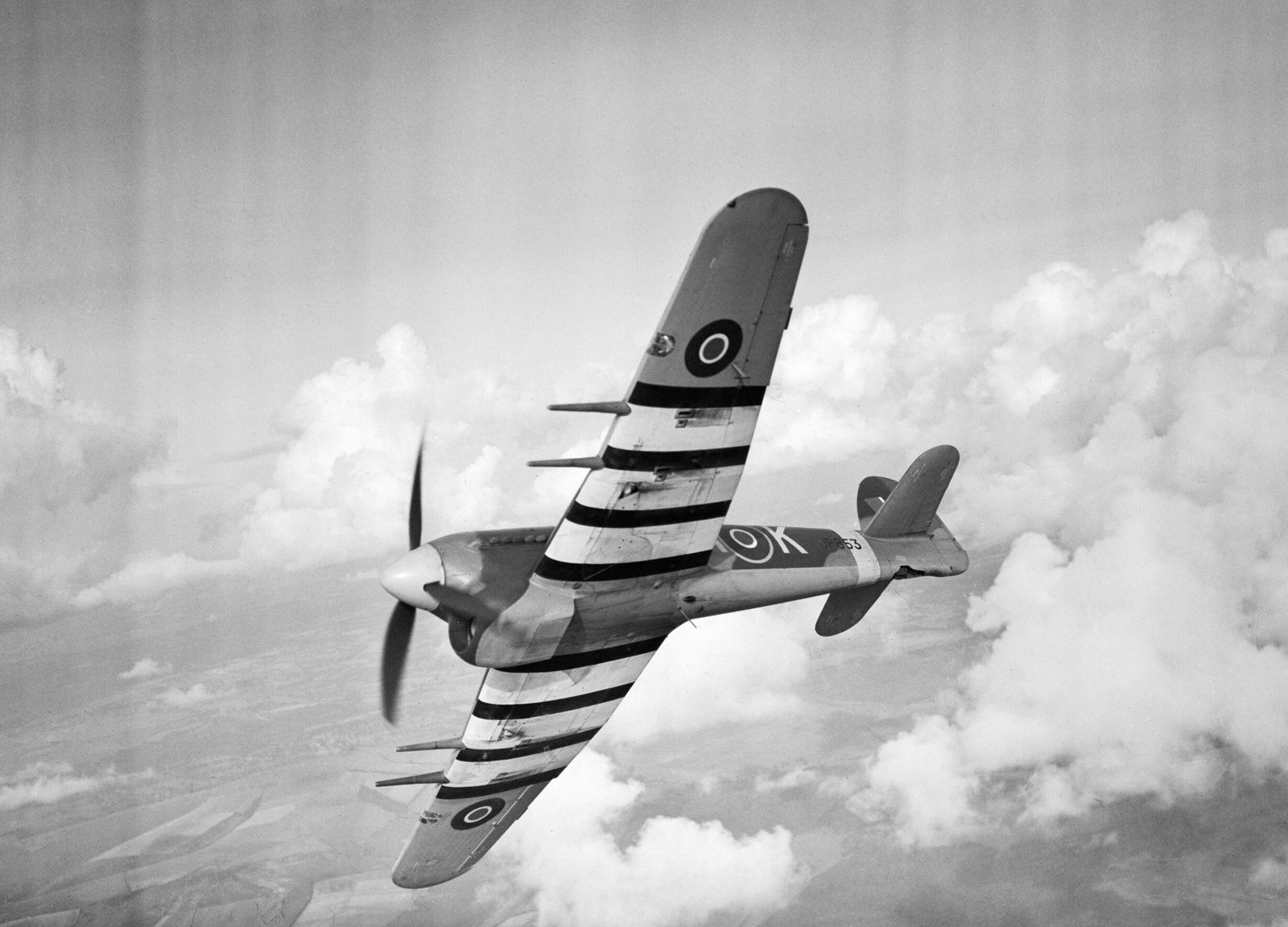
Design and Development
Designed by Sir Sydney Camm of Hawker Aircraft Ltd, the Typhoon was developed to meet Air Ministry Specification F.18/37. Camm envisioned the aircraft as a high-performance successor to the Hawker Hurricane, intending for it to serve as a medium- to high-altitude interceptor. The prototype, P5212, first flew on 24 February 1940. The design was characterized by a thick, large wing with a span of approximately 41 feet, which provided excellent lift at low altitudes but created significant drag that hindered performance above 20,000 feet. To achieve the required speed, the aircraft was powered by the Napier Sabre, a liquid-cooled, 24-cylinder H-type piston engine capable of producing between 2,000 and 2,200 hp, with the Sabre II variant typically delivering around 2,180 hp.
Production and Manufacturing
While Hawker Aircraft Ltd handled the design and initial production batches—including a small group of Typhoon IA and IB models built at Langley, Buckinghamshire—the majority of series production was transferred to the Gloster Aircraft Company to maintain Hawker's capacity for other projects. Production figures vary across sources, with estimates ranging from 3,205 to 3,330 aircraft. Most production occurred between 1941 and 1944, with the type being withdrawn from frontline service by December 1945. The manufacturing lineage of the aircraft is now represented by BAE Systems plc, the successor to the Hawker Siddeley group.
Military Service and Operational History
The Typhoon entered Royal Air Force (RAF) service in September 1941 with No. 56 Squadron. Initially plagued by structural failures, engine unreliability, and cockpit carbon monoxide leaks, the program was nearly cancelled. However, its ability to catch the German Fw 190 at low altitudes saved the aircraft and redefined its role. By late 1942, the Typhoon transitioned into a fighter-bomber, capable of carrying two 1,000 lb bombs. In the spring of 1943, the adoption of RP-3 rockets transformed it into a potent ground-attack platform.
Operating primarily within the 2nd Tactical Air Force, the Typhoon became indispensable during the D-Day landings and the subsequent campaign in northwest Europe. It played a decisive role in the Battle of the Falaise Pocket in August 1944 and conducted "Channel Stop" missions against German shipping. In total, 26 squadrons operated the type. Despite its success, attrition was high; over 500 aircraft were lost in combat, with the majority falling to flak.
Technical Specifications and Legacy
The standard Typhoon IB was armed with four 20 mm Hispano Mk II cannons, eight RP-3 rockets, and bombs up to 1,000 lbs. It reached a maximum speed of approximately 412 mph at 18,000 feet, with a service ceiling of 35,200 feet and a range of 510 miles. Following the war, most Typhoons were scrapped. Today, very few airframes survive, with MN235 being a notable example subject to modern restoration efforts. The Typhoon's legacy lies in its pioneering of high-speed rocket-attack tactics and its role as the precursor to the improved Hawker Tempest.