
Service History
The HU-16 Albatross established itself as the premier amphibious rescue aircraft of the United States Armed Forces, serving primarily with the U.S. Air Force, Navy, and Coast Guard from the late 1940s through the 1970s. More than 464 Albatrosses were produced between 1949 and 1961, making it one of the most successful post-war amphibious aircraft designs. The type dominated air-sea rescue missions during the Korean War and Vietnam conflict, where its ability to land on water proved invaluable for retrieving downed aircrews from hostile territory.
Military Variants and Operations
The aircraft served under multiple designations across different branches: the Air Force operated it as the SA-16 (later HU-16), while the Navy used it as the UF-1 and UF-2 variants. Coast Guard versions performed search and rescue missions along American coastlines, where the Albatross's amphibious capability allowed operations in areas inaccessible to conventional aircraft or surface vessels. During the Vietnam War, specialized variants equipped with defensive armament conducted combat rescue missions deep into enemy territory.
The Manufacturer
Grumman Aircraft Engineering Corporation, founded in 1929 by Leroy Grumman and partners on Long Island, New York, built its reputation on rugged naval aircraft designs. The company's expertise in carrier-based aircraft made it a natural choice for amphibious designs like the Albatross. Grumman operated independently until 1994, when it merged with Northrop Corporation to form Northrop Grumman. The company also produced legendary aircraft including the F6F Hellcat, F-14 Tomcat, and the civilian Gulfstream series.
Engine and Technical Details
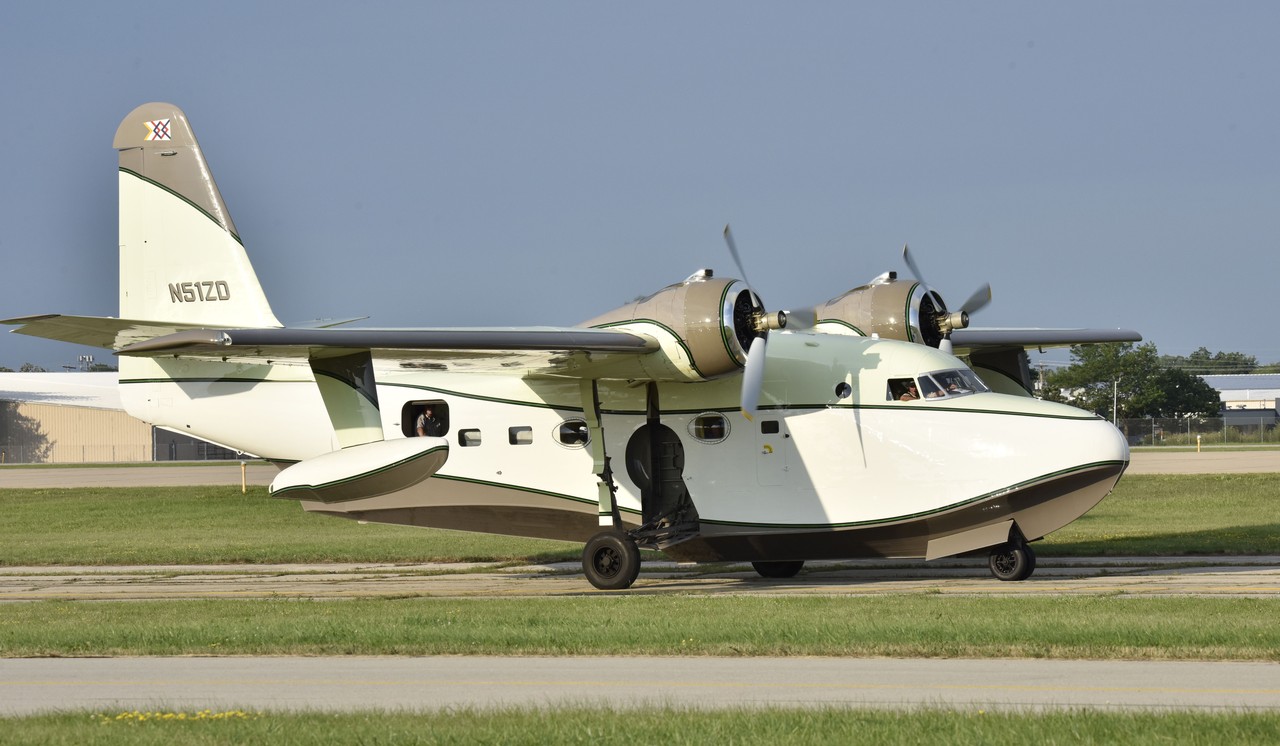
The HU-16 was powered by two Wright R-1820-76A Cyclone radial engines, each producing 1,425 horsepower. This powerplant configuration provided sufficient thrust for water takeoffs while maintaining reliability over long ocean flights. The aircraft featured a boat-like hull with retractable landing gear, allowing operations from prepared runways, grass fields, or open water. Wing-mounted floats provided lateral stability during water operations, while the high-wing design kept engines and propellers clear of spray.
Pilot Perspective
Pilots praised the Albatross for its stable handling characteristics both in the air and on water, though water landings required considerable skill due to the aircraft's size and weight. The type cruised at 150 miles per hour with a service ceiling of 21,500 feet and maximum range of 2,850 miles with auxiliary fuel tanks. Crews appreciated the spacious cabin and excellent visibility from the cockpit, essential features for search and rescue operations. However, pilots noted that the aircraft required careful attention to weight and balance, particularly when loading passengers or cargo through the large cabin doors.
International Service
Beyond U.S. military service, the Albatross found operators worldwide through military assistance programs and direct sales. Countries including Japan, Canada, Norway, and several South American nations operated the type for maritime patrol and rescue duties. The aircraft's robust construction and reliable engines made it particularly suitable for operations in remote areas with limited maintenance facilities.
Production and Legacy
Production ceased in 1961 after 464 aircraft were completed, making the HU-16 the last successful large amphibian produced in significant numbers by an American manufacturer. The type's success stemmed from its practical design that balanced performance, capacity, and operational flexibility. While most military examples were retired by the 1980s, civilian conversions continued flying cargo and passenger services in remote locations where amphibious capability remained valuable.
Current Status
Today, fewer than 50 Albatrosses remain airworthy worldwide, with most serving specialized roles in cargo hauling, firefighting, or recreational flying. Notable museum examples are displayed at the National Naval Aviation Museum in Pensacola, Florida, and the National Museum of the United States Air Force in Dayton, Ohio. The aircraft's combination of size, complexity, and specialized operating requirements has made restoration and maintenance challenging for civilian operators, contributing to the type's declining numbers in active service.