
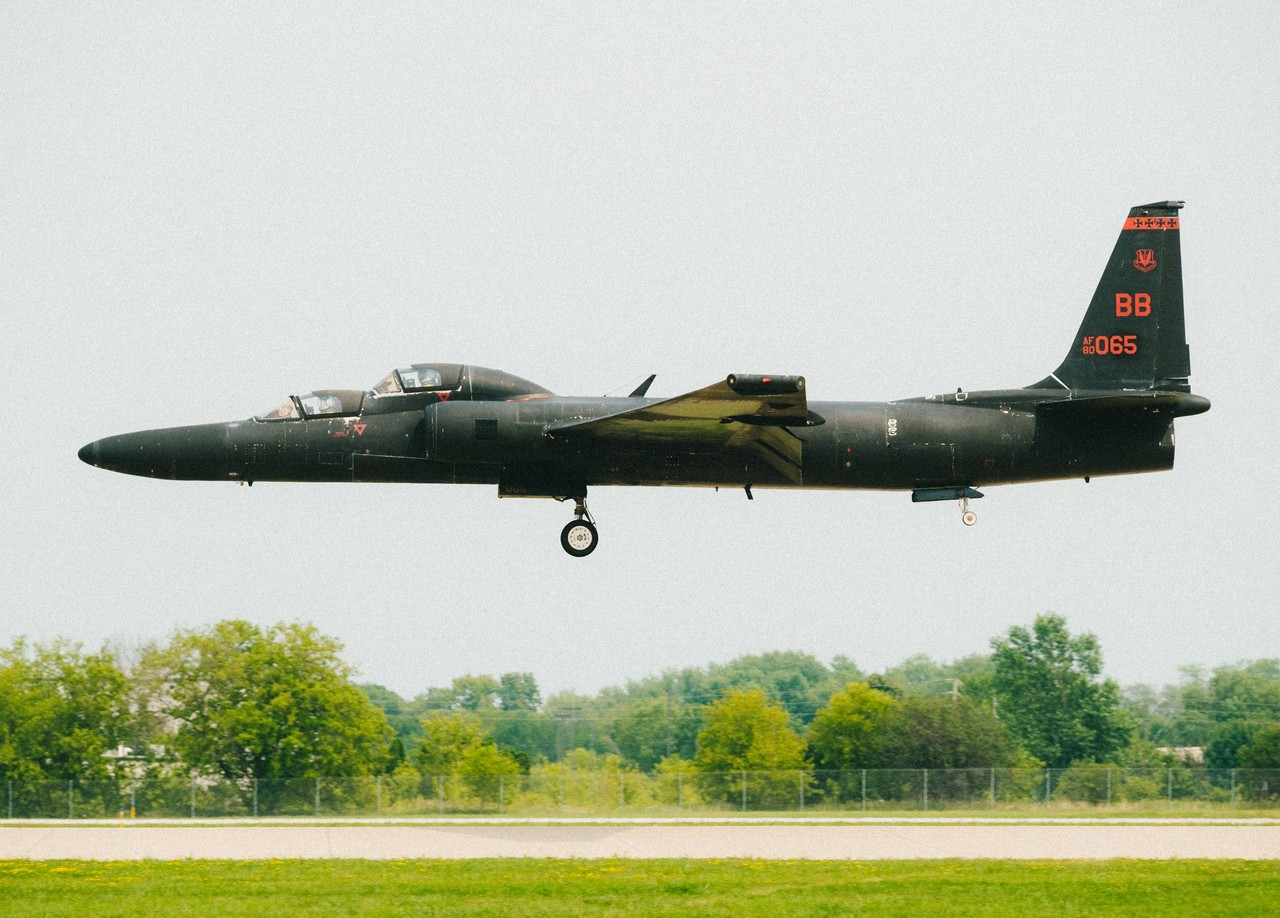
The Ultimate Cold War Spy Plane
The U-2's development began in 1954 when the CIA awarded Lockheed a $22.5 million contract for the first 20 aircraft, seeking a reconnaissance platform capable of overflying the Soviet Union beyond the reach of interceptors and surface-to-air missiles. The project demanded unprecedented performance: sustained flight at altitudes above 70,000 feet over hostile territory for hours at a time.
Design Revolution
Clarence L. "Kelly" Johnson, Lockheed's chief designer at the Skunk Works, created the U-2 by essentially mounting sailplane wings on a jet engine. His CL-282 design featured an 80-foot wingspan on a lightweight airframe measuring 49 feet in length. The aircraft's unusual landing gear configuration – bicycle-style main gear with wing-mounted "pogos" that dropped away on takeoff – reflected the extreme weight savings necessary to achieve the required altitude performance.
Test pilot Tony LeVier conducted the first flight at the secret Groom Lake facility in Nevada, though the aircraft's glider-like characteristics initially caught him off guard during landing attempts. The U-2's design prioritized altitude performance over conventional handling, requiring specialized pilot training and support equipment.
Operational History
The U-2 began operational missions in 1956, with the first overflight of the Soviet Union occurring on July 4, 1956, piloted by Hervey Stockman in aircraft 56-6680. For four years, U-2s conducted regular reconnaissance missions over denied territory, providing crucial intelligence on Soviet military capabilities and installations. These missions remained secret until May 1, 1960, when Soviet pilot Francis Gary Powers was shot down over Sverdlovsk while flying U-2C 56-6693.
The Powers incident created an international crisis, forcing President Eisenhower to admit to the overflights and effectively ending U-2 operations over the Soviet Union. However, the aircraft's intelligence value was definitively proven during the Cuban Missile Crisis in October 1962, when U-2 photographs revealed Soviet medium-range ballistic missiles under construction. Major Rudolf Anderson Jr. was killed when his U-2 was shot down over Cuba on October 27, 1962, nearly precipitating nuclear war.
Evolution and Variants
Production continued intermittently as mission requirements evolved. Lockheed built 30 U-2As through 1956, followed by 16 improved U-2Bs. The larger U-2R variant, first flown in 1967, stretched the fuselage to 63 feet and increased the wingspan to 103 feet, significantly expanding sensor capacity and endurance. In the 1980s, the Air Force ordered 25 TR-1A aircraft and 2 TR-1B trainers, officially designated for tactical reconnaissance but functionally identical to the U-2R.
The most significant upgrade came in 1994 with the U-2S program, which retrofitted aircraft with the General Electric F118-101 turbofan engine, replacing the original Pratt & Whitney J57 and later J75 turbojets. This powerplant, derived from the B-2 bomber's engine, increased endurance to over 12 hours and improved reliability for extended missions.
The Manufacturer
Lockheed Corporation's Skunk Works division, officially known as the Advanced Development Projects unit, earned its reputation for rapid, innovative aircraft development through programs like the U-2. Led by Kelly Johnson, the team completed the U-2's design and first flight in just nine months from contract signing. The secretive Burbank, California facility pioneered streamlined development processes that eliminated bureaucratic delays.
When Lockheed merged with Martin Marietta in 1995 to form Lockheed Martin, the Skunk Works tradition continued. The company has invested over $1.7 billion in U-2 upgrades since 1994, ensuring the aircraft's continued relevance in modern conflicts.
Technical Excellence
The U-2's performance remains classified, but the aircraft routinely operates at altitudes between 80,000 and 90,000 feet with mission durations exceeding 12 hours. Its range extends beyond 4,600 miles in current U-2S configuration, allowing global deployment from a few strategic bases. The single-pilot aircraft requires specialized high-altitude pressure suits and extensive physiological training due to the extreme operating environment.
Piloting the U-2 demands exceptional skill, particularly during landing when the aircraft's high lift-to-drag ratio and bicycle landing gear create unique challenges. The Air Force maintains a small cadre of U-2 pilots, typically selecting experienced fighter or test pilots for the demanding program.
Enduring Legacy
More than 100 U-2s were built across all variants, with 34 aircraft remaining in service today – 32 operational U-2S aircraft plus trainer variants operated by the 9th Reconnaissance Wing at Beale Air Force Base, California. Two additional aircraft serve NASA as ER-2s for high-altitude atmospheric research.
The U-2 holds the distinction of being the longest-serving aircraft in Air Force inventory, with some airframes approaching 70 years of service. Structural analysis indicates the aircraft can continue flying for decades, with 80 percent of design life remaining on most airframes. Several historically significant U-2s are displayed in museums, including the first aircraft to overfly the Soviet Union, preserved at the National Air and Space Museum in Washington, D.C.
The U-2's combination of extreme performance, adaptability, and operational effectiveness has made it irreplaceable in the modern military, continuing to provide critical intelligence capabilities well into the 21st century.