
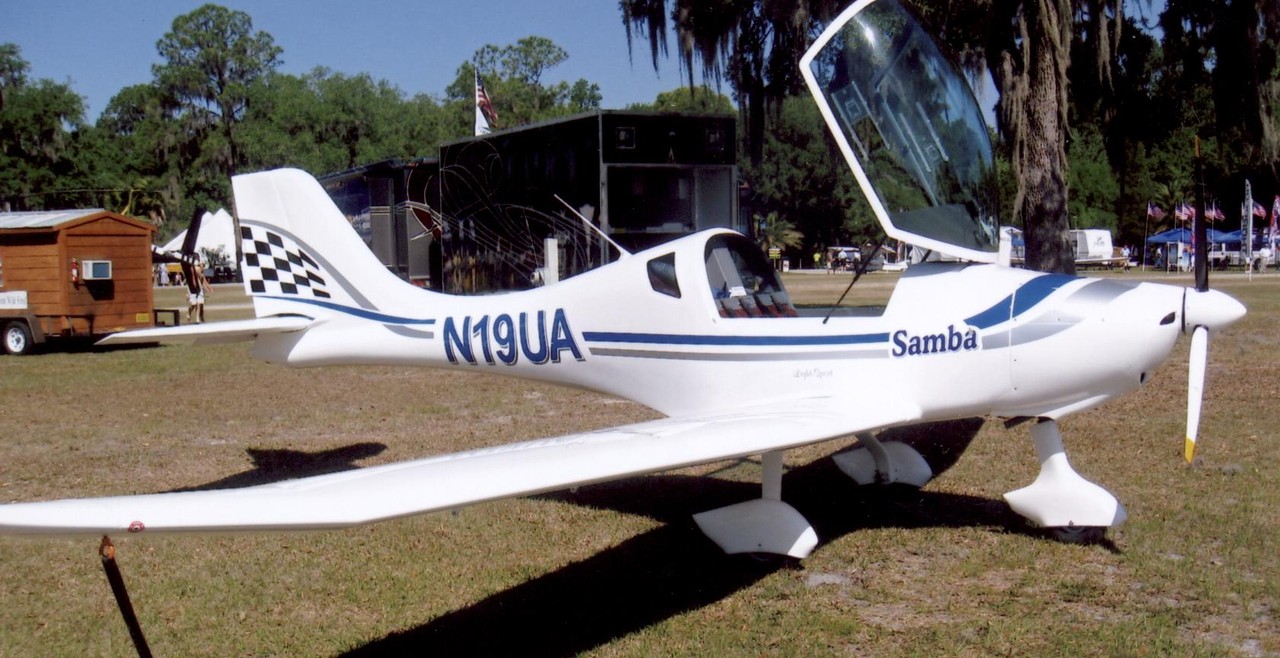
Development and Design
The UFM-10 Samba emerged from Urban Air's experience with the UFM-13 Lambada, sharing development roots in Czech microlight design philosophy. The company deliberately shortened both the wing and fuselage compared to the Lambada to achieve improved handling characteristics for training operations. Urban Air focused their design objectives on creating an economical touring aircraft suitable for sport flying and pilot instruction, utilizing advanced composite construction techniques that were becoming standard in European microlight manufacturing.
The aircraft's all-fiberglass construction represented a significant commitment to weight reduction and structural efficiency. This composite approach allowed Urban Air to achieve the strength-to-weight ratios necessary for microlight certification while providing durability for training environments where aircraft face frequent use and varied pilot experience levels.
Manufacturing and Production
Urban Air commenced production of the UFM-10 Samba around 1999-2000, with manufacturing facilities located in the Czech Republic. The company produced multiple variants including the Samba XL and XXL models, extending production through at least 2004. Czech registrations with OK- prefixes dominated early production, reflecting the aircraft's domestic market focus before international sales expanded.
The company's total production output reached 81 aircraft across all UFM-10 variants, though not all bore the Samba designation. This production level positioned Urban Air as a specialized manufacturer within the European microlight sector, focusing on quality over quantity in a competitive market segment.
International Service
The UFM-10 Samba achieved global distribution despite its modest production numbers, with aircraft registered across multiple continents. European operations included registrations in the Czech Republic, Germany, the United Kingdom, Ireland, and the Netherlands, reflecting strong acceptance within the European microlight community. International expansion reached South Africa and the United States, demonstrating the aircraft's adaptability to diverse operating environments and regulatory frameworks.
Private individuals comprised the primary operator base, utilizing the aircraft for personal sport flying and flight training activities. The side-by-side seating configuration proved particularly valuable for instruction, allowing effective communication between instructor and student while maintaining the economic advantages of microlight operation.
Technical Specifications and Performance
The UFM-10 Samba's single piston engine provided appropriate power for its intended role, though specific output figures and engine manufacturer details remain unspecified in available documentation. The aircraft's 5.9-meter length housed the two-seat cockpit and engine installation within a compact airframe optimized for microlight weight restrictions.
The low-wing configuration offered performance advantages over high-wing designs common in training aircraft, providing pilots with exposure to handling characteristics more representative of higher-performance aircraft. This design choice aligned with Urban Air's training objectives while maintaining the docile flight characteristics essential for student pilot operations.
Operational History and Safety Record
The UFM-10 Samba's operational history includes numerous documented incidents between 2002 and 2024, reflecting both the aircraft's active use and the inherent risks of microlight aviation. Five fatal accidents occurred during this period, including a 2004 incident in Mensfelden, Germany claiming two lives, a 2013 accident in Nevada resulting in two fatalities, and a 2023 crash in Havlickuv Brod, Czech Republic with one fatality.
Despite these incidents, many UFM-10 Sambas continue flying operations as of 2024. Active registrations include OK-JUA 03, photographed at Northrepps, United Kingdom in 2022, D-MVCO operating in Germany, and OK-NUA 11 documented in the Czech Republic in 2012, demonstrating the aircraft's continued viability for sport aviation.
Legacy and Current Status
Urban Air appears to have ceased operations under that company name, with no evidence of continued UFM-10 production or company activity beyond the mid-2000s. The Samba's legacy remains tied to its role in European microlight development and its contribution to affordable pilot training options during its production years.
The aircraft's impact on aviation history remains modest, limited by its small production run and niche market position. However, surviving examples continue serving their intended purpose of providing economical access to powered flight, maintaining Urban Air's vision of accessible recreational aviation for private pilots seeking cost-effective aircraft ownership and operation.