
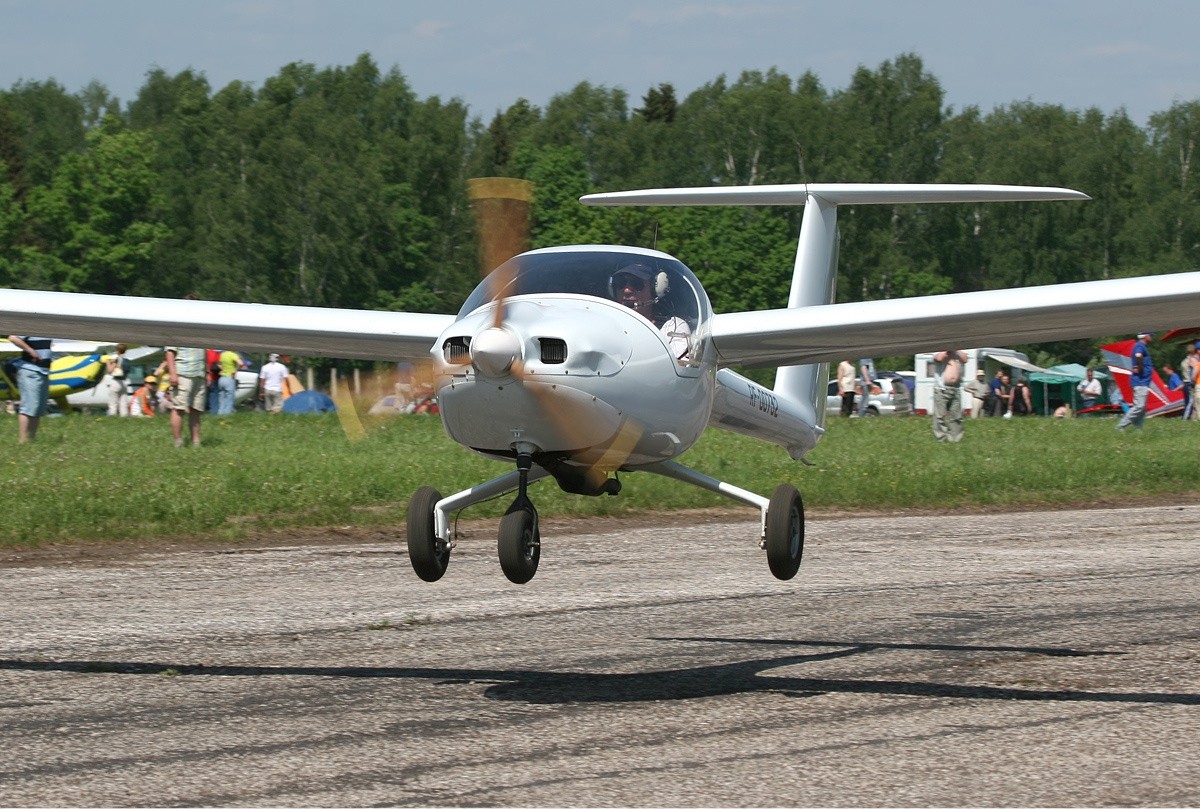
Development and Design Innovation
The UFM-13 Lambada emerged from the collaborative efforts of three Czech engineers led by Pavel Urban, with technical assistance from renowned glider manufacturer Schempp-Hirth. The design team faced the challenge of creating an aircraft that could satisfy both Fédération Aéronautique Internationale microlight regulations (472.5 kg gross weight) and US light-sport aircraft requirements (600 kg), while delivering genuine sailplane performance.
The prototype's maiden flight in May 1996 validated the team's ambitious design objectives. The aircraft featured an innovative composite construction utilizing fiberglass and carbon fiber in sandwich structures, married to a shoulder-wing cantilever configuration with SM 701 airfoil sections. The distinctive T-tail arrangement and bubble canopy provided excellent visibility, while the quickly dismountable wings enabled practical ground transportation.
Technical Excellence and Performance
Powered by proven four-stroke engines including the 80-horsepower Rotax 912UL or 85-horsepower Jabiru 2200, the Lambada achieves cruise speeds of 150 kilometers per hour while maintaining a gentle stall speed of just 64 kilometers per hour. The aircraft's most impressive characteristic lies in its soaring capability, with the 13-meter wing configuration delivering a 26:1 glide ratio that improves to 30:1 when fitted with the extended 15-meter wings.
The extendable wing system represents a significant engineering achievement, allowing operators to optimize the aircraft for specific missions. With 100 liters of fuel capacity distributed across twin 50-liter tanks, the Lambada provides substantial endurance for cross-country flights or extended glider towing operations. The standard Magnum ballistic parachute recovery system adds an important safety margin for both training and recreational use.
Production History and Corporate Changes
Urban Air s.r.o. commenced production following the prototype's successful test program, establishing manufacturing facilities in Ústí nad Orlicí. The company's commitment to quality earned recognition through multiple awards, including the 1996 Gold Medal at Aerosalon Jihlava and victory in the 1998 World Microlight Cup FTS Class competition in Matkopusza, Hungary.
Production continued steadily through the 2000s, with serial numbers indicating at least 113 aircraft completed by 2009. However, financial difficulties forced Urban Air's closure around 2010, threatening the Lambada's future. Distar Air, a division of Distar CZ a.s., acquired the design rights and resumed production, ensuring continuity for this successful design.
Operational Service and Global Reach
The Lambada found acceptance among private owners and gliding clubs worldwide, with examples registered across multiple continents. In the United States, Urban Air USA distributed the aircraft from Melbourne, Florida, as of 2008, targeting the growing light-sport aircraft market. The type's dual role capability as both recreational aircraft and glider tug enhanced its commercial appeal.
Notable examples include ZK-MFS in New Zealand, originally assembled by Wings N Tracks in South Africa before registration as ZS-GXD on July 22, 2003. This aircraft later received the extended 15-meter wing modification by August 17, 2014. The Netherlands registered PH-3H4 (serial number 5/15) on March 20, 2000, with type certification updated on April 25, 2007.
Safety Record and Incidents
Despite its generally positive safety record, the Lambada has experienced notable accidents that highlight the importance of proper pilot training and operational procedures. On March 7, 2010, ZS-GXH (serial number 34/13) crashed at Worcester Airfield in South Africa, claiming the life of a 55-year-old pilot. Earlier, on June 23, 2009, N17UA (MSN 113/13) operated by San Antonio Light Sport Aircraft crashed in the United States due to exceeding the aircraft's never-exceed speed of 200 kilometers per hour.
Current Status and Legacy
As of 2012, Distar Air continued active production of the Lambada, with two new units nearing completion for US delivery in March 2013. The aircraft's influence extends beyond direct sales, inspiring related designs including the Urban Air UFM-10 Samba and contributing to advances in composite light aircraft construction.
The Lambada's legacy lies in demonstrating that microlight and light-sport aircraft could achieve genuine sailplane performance while maintaining practical operational characteristics. Its 30:1 glide ratio with extended wings rivals purpose-built gliders, while the robust landing gear options and side-by-side seating configuration suit both training and recreational missions. Today, surviving examples continue serving gliding clubs and private owners, representing an important milestone in the evolution of efficient light aviation.