
Service History
The UTVA 65 Privrednik carved out a specialized niche in agricultural aviation across southeastern Europe and North Africa during the late 1960s and early 1970s. Yugoslav agricultural cooperatives formed the primary operator base, utilizing the aircraft's purpose-built design for extensive pesticide spraying campaigns and mosquito control programs. The type's international reach extended to Algeria, where Société de Travail Aérien acquired five UTVA-65s beginning in October 1968, demonstrating the aircraft's suitability for Mediterranean agricultural conditions.
The Manufacturer
Fabrika Aviona Utva emerged as Yugoslavia's premier light aircraft manufacturer following its establishment on June 5, 1937, in Zemun. The company relocated to Pančevo by 1940, where it initially focused on glider production before expanding into powered aircraft manufacturing in 1939. UTVA weathered significant challenges, including substantial damage during the 1999 NATO bombing of Yugoslavia, but maintained operations through various ownership changes. In 2017, Serbian defense company Yugoimport SDPR acquired approximately 96 percent of shares, ensuring the manufacturer's continuation as a subsidiary specializing in general aviation aircraft, trainers, and unmanned aerial vehicles.
Engine & Technical Details
The design team of B. Nikolić, M. Dabinović, and S. Cotič engineered the UTVA 65 as a derivative of the high-wing UTVA-60, transforming it into a low-wing configuration optimized for agricultural operations. The engineers strengthened the wing roots and increased the wingspan by 0.82 meters, creating a robust platform for low-altitude spray missions. The aircraft's single-spar all-metal wings incorporated interconnected ailerons and flaps, with the flaps drooping 15 degrees at full extension for enhanced low-speed handling characteristics.
Power came from Lycoming's proven six-cylinder horizontally-opposed air-cooled engines, with operators choosing from multiple variants based on operational requirements. The GO-480-B1A6 produced 270 horsepower, while the geared GO-480-G1A6 delivered between 290 and 295 horsepower with improved propeller efficiency for agricultural work. The most powerful standard variant, the IGO-540-B1A, generated 350 horsepower, providing exceptional performance for heavily loaded spray missions. Later production aircraft received IO-540 series engines, including the IO-540-K1A5 at 300 horsepower and the IO-540-A1C producing 350 horsepower in the 1973 Super Privrednik-350.
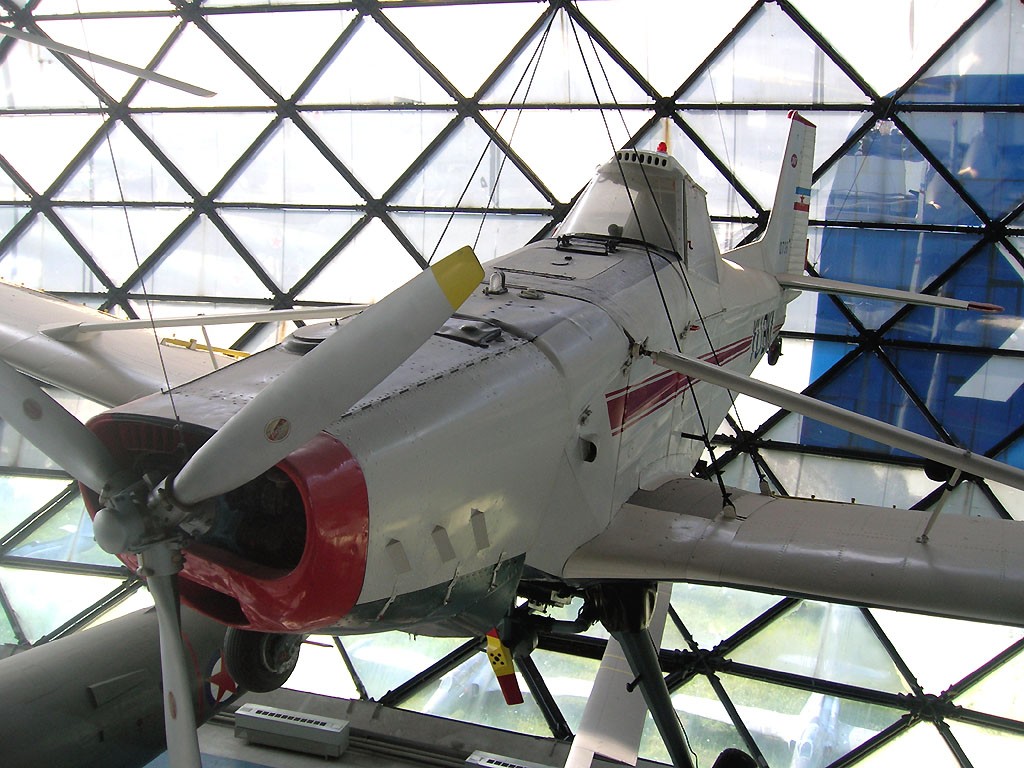
The aircraft's steel-tube fuselage combined metal and fabric construction, balancing structural integrity with weight considerations. A cantilever tailwheel undercarriage angled outward from the wing roots, providing stable ground handling on unprepared agricultural strips. The elevated cockpit position afforded pilots excellent visibility for precision spray applications, while the 0.75 cubic meter chemical hopper positioned ahead of the cockpit maintained proper weight distribution.
Pilot Perspective
Pilots appreciated the UTVA 65's docile handling characteristics and robust construction, essential qualities for low-altitude agricultural operations. The aircraft demonstrated impressive low-speed performance with a stall speed of just 76 kilometers per hour, enabling precise application patterns over irregular terrain. At cruise power, the Privrednik maintained 192 kilometers per hour while carrying full chemical loads, with a maximum speed of 234 kilometers per hour available when needed.
Operational range reached 620 kilometers with standard 185-liter fuel capacity, providing substantial coverage for regional spray contracts. The aircraft's design philosophy emphasized reliability and maintainability over outright performance, reflecting the practical demands of agricultural aviation where aircraft often operated from remote strips with limited support facilities.
Production & Legacy
UTVA's production run totaled exactly 69 aircraft between 1965 and the early 1970s, representing a modest but successful specialized program. The limited production reflected the aircraft's narrow market focus rather than design shortcomings, as the Privrednik effectively served its intended agricultural role throughout its operational career.
The type has since retired from active service, with no confirmed airworthy examples remaining in operation today. Aviation Museum Belgrade in Serbia preserves a UTVA-65S as a representative example of Yugoslavia's agricultural aviation heritage, displaying the aircraft as part of the country's broader aviation development story.
The UTVA 65 Privrednik stands as a testament to focused engineering, successfully adapting proven design elements for specialized agricultural requirements while maintaining the reliability essential for commercial spray operations across diverse operational environments.