
Service History
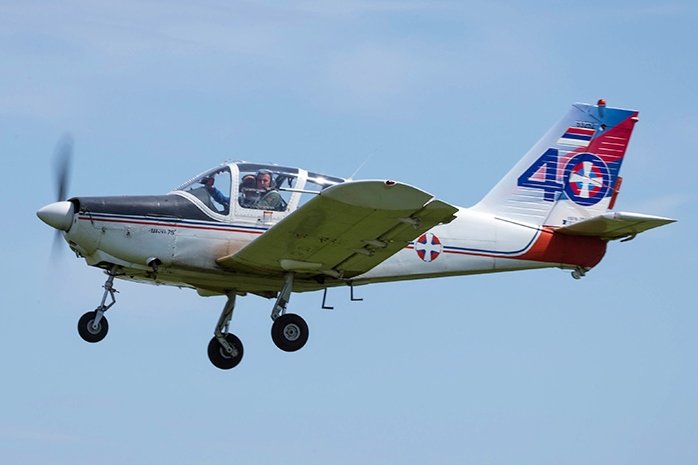
The UTVA 75 entered Yugoslav Air Force service in 1976 as the primary replacement for the aging wooden UTVA Aero 3, which had served since 1956. The aircraft fulfilled multiple roles including primary flight training, observation, target designation, and liaison duties. Following Yugoslavia's dissolution in 1991, the fleet was distributed among successor states, with Serbia retaining the largest number for continued military training operations at Batajnica Air Base's 252nd Training Squadron, 204th Air Brigade.
The aircraft found its way into civilian hands through Yugoslav aeroclubs, including AK Maribor which operated YU-DGF and AK Štip which flew YU-DGX. Slovenia's 15th Military Aviation Brigade acquired ex-YU-DGF (construction number 53171, built in 1980), while Macedonia brought Z3-DGX (construction number 53183, built in 1981) into service in June 1993.
Wartime Operations
During the Yugoslav Wars of 1991-1995, the UTVA 75 saw its only combat application when Croatian forces hastily modified several aircraft with wing-mounted M79 and M80 shoulder-launched anti-tank rockets. This improvised weaponization marked the first and only time the aircraft was used in an offensive role, demonstrating the desperate measures taken during the conflict's early stages.
Slovenian forces maintained their UTVA 75 strictly for training purposes throughout the conflicts, while Macedonian examples served primarily in observation and liaison roles. The aircraft's simple construction and reliable Lycoming powerplant proved valuable during a period when international arms embargoes complicated spare parts procurement.
The Manufacturer
UTVA Aviation Industry traces its origins to 5 June 1937, when it was founded as UTVA Fabrika Aviona in Zemun, Yugoslavia. Initially focused on glider production, the company transitioned to powered aircraft in 1939, manufacturing licensed Bücker Bü 131 Jungmann trainers alongside indigenous designs like the Ikarus 212/213 series and UTVA Aero 3.
The company relocated to Pančevo in 1939, where it would remain for the duration of its existence. By 1983, it had become UTVA-Sour Metalne Industrije, RO Fabrika Aviona, producing over 20 variants of the successful UTVA-56 four-seat monoplane, which first flew on 22 April 1959. NATO air strikes on 24 March 1999 severely damaged the Pančevo facility, halting projects including the G-4M Super Galeb, Lasta 2, and UTVA-96. While UTVA-96 production resumed in late 2003, the company ceased independent operations, though elements survived within Serbia's aviation sector to support modern projects like the UTVA Lasta 95, introduced in 2011.
Design and Development
The UTVA 75 evolved from earlier concepts designated M-10 (two-seat utility) and M-11 (four-seat touring), with initial assistance from Polish manufacturers that ended due to financial constraints. Design objectives emphasized creating a modern, reliable primary trainer to replace the obsolete wooden UTVA Aero 3, incorporating an all-metal low-wing configuration with fixed tricycle landing gear.
The prototype achieved first flight on 19 May 1976, marking a generational shift from wood and fabric construction to all-metal manufacturing. The design prioritized simplicity and reliability while maintaining multirole potential for training, observation, and target designation missions.
Engine and Technical Specifications
Powering the UTVA 75 was a single Textron Lycoming AEIO-360-B1F four-cylinder horizontally-opposed piston engine, producing 180 to 185 horsepower. This powerplant choice reflected Yugoslavia's pragmatic approach to aircraft design, selecting proven Western technology rather than attempting domestic engine development.
The aircraft featured side-by-side seating for instructor and student, optimizing communication during training flights. The low-wing configuration provided ground handling advantages and simplified maintenance compared to high-wing alternatives, while the fixed tricycle gear reduced complexity and training time for new pilots.
Production and Variants
UTVA manufactured approximately 136 UTVA-75A21 military trainers between 1977 and 1985, with total production including civilian variants reaching an estimated 200 aircraft. The primary military variant served in observation and target designation roles based on the earlier UTVA-66 concept.
In 1986, UTVA developed prototypes of the UTVA-75A41, a four-seat civilian variant intended for the general aviation market. However, this variant never entered production due to comfort and noise issues that made it unsuitable for commercial success.
International Service
Beyond the Balkans, Sudan acquired six second-hand UTVA 75 aircraft in 2009. SAFAT Aviation Group subsequently modernized at least two examples as the SAFAT 03, displaying one at the 2011 Dubai Air Show with reported intentions for serial production, though this program's current status remains unclear.
Legacy
Dozens of UTVA 75 aircraft remain airworthy in private hands throughout the Balkans, with Serbia's Air Force continuing limited operations for pilot evaluation, technical training, and glider towing missions. While officially replaced by the UTVA Lasta 95 in 2011, the type continues in auxiliary roles, representing one of the last examples of Yugoslavia's domestic aviation industry achievements during the Cold War era.