
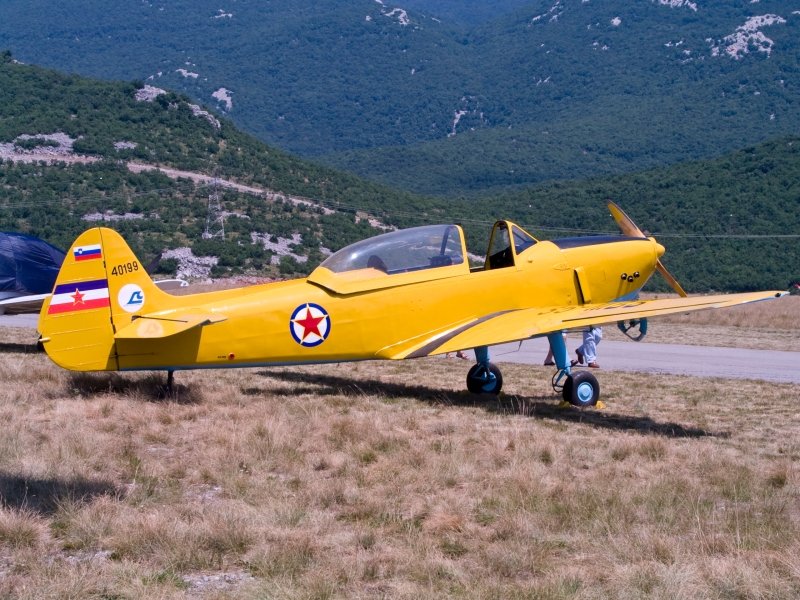
The Utva Aero 3 was developed in the mid-1950s by the Utva Aviation Industry in Yugoslavia to serve as a domestic replacement for the Ikarus Aero 2. Designed to meet specific Yugoslav Air Force requirements, the aircraft was intended for use as both a primary trainer and an army co-operation liaison aircraft. The Aero 3 performed its maiden flight in 1956 and entered active service with the Yugoslav Air Force by 1958. It quickly became the nation's primary training aircraft, a role it maintained until the mid-1970s.
Technically, the Aero 3 is a low-wing cantilever monoplane characterized by its traditional all-wood construction with fabric elements. The aircraft features a fixed tailwheel landing gear and a bubble canopy covering two tandem seats for a student and an instructor. It is powered by a nose-mounted Lycoming O-435-A piston engine, which delivers 185 hp. In terms of performance, the aircraft is capable of a maximum speed of 143 mph and a cruise speed of 112 mph, with a service ceiling of 14,100 feet and a maximum range of 422 statute miles.
Production of the Aero 3 was carried out by Utva Aviation Industry, a company founded on June 5, 1937, which continues to operate today as UTVA AVIO d.o.o. While exact production dates are not documented, approximately 110 aircraft were built. The type remained the cornerstone of Yugoslav pilot training for nearly two decades until it was eventually superseded by the UTVA 75. The transition occurred in the mid-1970s as the Aero 3's spartan equipment and wooden airframe were considered obsolete.
Following its military retirement, very few examples of the Aero 3 survive. One notable survivor is an Aero-3-F (construction number 40169), registered as N9105Y, which is preserved at the Estrella Warbirds Museum in California. According to museum records, only one or two other flying examples of the Aero 3 are known to exist worldwide, making the surviving airframes exceptionally rare representatives of Yugoslav aviation history.