
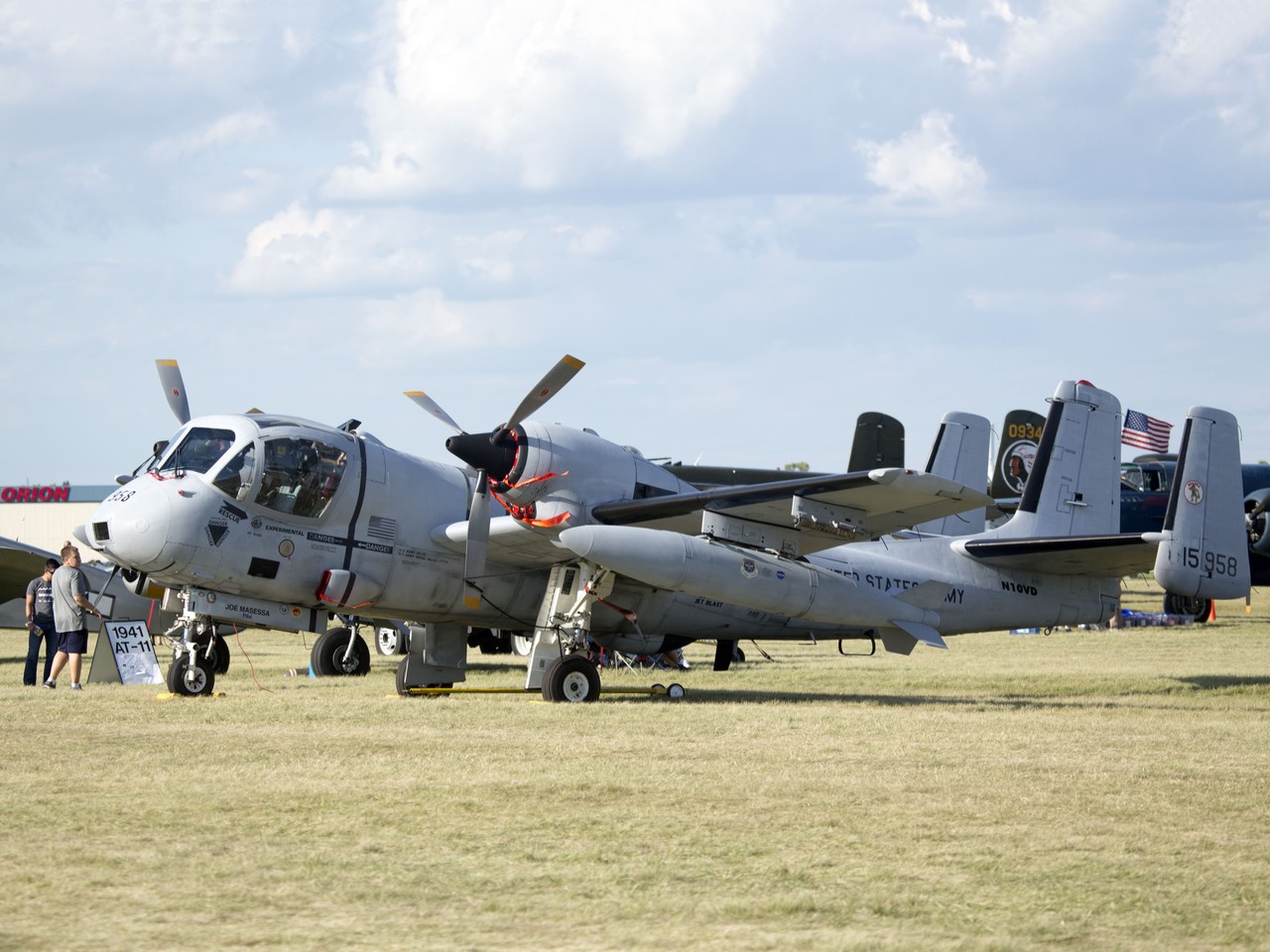
Revolutionary Battlefield Intelligence
The OV-1 Mohawk dominated U.S. Army tactical reconnaissance from 1961 to 1996, introducing advanced electronic surveillance capabilities directly under field commanders' control. During the Vietnam War, five surveillance companies operated Mohawks throughout Southeast Asia by 1968, providing real-time battlefield intelligence that transformed ground operations. The aircraft's modular pallet system allowed crews to reconfigure between photographic, radar, and infrared missions in approximately one hour, making it the most versatile reconnaissance platform of its era.
Combat Service and Variants
The Mohawk entered combat in September 1962 when the first aircraft arrived in South Vietnam. Four distinct variants served specific reconnaissance roles: the OV-1A carried KA-60 cameras for photographic intelligence, the OV-1B featured side-looking airborne radar (SLAR) for all-weather surveillance, the OV-1C specialized in infrared detection, and the OV-1D combined all capabilities through interchangeable sensor pallets.
Beyond Vietnam, Mohawks patrolled the Korean Demilitarized Zone from 1963, monitored Berlin Wall activities during Cold War tensions, and served with the 7th Army in Germany. The aircraft's ability to operate from rough forward airstrips brought sophisticated surveillance capabilities directly to combat zones for the first time.
Grumman's Engineering Excellence
Grumman Aircraft Engineering Corporation developed the G-134 design in response to a 1954 Army requirement for a battlefield surveillance aircraft superior to the piston-powered Cessna L-19 Bird Dog. The company, founded in 1929, had earned recognition for innovative naval fighters including the F4F Wildcat and F6F Hellcat during World War II, plus postwar designs like the F9F Panther jet and E-2 Hawkeye early warning aircraft.
Chief test pilot Ralph Donnell flew the prototype YAO-1AF from Grumman's Bethpage, New York facility on April 14, 1959. The design team incorporated several innovations: exceptional low-speed handling, short takeoff and landing capability, and a distinctive upswept tail design that provided excellent visibility for the observer. Grumman operated until 1994, when it merged with Northrop Corporation to form Northrop Grumman.
Twin Turboprop Powerplant
Two Lycoming T53 turboshaft engines, modified for turboprop operation, powered the Mohawk through its service life. Early OV-1A and OV-1B models used T53-L-3A engines, while later variants employed more powerful versions including the T53-L-15 producing 1,150 shaft horsepower each, and the T53-L-701 in the final OV-1D model.
Lycoming, part of the Avco Corporation and later Textron, manufactured more than 17,000 T53 engines between 1955 and the 1980s. The free-turbine design provided excellent throttle response for the demanding requirements of low-altitude reconnaissance missions, while proving exceptionally reliable in forward operating conditions.
Operational Characteristics
Pilots praised the Mohawk's forgiving flight characteristics and remarkable agility for such a large aircraft. The high-wing configuration and powerful engines provided excellent short-field performance, essential for operations from crude forward airstrips. With a maximum takeoff weight of 18,109 pounds, the aircraft could carry substantial sensor equipment while maintaining the maneuverability needed for tactical reconnaissance.
The side-by-side seating arrangement allowed the pilot and observer to coordinate effectively during missions, while the aircraft's stable platform proved ideal for photography and electronic surveillance. The distinctive inverted gull-wing landing gear provided ground clearance for underwing sensors while keeping the cabin low for easy crew access.
Production Legacy
Grumman delivered exactly 380 Mohawks across all variants: 64 OV-1As (1960-1965), 101 OV-1Bs (1960-1965), 169 OV-1Cs (1961-1969), and 46 new-production OV-1Ds (1969-1970). An additional 73 earlier aircraft were upgraded to OV-1D standard between 1973 and 1987, extending the type's operational relevance.
The Mohawk's influence extended beyond its direct military service, establishing the concept of modular reconnaissance systems that influenced subsequent surveillance aircraft designs. Its success demonstrated the value of turboprop power for tactical roles, paving the way for later Army aviation developments.
Today, fewer than ten Mohawks remain airworthy worldwide. The Planes of Fame Air Museum in California maintains OV-1A serial number 59-2604, the second production aircraft built at Bethpage in 1960, while MAPS Air Museum displays OV-1A 63-13128 from late 1963 production. These survivors represent the pioneering aircraft that revolutionized battlefield intelligence gathering for a generation of military operations.