
Service History
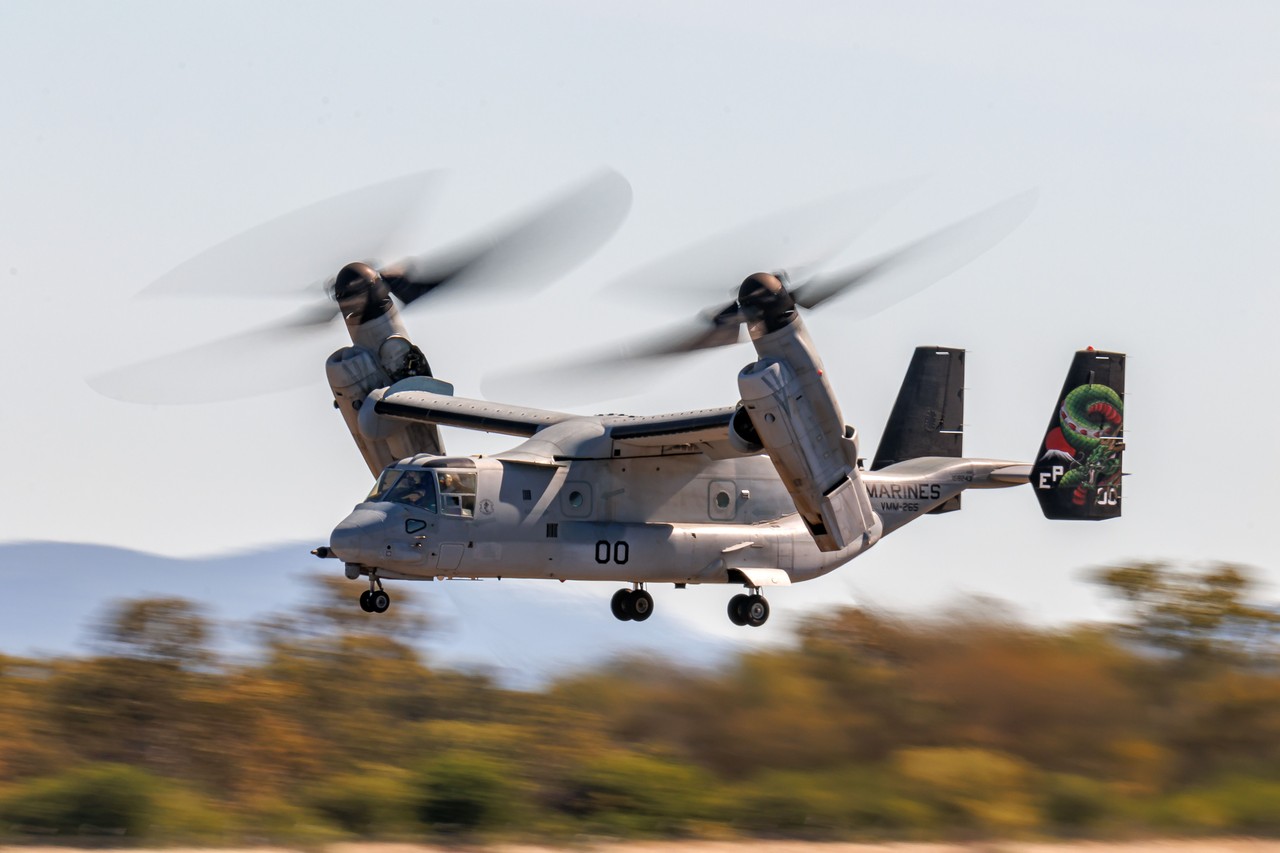
The V-22 Osprey achieved operational status with the U.S. Marine Corps in early 2007, marking the culmination of nearly two decades of development challenges. On September 17, 2007, Marine Medium Tiltrotor Squadron VMM-263 made aviation history by deploying from Marine Corps Air Station New River aboard the USS Wasp with 10 MV-22 Ospreys, becoming the first operational tiltrotor squadron. Over the following decade, the Osprey demonstrated what military officials described as "unparalleled operational performance" during extensive combat operations in Iraq and Afghanistan as part of Operations Iraqi Freedom and Enduring Freedom.
The aircraft's unique capabilities filled a critical gap in military aviation, replacing the aging CH-46 Sea Knight helicopters while providing substantially greater speed and range. Three distinct variants serve different military branches: 360 MV-22s for the Marine Corps, 50 CV-22s for the Air Force, and 44 CMV-22Bs for the Navy. The Navy's variant achieved initial operating capability in 2021, with the first CMV-22B completing its inaugural flight in December 2019 and beginning fleet deployment aboard USS Carl Vinson in summer 2021.
Development and Manufacturing
Bell Helicopter and Boeing Helicopters formed their partnership in April 1983 when they received the initial development contract. The aircraft received its official V-22 Osprey designation on January 15, 1985, with the first six prototypes entering production by March 1985. The development process proved extraordinarily challenging, requiring innovative solutions for the world's first military tiltrotor design.
Manufacturing responsibilities were strategically divided between the two companies. Boeing assembles the fuselage at their Philadelphia facility, while Bell attaches the nacelles and wings at their Amarillo, Texas plant before final delivery. Bell manufactures the wing, nacelles, rotors, drive system, tail surfaces, and aft ramp components, while Boeing handles the fuselage, cockpit, avionics, and flight control systems.
Full-rate production approval came on September 28, 2005, after years of testing and refinement. Manufacturing capacity increased from 11 aircraft annually to between 24 and 48 per year by 2012. The program's total planned production of 458 aircraft carries an average unit cost of $110 million including development expenses.
Technical Innovation and Challenges
The V-22's revolutionary tiltrotor design required solving unprecedented engineering challenges. Powered by Rolls-Royce engines (derivatives of the Allison T406-AD-400), the aircraft's nacelles rotate 90 degrees to transition between helicopter and airplane flight modes. This capability allows vertical takeoff and landing while achieving cruise speeds and ranges impossible for conventional helicopters.
Development faced significant setbacks that nearly terminated the program. In June 1991, a prototype crashed in Delaware minutes after takeoff, injuring both pilots. A more serious accident occurred in July 1992 when another prototype crashed while landing in Virginia, killing seven people. Despite these tragedies, Congress continued funding, and the Navy committed to the program in October 1992, awarding contracts for a redesigned, lighter V-22B variant.
Production and Legacy
By June 2013, the Department of Defense had awarded $4.9 billion in contracts for 99 V-22s in production Lots 17 and 18, bringing total contract value to $6.5 billion. Current production continues under a $4.2 billion multi-year contract extending through 2025. Both Bell (now part of Textron) and Boeing remain active in defense contracting, ensuring continued support for the Osprey fleet.
The V-22's 30-year development timeline from first flight to operational deployment demonstrates the complexity of pioneering new aviation technologies. As the world's first successful production tiltrotor, it established an entirely new category of military aircraft. The Navy is currently developing an upgraded gearbox system for their CMV-22B variant, indicating continued evolution of the platform.
Today, the Osprey serves as a cornerstone of U.S. military aviation, providing capabilities no other aircraft can match. Its success has validated the tiltrotor concept and inspired continued development of similar technologies for both military and civilian applications.