
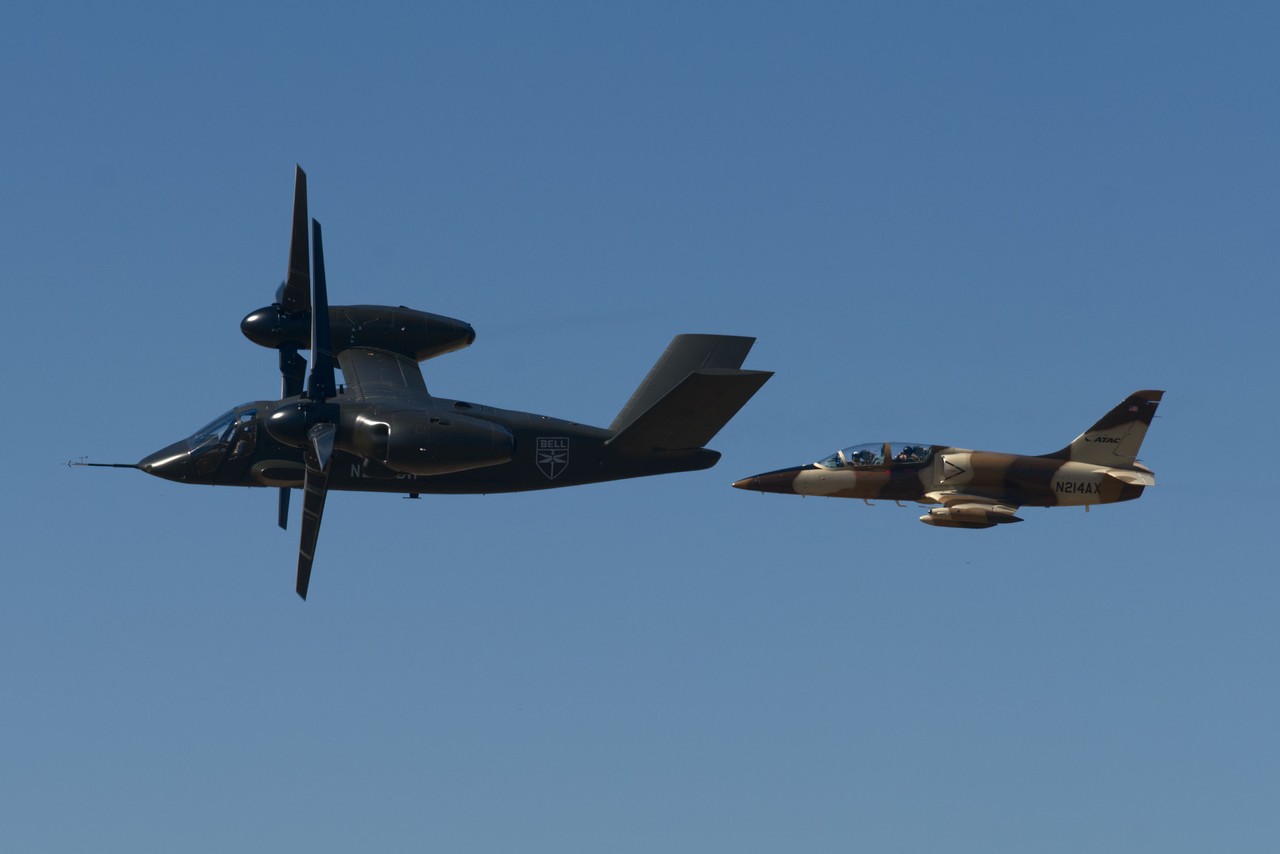
Revolutionary Design Philosophy
The V-280 Valor emerged from Bell's decades of tiltrotor expertise, building upon lessons learned from over 600,000 flight hours accumulated by the V-22 Osprey and earlier experimental aircraft like the XV-3 and XV-15. Unlike traditional helicopters limited by retreating blade stall, the Valor's tiltrotor configuration enables it to achieve airliner-like cruise speeds while retaining vertical flight capabilities essential for military operations.
Bell unveiled the Valor concept in June 2013 at the Army Aviation Association of America's Annual Professional Forum in Fort Worth, Texas. The aircraft was specifically engineered for the Joint Multi-Role Technology Demonstrator program, which sought to identify technologies for future vertical lift platforms. The design team prioritized speed, range, and survivability over the incremental improvements offered by conventional helicopter designs.
Advanced Engineering Solutions
Two Rolls-Royce AE 1107F turboshaft engines, each producing approximately 5,000 shaft horsepower, power the V-280 through nacelles mounted at the wingtips. This configuration allows both rotors to be driven by either engine through an interconnecting shaft system running through the composite wing structure, providing critical redundancy during single-engine operations.
The aircraft's carbon fiber-reinforced polymer composite construction reduces weight while increasing durability compared to the Black Hawk's traditional aluminum airframe. This advanced material selection contributes directly to the Valor's superior payload capacity of 12,000 pounds and maximum takeoff weight of 57,500 pounds. The 10.7-meter rotor diameter was optimized to balance hover efficiency with forward flight performance.
Flight Testing Achievements
Between December 2017 and June 2021, Bell's flight demonstrator accumulated more than 214 flight hours across 15 sorties, systematically proving the aircraft's capabilities. The test program achieved a maximum demonstrated speed of 305 knots, validating predictions that the Valor would cruise comfortably at 280-300 knots. Five Army experimental test pilots flew the aircraft during this period, providing critical feedback that influenced the production design.
The flight test program demonstrated the aircraft's ability to seamlessly transition between helicopter and airplane flight modes, a complex aerodynamic challenge that had limited earlier tiltrotor designs. Low-speed agility trials confirmed the Valor could match helicopter-like precision in confined landing zones, while high-speed cruise tests validated its 2,100-nautical-mile ferry range capability.
Military Competition Victory
On December 5, 2022, the U.S. Army selected the V-280 Valor over the competing Sikorsky-Boeing SB-1 Defiant X for the Future Long-Range Assault Aircraft program. This decision represented a fundamental shift in military vertical lift philosophy, choosing transformational capability over evolutionary improvement. The Army's selection validated Bell's approach of leveraging proven tiltrotor technology rather than developing entirely new rotor systems.
The FLRAA competition emphasized not just performance specifications but also manufacturing readiness, sustainment costs, and technological maturity. Bell's extensive V-22 production experience and established supply chain relationships provided significant advantages in demonstrating their ability to deliver aircraft on schedule and budget.
Bell Helicopter Heritage
Bell Helicopter, founded in 1935 by Lawrence Dale Bell, has delivered over 30,000 vertical lift aircraft across its 85-year history. The company pioneered helicopter mass production with the Model 47 in the 1940s and later dominated military markets with the UH-1 Iroquois, which became synonymous with Vietnam War operations. Bell's tiltrotor expertise began with the XV-3 in the 1950s and culminated in the V-22 Osprey program, providing the technological foundation for the V-280's development.
Textron Inc. acquired Bell in 1960, providing the financial resources necessary for advanced research programs. This corporate stability enabled Bell to invest in tiltrotor technology during periods when conventional wisdom favored traditional helicopter configurations.
Production Timeline and Challenges
The V-280 remains in the development and certification phase as of 2026, with initial production aircraft originally scheduled for delivery by 2025. The program timeline has been extended to ensure thorough testing and system integration, with operational service now expected in the mid-2030s. This deliberate approach reflects lessons learned from previous military aircraft programs where premature fielding led to costly modifications.
Current development activities focus on weapon system integration, sustainment planning, and manufacturing preparation. Lockheed Martin serves as Bell's primary partner, providing sensors, weapons integration, and mission systems that will transform the basic aircraft into a combat-capable platform.
Operational Impact
When fielded, the V-280 will replace UH-60 Black Hawks that have served since the 1970s, representing the most significant advancement in U.S. Army aviation since the introduction of turbine-powered helicopters. The Valor's 500-800 nautical mile combat range will enable rapid deployment across vast operational areas without forward refueling, fundamentally altering military logistics planning.
The aircraft's 28-troop capacity matches the Black Hawk's passenger load while offering dramatically improved survivability through higher cruise altitudes and speeds that reduce exposure to ground-based threats. This combination of payload, range, and speed positions the V-280 to reshape military aviation tactics and operational concepts for decades to come.