
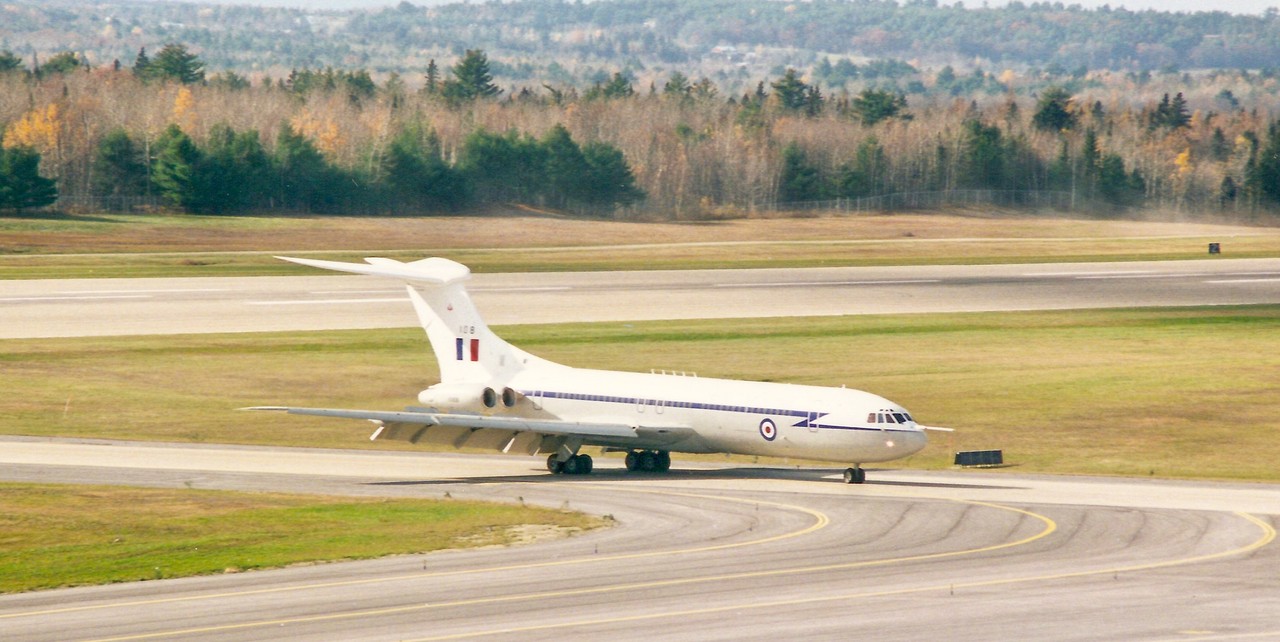
Service History
The VC10 entered commercial service on April 29, 1964, with British Overseas Airways Corporation (BOAC) on the demanding London to Lagos route. BOAC operated the majority of the 54 aircraft produced, with the type serving as the backbone of British long-haul operations throughout the 1960s and 1970s. On May 16, 1968, BOAC Super VC10 G-ASGK achieved aviation history by completing the first automatic landing in commercial service at London Heathrow. The aircraft's finest hour came in March 1979 when a BOAC VC10 set the fastest-ever Atlantic crossing record, flying from New York's JFK to Glasgow Prestwick in just 5 hours and 1 minute—a record that stood unchallenged for 41 years.
Beyond BOAC, East African airlines including Kenya Airways, Tanzania, and Uganda operated Super VC10s on regional routes, while British United Airways operated one aircraft. Despite its technical superiority, the VC10's commercial success was limited by the Boeing 707's market dominance and the expansion of airport runways that negated the British aircraft's primary advantage.
Military Service Excellence
The Royal Air Force recognized the VC10's exceptional capabilities, acquiring 14 VC10 C Mk 1 transport variants and later converting 27 aircraft to tanker configuration. These military VC10s served with distinction for 48 years, participating in major conflicts including the Falklands War, Gulf Wars, and Yugoslavia campaigns. RAF VC10s demonstrated remarkable longevity and reliability, continuing operations until September 20, 2013, when the last aircraft completed its final service flight. The final VC10 journey occurred on September 25, 2013, from RAF Brize Norton to Bruntingthorpe for scrapping, marking the end of an era.
The Manufacturer Legacy
Vickers-Armstrongs originally developed the VC10 at their Weybridge, Surrey facilities, with additional work conducted at Hurn and subcontract manufacturing by Short Brothers & Harland in Belfast. In 1960, Vickers-Armstrongs merged with English Electric to form the British Aircraft Corporation (BAC), which continued VC10 production until 1970. BAC was subsequently acquired and evolved into BAE Systems, which remains a major global defense and aerospace company today. The VC10 represented Britain's ambitious attempt to compete with American jet dominance during the crucial early jet age.
Revolutionary Design and Engineering
The VC10's rear-engine configuration resulted from BOAC's demanding requirements for operations at high-altitude, hot-climate airports in Africa and the Far East with short runways. Four Rolls-Royce RB.80 Conway turbofan engines—the world's first bypass engines to enter service—were mounted at the aircraft's rear, creating the distinctive T-tail design. This configuration provided more thrust than the Boeing 707 and delivered exceptional short-field performance that made it ideally suited for challenging airport conditions.
The aircraft required no prototype development; the first aircraft, G-ARTA, was built with full production tooling and required a temporary 600-foot runway extension at Brooklands Airfield for its maiden flight. Wind tunnel testing was extensive, consuming 2,000 hours using 34 major models in 13 separate tunnels during development.
Performance and Pilot Experience
Pilots praised the VC10 for its smooth handling characteristics and superior runway performance compared to contemporary aircraft. The Standard VC10 accommodated approximately 139 passengers, while the Super VC10 variant featured a 28-foot fuselage extension and wing-tip tanks, increasing capacity to 212 passengers. The aircraft's transatlantic range capability with full payload made it suitable for the world's longest routes, while its quiet cabin and smooth ride made it exceptionally popular with passengers.
The VC10's first transatlantic flight occurred on February 8, 1964, to Montreal, Canada, during certification testing, demonstrating its long-range capabilities that would define its service career.
Production Numbers and Legacy
Production totaled exactly 54 aircraft between 1962 and 1970, comprising 32 Standard VC10s and 22 Super VC10s. While these numbers were modest compared to American competitors, the VC10 achieved distinction as the biggest jet airliner built in Britain. British Airways retired the last commercial VC10 on March 29, 1981, ending civilian service after 17 years.
No VC10s remain in flying condition today, with the last aircraft scrapped in 2013. However, the type's legacy endures as a symbol of British engineering excellence and innovation, proving that alternative design approaches could achieve superior performance in specific operational requirements. The VC10's 48-year military service life stands as testament to its exceptional durability and the soundness of its engineering principles.